
In manufacturing, a mould is a hollow form or cavity into which molten material (metal, plastic, or other substances) is poured or injected to shape it into the desired product.
In this article:
Mould in Manufacturing :
Here’s a detailed explanation of what a mould is in manufacturing, including its types, materials, functions, and applications.
1. Definition of Mould
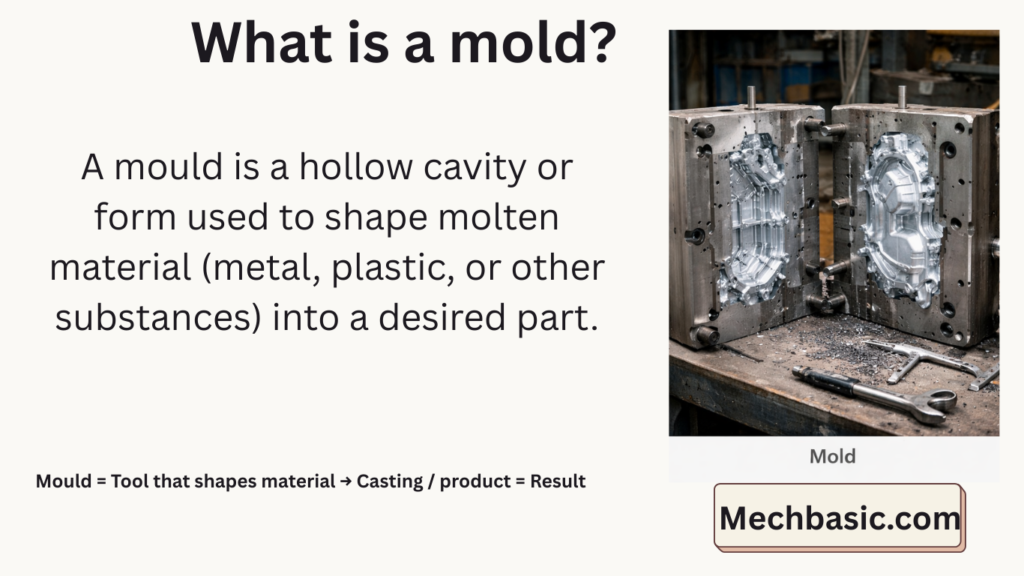
A mould is a hollow cavity or form used to shape molten material (metal, plastic, or other substances) into a desired part.
- The mould cavity has the negative shape of the final product.
- Molten material is poured or injected into the mould, allowed to solidify, and then removed to obtain the finished part (casting or product).
Mould = Tool that shapes material → Casting / product = Result
2. Function / Purpose of a Mould
- Provides desired shape to molten material
- Ensures dimensional accuracy
- Enables production of complex shapes
- Supports internal cavities when used with cores
- Can be single-use or reusable depending on material
3. Materials Used for Moulds
| Material | Characteristics | Applications |
|---|---|---|
| Sand | Cheap, high melting point, disposable | Metal casting (iron, steel, aluminum) |
| Metal (steel, cast iron, copper) | Durable, reusable, high accuracy | Die casting, gravity die casting |
| Ceramic | Heat resistant, precise, smooth surface | Investment casting, turbine blades |
| Plaster | Easy to shape, low strength | Small alloy castings, jewelry |
4. Types of Moulds
A. Based on Material
- Sand Mould – used in sand casting
- Permanent / Metal Mould – used in die casting
- Ceramic / Shell Mould – used in precision casting
- Plaster Mould – for small, intricate castings
B. Based on Manufacturing Method
- Open Mould – simple, only one half of the mould is used
- Closed Mould – both halves (cope & drag) enclose the cavity
- Gravity Die Mould – molten metal poured by gravity
- Injection / Pressure Die Mould – molten metal/plastic injected under pressure
5. Key Features of a Good Mould
- High dimensional accuracy
- Good surface finish
- Strong and durable (if reusable)
- Able to withstand temperature and metal pressure
- Proper venting and gating system to avoid casting defects
6. Difference Between Mould and Pattern (for clarity)
| Aspect | Mould | Pattern |
|---|---|---|
| Definition | Hollow cavity used to shape molten material | Replica of casting used to form mould cavity |
| Nature | Tool | Model |
| Role | Receives molten material | Forms mould |
| Material | Sand, metal, ceramic | Wood, metal, plastic |
| Reusability | Reusable (metal) / Disposable (sand) | Usually reusable |
| Example | Sand mould for pump casing | Wooden pattern for pump casing |
7. Applications of Moulds
- Metal Casting: engine blocks, pump housings, valves
- Plastic Moulding: bottles, containers, automotive panels
- Die Casting: aluminium parts, zinc components
- Investment Casting: turbine blades, jewelry
8. Manufacturing Process Using a Mould (Basic Flow)
- Pattern preparation
- Mould making (sand packing or machining metal/ceramic mould)
- Core placement (for internal cavities)
- Pouring molten material
- Solidification and cooling
- Mould removal / opening
- Finishing operations
Conclusion
A mould in manufacturing is a hollow cavity, made of sand, metal, or ceramic, into which molten material is poured or injected to produce a part with the desired shape, size, and surface finish.
Other courses:





