
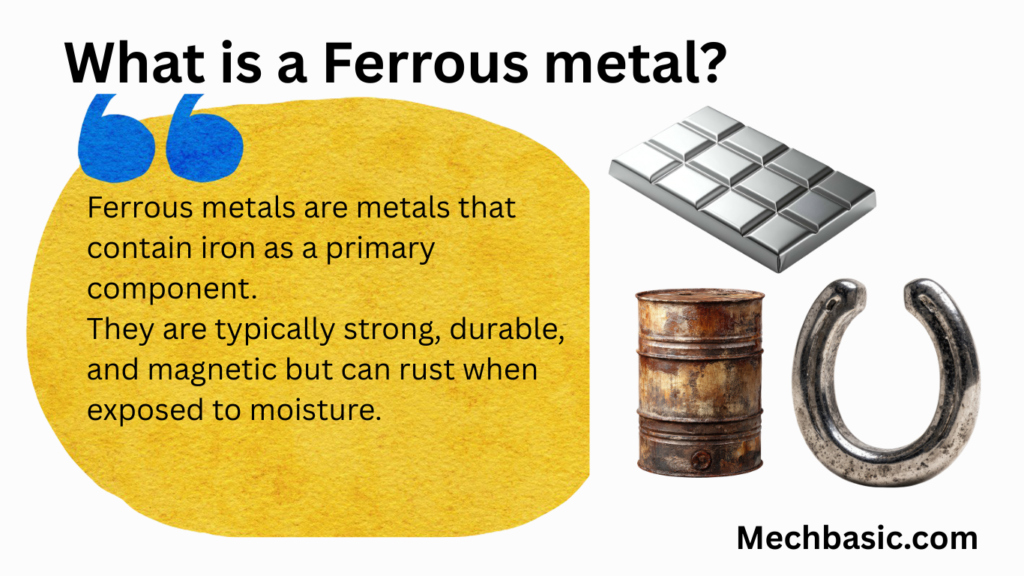
Ferrous metals are metals that contain iron as a primary component.
They are typically strong, durable, and magnetic but can rust when exposed to moisture.
Common examples include steel, cast iron, and wrought iron.
Ferrous metals are widely used in construction, machinery, and automotive industries.
In this article:
- Ferrous Metal:
- 1. Definition of Ferrous Metals
- 2. Characteristics / Properties of Ferrous Metals
- 3. Types of Ferrous Metals
- 4. Properties of Ferrous Metals
- 5. Advantages of Ferrous Metals
- 6. Disadvantages of Ferrous Metals
- 7. Applications of Ferrous Metals
- 8. Examples of Ferrous Metals
- 9. Comparison with Non-Ferrous Metals (Summary)
Ferrous Metal:
Ferrous metals are metals that contain iron as a primary component.
They are typically strong, durable, and magnetic but can rust when exposed to moisture.
Common examples include steel, cast iron, and wrought iron.
Ferrous metals are widely used in construction, machinery, and automotive industries.
Here’s a complete detailed explanation of ferrous metals, covering definition, properties, types, examples, applications, advantages, disadvantages, and comparison with non-ferrous metals.
1. Definition of Ferrous Metals
Ferrous metals are metals that contain iron (Fe) as their main component.
- Iron is the primary element that provides strength and hardness.
- They may also contain small amounts of other elements like carbon, manganese, chromium, or nickel to improve properties.
Examples:
- Wrought iron
- Cast iron
- Steel (mild steel, carbon steel, alloy steel)
2. Characteristics / Properties of Ferrous Metals
| Property | Description |
|---|---|
| Iron Content | High; iron is the main constituent |
| Strength | High tensile and compressive strength |
| Weight / Density | Heavy; usually 7–8 g/cm³ |
| Magnetic Properties | Usually magnetic |
| Corrosion Resistance | Low; prone to rust unless alloyed (stainless steel) |
| Ductility & Malleability | Varies: mild steel ductile, cast iron brittle |
| Melting Point | High; usually above 1200°C |
| Thermal Conductivity | Moderate |
| Electrical Conductivity | Moderate |
3. Types of Ferrous Metals
3.1 Wrought Iron
- Almost pure iron with <0.08% carbon
- Soft, malleable, ductile
- Corrosion-resistant
- Applications: Gates, railings, decorative items
3.2 Cast Iron
- Contains 2–4% carbon
- Hard and brittle
- Poor tensile strength but excellent compressive strength
- Applications: Engine blocks, pipes, machinery bases, manhole covers
3.3 Steel
- Iron + 0.02–2.1% carbon (varies by type)
- Can include alloying elements (Cr, Ni, Mn) for enhanced properties
Types of Steel:
- Mild Steel (Low Carbon)
- 0.05–0.25% C
- Ductile, easy to weld and machine
- Applications: Construction beams, automobile parts
- Medium Carbon Steel
- 0.25–0.6% C
- Balanced strength and ductility
- Applications: Gears, axles, railway tracks
- High Carbon Steel
- 0.6–1.5% C
- Very hard, less ductile
- Applications: Cutting tools, springs, knives
- Alloy Steel
- Alloyed with Cr, Ni, Mo, V, etc.
- High strength, corrosion and wear-resistant
- Applications: Aerospace, heavy machinery, pipelines
- Stainless Steel
- Contains ≥11% chromium
- Corrosion-resistant
- Applications: Kitchenware, medical instruments, chemical plants
4. Properties of Ferrous Metals
- Mechanical Strength: High tensile and compressive strength
- Durability: Strong and long-lasting
- Magnetism: Usually magnetic
- Corrosion: Prone to rust, except stainless steel
- Workability: Can be forged, rolled, welded, machined
- Cost: Generally cheaper than non-ferrous metals
5. Advantages of Ferrous Metals
- Strong and durable
- Relatively cheap and widely available
- Good load-bearing capability
- Can be heat-treated to improve properties
- Magnetic properties useful in electrical applications
6. Disadvantages of Ferrous Metals
- Susceptible to rust and corrosion (unless alloyed)
- Heavy; not suitable for lightweight applications
- Some types (cast iron) are brittle
- Requires maintenance (painting, coating) to prevent corrosion
7. Applications of Ferrous Metals
| Type | Applications |
|---|---|
| Wrought Iron | Decorative gates, railings, furniture |
| Cast Iron | Engine blocks, pipes, machinery bases |
| Mild Steel | Structural beams, automotive parts |
| High Carbon Steel | Cutting tools, springs, knives |
| Stainless Steel | Kitchenware, medical instruments, chemical equipment |
| Alloy Steel | Aerospace parts, heavy machinery, pipelines |
8. Examples of Ferrous Metals
| Metal | Carbon Content | Key Features |
|---|---|---|
| Wrought Iron | <0.08% | Soft, ductile, corrosion-resistant |
| Cast Iron | 2–4% | Hard, brittle, compressive strength high |
| Mild Steel | 0.05–0.25% | Ductile, easy to work |
| Medium Carbon Steel | 0.25–0.6% | Balanced strength & ductility |
| High Carbon Steel | 0.6–1.5% | Very hard, less ductile |
| Stainless Steel | ≥11% Cr | Corrosion-resistant |
9. Comparison with Non-Ferrous Metals (Summary)
| Feature | Ferrous Metals | Non-Ferrous Metals |
|---|---|---|
| Iron Content | High | None or negligible |
| Corrosion | Prone to rust | Corrosion-resistant |
| Weight | Heavy | Can be light (Al, Mg) or heavy (Au, Pb) |
| Magnetic | Usually magnetic | Usually non-magnetic |
| Strength | High | Moderate to high |
| Cost | Generally low | Generally high |
| Examples | Steel, Cast Iron | Al, Cu, Ti, Au, Ag |
10. Conclusion
Ferrous metals are iron-based metals that are strong, durable, and widely used in construction and manufacturing. They are cost-effective but require protection against corrosion. Proper alloying (e.g., stainless steel) can improve corrosion resistance and widen their applications.
Other courses:





