
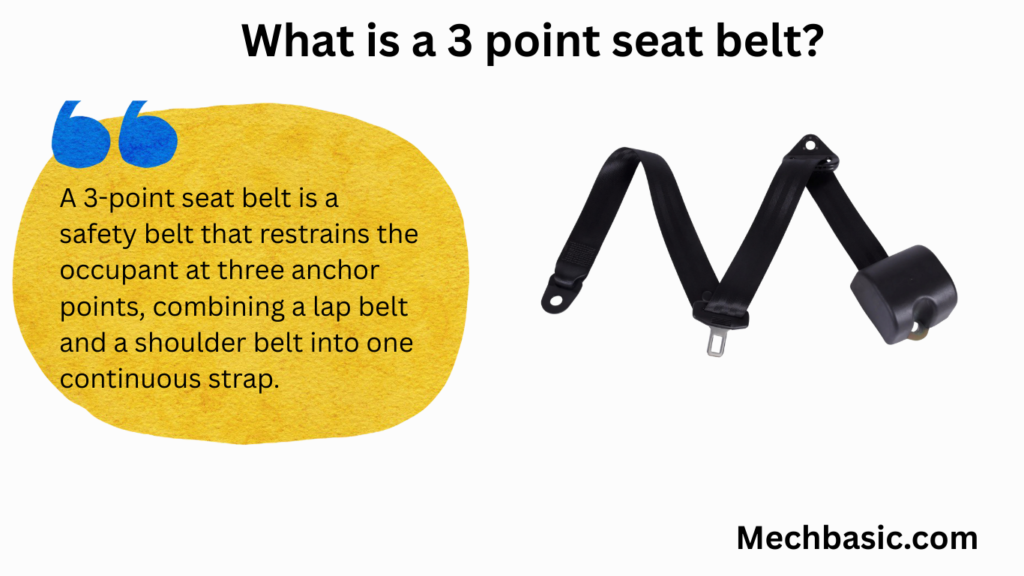
A 3-point seat belt is a safety belt that has three attachment points and secures both the lap and shoulder of a passenger. It spreads the force of a crash across stronger parts of the body such as the chest, pelvis, and shoulders. This design provides better protection and is the standard seat belt used in most modern cars.
In this article:
3-Point Seat Belt
A 3-point seat belt is the most widely used safety restraint system in modern automobiles. It secures the driver or passenger at three different points of the body—across the shoulder, chest, and lap—to provide maximum protection during sudden braking or collisions. This design distributes crash forces across stronger parts of the body and significantly reduces injuries.
The modern three-point seat belt was invented by Nils Bohlin for Volvo in 1959, and it is now a standard safety feature in almost all cars worldwide. 🚗🛡️
1. Definition
A 3-point seat belt is a safety belt that restrains the occupant at three anchor points, combining a lap belt and a shoulder belt into one continuous strap.
It protects passengers by:
- Holding the body firmly in the seat
- Preventing forward movement during crashes
- Reducing the risk of serious head and chest injuries
2. Construction of a 3-Point Seat Belt
The system consists of several components:
1. Webbing
- A strong woven polyester strap.
- Designed to withstand very high forces during collisions.
2. Retractor Mechanism
- A spring-loaded device that allows the belt to extend and retract.
- Automatically locks when the vehicle stops suddenly.
3. Buckle and Latch Plate
- The buckle locks the seat belt in place.
- The latch plate is inserted into the buckle to secure the belt.
4. Anchor Points
The belt is attached to the vehicle body at three points:
- Near the floor beside the seat
- At the side pillar (B-pillar) above the shoulder
- At the seat frame or floor near the buckle
5. Pretensioner
- Tightens the belt instantly during a crash.
- Removes slack and holds the passenger firmly.
6. Load Limiter
- Allows slight belt extension during severe crashes.
- Reduces pressure on the chest.
3. Working Principle
The three-point seat belt works based on inertia and restraint principles.
Step-by-step operation
- Normal Driving
- The belt moves freely with the passenger’s movements.
- Sudden Braking or Collision
- The retractor mechanism locks instantly.
- The belt restrains the body and prevents forward motion.
- Impact Force Distribution
- The belt spreads the crash force across the chest, pelvis, and shoulders.
- Pretensioner Activation
- Tightens the belt immediately during impact.
- Load Limiter Action
- Releases slight tension to reduce chest injuries.
4. Advantages of 3-Point Seat Belts
- Provides better protection than lap belts.
- Prevents head and chest injuries.
- Reduces risk of passenger ejection from the vehicle.
- Distributes crash forces across strong body areas.
- Works effectively with airbags.
Studies show that 3-point seat belts reduce fatal injuries by about 45–50% in car crashes.
5. Importance in Vehicle Safety
The 3-point seat belt is considered the most effective safety device in automobiles because:
- It protects occupants in most types of accidents.
- It is simple, reliable, and inexpensive.
- It works together with airbags and other safety systems.
Many countries require drivers and passengers to wear seat belts by law.
6. Limitations
Although highly effective, the 3-point seat belt has some limitations:
- Must be worn correctly to be effective.
- Not suitable for small children without child safety seats.
- Improper positioning may reduce protection.
Conclusion
The 3-point seat belt is the standard and most effective occupant restraint system in modern vehicles. By securing the shoulder and lap simultaneously, it distributes impact forces safely and significantly reduces injuries during accidents. Because of its effectiveness, it remains a fundamental safety feature in every automobile.
Other courses:





