
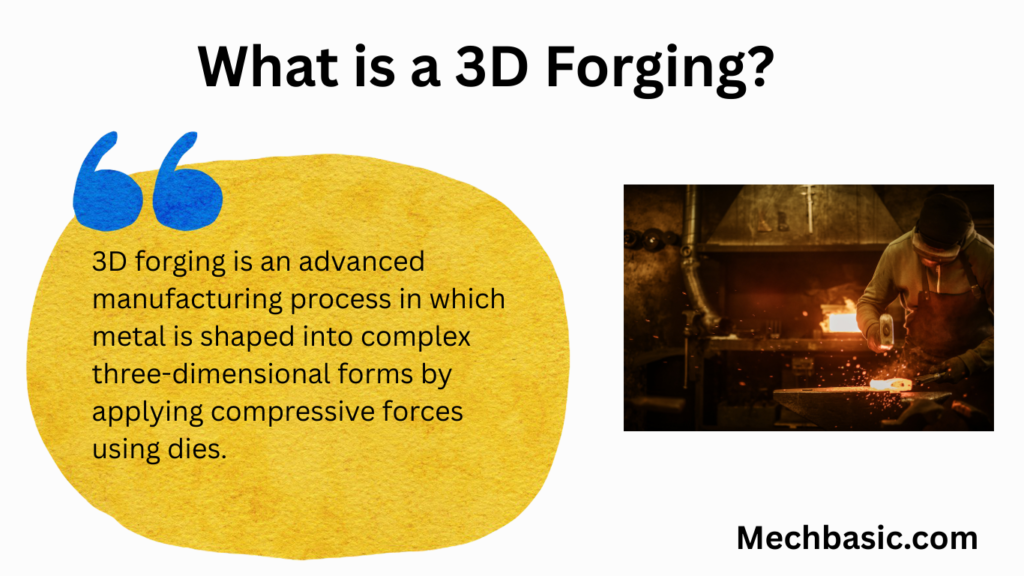
3D forging is an advanced manufacturing process in which metal is shaped into complex three-dimensional forms by applying compressive forces using dies.
Unlike traditional forging, which is often limited to simpler geometries, 3D forging allows precise control over material flow, strength, and shape, making it suitable for producing high-performance components.
This process improves mechanical properties such as strength, toughness, and fatigue resistance while reducing material waste. Due to these advantages, 3D forging is widely used in industries like automotive, aerospace, and heavy machinery, where accuracy, durability, and reliability are critical.
In this article:
What is a 3D Forging?
3D forging (also called near-net-shape forging or precision forging) is an advanced metal forming process in which a heated or cold metal workpiece is plastically deformed inside three-dimensionally contoured dies to produce parts with complex shapes, controlled grain flow, and high mechanical strength.
Unlike simple open-die forging that mainly changes thickness or length, 3D forging shapes the material in all three spatial directions (X, Y, and Z), allowing the creation of intricate geometries close to the final product shape.
1. Basic Principle of 3D Forging
In 3D forging, a metal billet is placed between upper and lower dies that contain a full 3D cavity. When force is applied:
- The metal flows plastically to fill the die cavity
- Internal grain structure follows the part geometry
- Excess material (if any) escapes as flash or is eliminated entirely in flashless systems
The goal is to achieve:
- Minimal machining after forging
- High dimensional accuracy
- Superior mechanical properties
2. Types of 3D Forging Processes
a) Closed-Die (Impression Die) Forging
- Uses shaped dies with a defined cavity
- Material flows in all directions
- Common for automotive and aerospace components
b) Precision / Flashless Forging
- No flash is formed
- Requires accurate billet volume
- Produces near-net-shape parts
c) Multi-Stage 3D Forging
- Part is forged in several steps:
- Preforming
- Blocking
- Finishing
- Improves material flow and die life
d) Cold 3D Forging
- Performed at room temperature
- High accuracy and surface finish
- Limited to ductile materials (aluminum, copper, low-carbon steel)
e) Warm & Hot 3D Forging
- Warm: 650–850 °C
- Hot: 950–1250 °C
- Enables forging of high-strength steels and superalloys
3. Materials Used in 3D Forging
- Carbon and alloy steels
- Aluminum alloys
- Titanium alloys
- Magnesium alloys
- Nickel-based superalloys
4. Equipment Used
- Mechanical presses
- Hydraulic presses
- Screw presses
- Drop hammers
- CNC-controlled forging presses
Modern 3D forging often integrates:
- Finite Element Analysis (FEA)
- CAD/CAM systems
- Automated billet handling
- Die temperature control
5. Advantages of 3D Forging
✔ High strength due to directional grain flow
✔ Excellent fatigue and impact resistance
✔ Reduced material waste
✔ Near-net-shape production
✔ Superior structural integrity compared to casting
✔ Improved reliability for safety-critical parts
6. Limitations
✖ High tooling and die cost
✖ Requires precise billet volume control
✖ Complex die design and maintenance
✖ Not economical for very low production volumes
7. Applications of 3D Forging
- Automotive: crankshafts, connecting rods, steering knuckles, gears
- Aerospace: turbine disks, landing gear components
- Defense: weapon parts, armor components
- Industrial machinery: shafts, flanges, couplings
- Medical: orthopedic implants
8. Comparison with Other Manufacturing Processes
| Process | Strength | Shape Complexity | Material Waste |
|---|---|---|---|
| Casting | Low–Medium | Very High | Low |
| Machining | Medium | Very High | High |
| 3D Forging | Very High | High | Low |
9. Future Trends in 3D Forging
- Integration with AI-based process optimization
- Hybrid forging + additive manufacturing
- Smart dies with embedded sensors
- Fully automated Industry 4.0 forging lines
Summary
3D forging is a high-precision metal forming technique that shapes components in all three dimensions using contoured dies, resulting in superior mechanical properties, reduced waste, and complex near-net-shape parts. It is widely used where strength, reliability, and performance are critical.
FAQ Section:
- What is 3D forging?
3D forging is a metal forming process where heated or cold metal is shaped into complex three-dimensional components using controlled compressive forces and specially designed dies. - How is 3D forging different from traditional forging?
Traditional forging usually produces simpler shapes, while 3D forging allows the creation of intricate geometries with better control over material flow and dimensional accuracy. - What materials are commonly used in 3D forging?
Common materials include steel, aluminum, titanium, magnesium alloys, and nickel-based superalloys, depending on the application requirements. - What are the main advantages of 3D forging?
Key advantages include improved mechanical strength, better grain structure, reduced material waste, high precision, and enhanced durability of components. - Which industries use 3D forging the most?
3D forging is widely used in automotive, aerospace, defense, heavy machinery, medical equipment, and energy sectors. - Is 3D forging suitable for mass production?
Yes, once the dies and tooling are developed, 3D forging is highly efficient and suitable for large-scale production with consistent quality. - Does 3D forging reduce manufacturing costs?
Although initial tooling costs can be high, 3D forging often reduces overall costs by minimizing material waste, machining time, and part failures. - What role does computer simulation play in 3D forging?
Computer simulations help predict material flow, detect defects, optimize die design, and reduce trial-and-error during production. - What types of defects can occur in 3D forging?
Possible defects include laps, cracks, incomplete filling, and uneven grain flow, which can be minimized through proper process design and control. - What is the future of 3D forging technology?
The future includes greater use of automation, AI-based process optimization, advanced simulations, and integration with smart manufacturing systems.
Other courses:





