
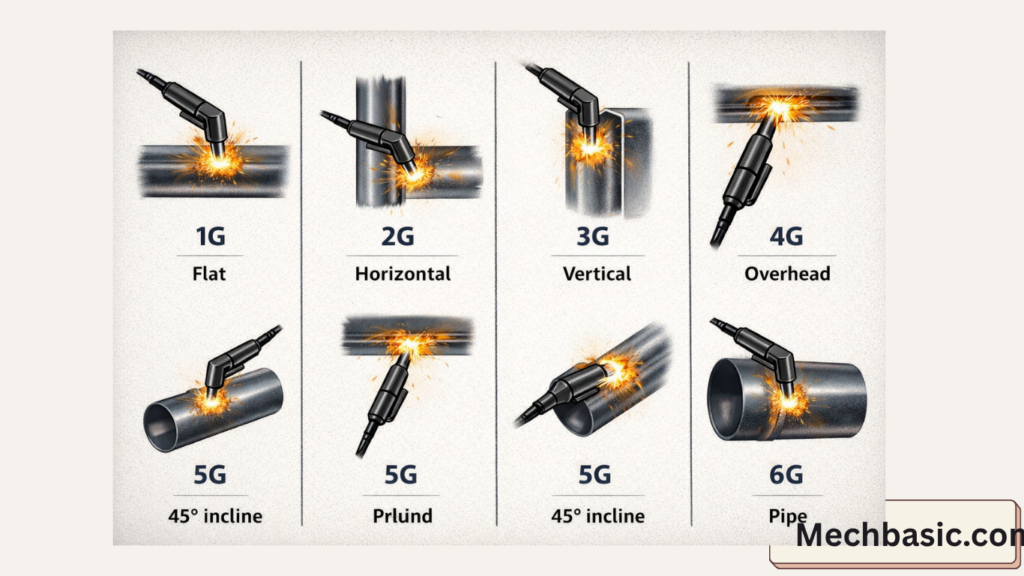
1G to 6G welding refer to different welding positions used to test a welder’s skill and technique.
1G is flat, 2G is horizontal, 3G is vertical, and 4G is overhead, while 5G and 6G are pipe welding positions at fixed angles.
Higher positions like 5G and 6G are more difficult and require greater control and experience.
In this article:
- Types of Welding Positions:
- What does “G” mean?
- 1. 1G Welding Position (Flat Position)
- 2. 2G Welding Position (Horizontal Position)
- 3. 3G Welding Position (Vertical Position)
- 4. 4G Welding Position (Overhead Position)
- 5. 5G Welding Position (Pipe Welding – Fixed Horizontal Pipe)
- 6. 6G Welding Position (Pipe Welding – Inclined Pipe)
- Quick Comparison
- Summary:
- Conclusion
Types of Welding Positions:
The terms 1G, 2G, 3G, 4G, 5G, and 6G in welding refer to welding positions, especially for groove welds (G = Groove). These positions describe how the workpiece is oriented and how the welding is performed.
Let’s go through each one clearly and in detail.
What does “G” mean?
- G = Groove weld
- Used when two plates are joined with a groove between them
1. 1G Welding Position (Flat Position)
Definition
Welding is done on a flat surface, and the weld is deposited from above.
Orientation
- Workpiece is horizontal
- Welding is done from top side
Advantages
- Easiest position
- Good control of molten metal
- High-quality weld
Applications
- Basic welding practice
- Plate welding
2. 2G Welding Position (Horizontal Position)
Definition
Welding is performed on a vertical surface, but the weld axis is horizontal.
Orientation
- Plate is vertical
- Welding is done sideways
Challenges
- Molten metal tends to sag downward
- Requires better skill
3. 3G Welding Position (Vertical Position)
Definition
Welding is done in a vertical direction on a vertical plate.
Orientation
- Plate is vertical
- Welding is done upward or downward
Types:
- Vertical up (3G-up) → stronger weld
- Vertical down (3G-down) → faster but weaker
Challenges
- Gravity affects molten pool
- Requires high skill
4. 4G Welding Position (Overhead Position)
Definition
Welding is done from the underside of the workpiece.
Orientation
- Plate is horizontal
- Welding is performed from below
Challenges
- Molten metal may fall due to gravity
- Most difficult among basic positions
5. 5G Welding Position (Pipe Welding – Fixed Horizontal Pipe)
Definition
Used for pipe welding, where the pipe is fixed horizontally.
Orientation
- Pipe is horizontal and fixed
- Welder moves around the pipe
Characteristics
- Combines:
- Flat
- Vertical
- Overhead positions
Difficulty
- More complex than 1G–4G
6. 6G Welding Position (Pipe Welding – Inclined Pipe)
Definition
Pipe is fixed at an inclined angle (usually 45°), and welding is done all around.
Orientation
- Pipe is tilted (≈45°)
- Cannot be rotated
Characteristics
- Combines all welding positions
- Requires highest skill level
Importance
- Considered the most difficult and advanced position
Quick Comparison
| Position | Orientation | Difficulty | Application |
|---|---|---|---|
| 1G | Flat | Easy | Basic welding |
| 2G | Horizontal | Medium | Structural work |
| 3G | Vertical | Hard | Construction |
| 4G | Overhead | Very hard | Repair work |
| 5G | Pipe (horizontal fixed) | Very hard | Pipelines |
| 6G | Pipe (inclined) | Extremely hard | Oil & gas, critical welding |
Summary:
- 1G → Flat
- 2G → Side (horizontal)
- 3G → Vertical
- 4G → Overhead
- 5G → Pipe (horizontal)
- 6G → Pipe (angled)
Conclusion
- G = Groove welding positions
- Positions depend on workpiece orientation
- Difficulty increases from 1G → 6G
- 6G is the most important for certification
Other courses:





