
Sheet metal is metal that has been formed into thin, flat pieces and is widely used in construction, automotive, aerospace, and manufacturing industries. It’s valued for its strength, durability, and ability to be cut, bent, and shaped into various forms.
In this article:
Types of Sheet Metal
Sheet metal is a flat, thin piece of metal that can be easily fabricated, bent, or formed into desired shapes. Its thickness typically ranges from 0.2 mm to 6 mm, while wider and thicker sheets are called plates. Sheet metals are widely used in automotive, aerospace, construction, appliances, and electronics.
The types of sheet metal are classified based on material, manufacturing process, mechanical properties, and surface finish.
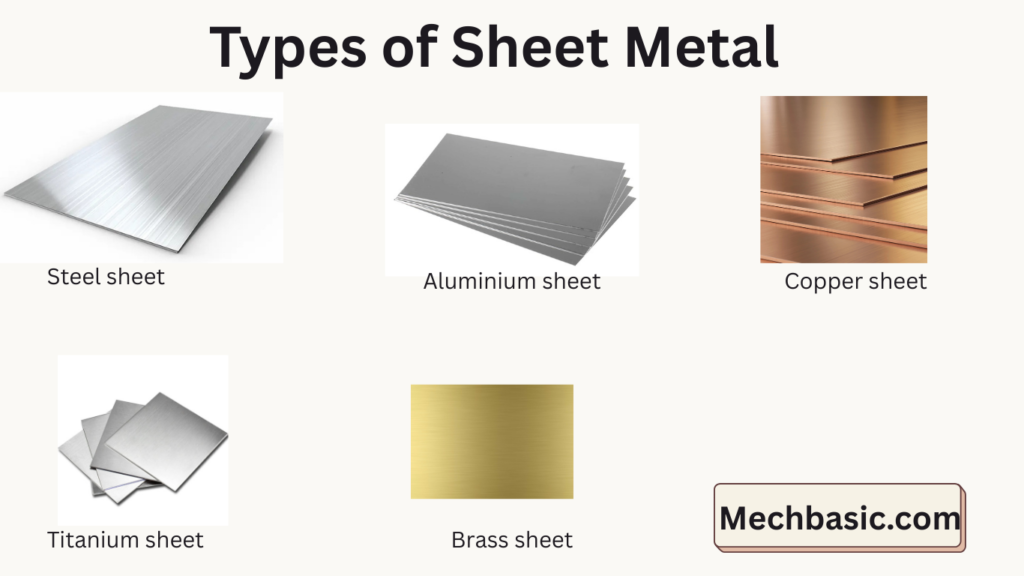
1. Classification by Material
1.1 Steel Sheet Metals
- Low Carbon Steel (Mild Steel)
- Properties: Soft, ductile, easy to cut and form.
- Applications: Automobile panels, ducts, furniture.
- High Carbon Steel
- Properties: Harder, stronger, less ductile.
- Applications: Tools, cutting dies, springs.
- Stainless Steel
- Properties: Corrosion-resistant, strong.
- Applications: Kitchen utensils, medical instruments, architectural panels.
- Galvanized Steel
- Properties: Coated with zinc to prevent rusting.
- Applications: Roofing sheets, automobile body panels, HVAC ducts.
1.2 Aluminum Sheet Metals
- Properties: Lightweight, corrosion-resistant, good thermal conductivity.
- Applications: Aircraft skins, packaging (cans), heat exchangers, automotive parts.
- Common Alloys: 1100, 3003, 5052, 6061.
1.3 Copper Sheet Metals
- Properties: Excellent electrical & thermal conductivity, corrosion-resistant.
- Applications: Electrical wiring, roofing, plumbing, decorative items.
1.4 Brass Sheet Metals
- Properties: Alloy of copper and zinc, corrosion-resistant, decorative finish.
- Applications: Musical instruments, decorative panels, fittings.
1.5 Nickel and Titanium Sheet Metals
- Properties: High strength, heat-resistant, corrosion-resistant.
- Applications: Aerospace, chemical industry, high-temperature applications.
2. Classification by Manufacturing Process
2.1 Rolled Sheet Metals
- Produced by hot or cold rolling of metal slabs.
- Hot rolled: Thicker, rough surface.
- Cold rolled: Smooth surface, accurate dimensions.
2.2 Clad or Laminated Sheets
- Two or more metals bonded together.
- Example: Copper-clad aluminum sheets.
- Applications: Electronics, circuit boards.
2.3 Perforated or Embossed Sheets
- Sheets with holes (perforated) or raised patterns (embossed).
- Applications: Decorative panels, ventilation grilles.
3. Classification by Mechanical Properties
3.1 Mild / Soft Sheet Metals
- High ductility, easily formed, low strength.
- Applications: Car body panels, appliance casing.
3.2 Hard / High Strength Sheet Metals
- Less ductile, higher tensile strength.
- Applications: Tools, structural components.
3.3 Alloyed Sheet Metals
- Alloying elements improve corrosion resistance, strength, or hardness.
- Examples: Stainless steel, aluminum alloys, brass.
4. Classification by Thickness
| Type | Thickness Range | Examples |
|---|---|---|
| Foil | < 0.2 mm | Aluminum foil, copper foil |
| Sheet | 0.2 – 6 mm | Car body panels, roofing sheets |
| Plate | > 6 mm | Steel plates for bridges, ships |
5. Classification by Surface Finish
5.1 Cold Rolled Sheet
- Smooth finish, precise dimensions.
- Applications: Appliance panels, precision components.
5.2 Hot Rolled Sheet
- Rougher surface, less dimensional accuracy.
- Applications: Structural steel, automotive frames.
5.3 Coated / Painted Sheet
- Coated with zinc, tin, or paint for corrosion protection.
- Applications: Roofing, appliances, outdoor structures.
5.4 Patterned or Textured Sheets
- Embossed, checkered, or patterned for aesthetics or grip.
- Applications: Decorative panels, flooring, industrial mats.
6. Summary Table of Sheet Metal Types
| Classification | Types | Properties | Applications |
|---|---|---|---|
| Material | Steel, Aluminum, Copper, Brass, Titanium | Strength, corrosion resistance, conductivity | Automotive, aerospace, roofing, electronics |
| Manufacturing | Rolled, Clad, Perforated, Embossed | Thickness, surface finish | Panels, decorative sheets, circuit boards |
| Mechanical Properties | Soft, Hard, Alloyed | Ductility, strength | Car panels, tools, structural parts |
| Thickness | Foil (<0.2 mm), Sheet (0.2–6 mm), Plate (>6 mm) | Formability, strength | Foil for packaging, sheets for appliances, plates for bridges |
| Surface Finish | Cold rolled, Hot rolled, Coated, Patterned | Smoothness, corrosion protection | Appliances, roofing, flooring, decorative panels |
7. Conclusion
Sheet metals are classified based on material, thickness, mechanical properties, manufacturing process, and surface finish. Choosing the right type is critical depending on strength, formability, corrosion resistance, and application requirements.
Other courses:





