
Sheet metal operations are processes used to cut, bend, and shape thin metal sheets into required components.
They are mainly classified into cutting operations (shearing, punching, blanking), bending operations (bending, flanging, hemming), and drawing operations (deep drawing, embossing).
These operations are widely used in automotive, aerospace, and manufacturing industries for mass production.
In this article:
Sheet Metal Operations
Sheet metal operations are manufacturing processes that involve shaping, cutting, or joining thin sheets of metal into desired forms without changing the metal’s thickness significantly. These operations are widely used in automobile, aerospace, appliance, and construction industries.
1. Classification of Sheet Metal Operations
Sheet metal operations can be broadly classified into:
- Cutting operations – remove unwanted material.
- Forming operations – change the shape without removing material.
- Bending operations – deform metal along a straight axis.
- Drawing operations – produce hollow or cup-shaped components.
- Special operations – combined or advanced processes for specific purposes.
2. Cutting Operations
Cutting operations remove metal to create blanks or desired shapes.

2.1 Shearing
- Metal is cut by applying shear force between two blades.
- Examples: Straight cuts, trimming, blanking.
- Applications: Cutting sheet plates, strips.
2.2 Blanking
- Produces a flat piece (blank) by punching out metal from a sheet.
- The blank is the workpiece for further operations.
2.3 Punching
- Produces a hole in sheet metal by forcing a punch into a die.
- Applications: Perforated sheets, ventilation holes.
2.4 Notching
- Removes small sections from edges or corners.
- Applications: Frames, brackets, sheet corners.
2.5 Perforating
- Creates multiple small holes in sheets for decorative or functional purposes.
3. Forming Operations
Forming operations deform the sheet without removing material.

3.1 Bending
- Metal is bent along a straight axis using a press brake or dies.
- Types: V-bending, U-bending, edge bending.
- Applications: Channels, brackets, enclosures.
3.2 Stretching
- Sheet is stretched over a form to produce curved surfaces.
- Applications: Aircraft skins, car body panels.
3.3 Drawing
- Flat sheet is drawn into a die to produce hollow components.
- Depth may be less (shallow drawing) or greater (deep drawing).
- Applications: Cups, cans, fuel tanks.
3.4 Spinning
- Sheet metal is rotated on a mandrel and pressed to form axisymmetric shapes.
- Applications: Kitchen utensils, lampshades, cones.
3.5 Curling
- Edges of the sheet are rolled to form rounded edges.
- Applications: Safety edges, decorative edges.
3.6 Hemming
- Sheet edges are folded over to reinforce strength or improve appearance.
- Applications: Automobile doors, panels.

3.7 Embossing
- Raises patterns or designs on sheet surface using a punch and die.
- Applications: Decorative panels, roofing sheets.
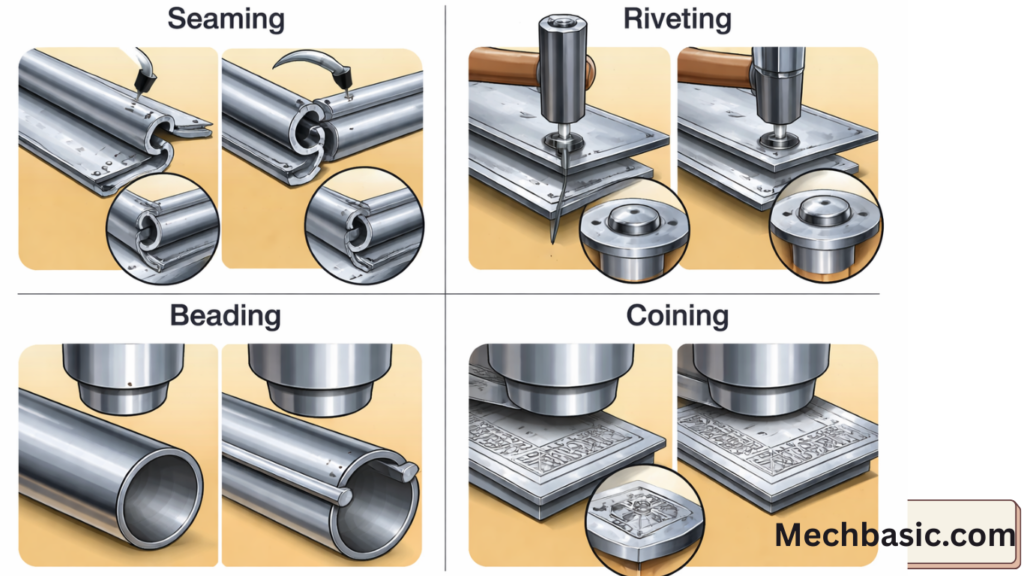
3.8 Coining
- Sheet metal is compressed between dies to produce fine details.
- Applications: Coins, medallions, precision components.
3.9 Beading
- Produces ridges along edges to increase stiffness.
- Applications: Thin-walled panels, machine guards.
4. Joining Operations
Sheet metal is often joined without welding using mechanical means:
4.1 Riveting
- Fastens sheets together using rivets.
- Applications: Aircraft skins, tanks.
4.2 Folding / Seaming
- Folds two sheets together to make a joint.
- Applications: Roofing, ducts.
4.3 Spot Welding (Electrical Resistance Welding)
- Common in automobile manufacturing.
5. Special Sheet Metal Operations
5.1 Perforating / Punching for Decoration
- Makes patterns or holes for function or aesthetics.
5.2 Laminating / Cladding
- Attaches thin metal sheets onto other surfaces.
5.3 Progressive Die Operations
- Combines multiple steps (cutting, bending, punching) in one press cycle.
- Applications: Mass production of components.
6. Summary Table of Common Sheet Metal Operations
| Operation Type | Purpose | Examples / Applications |
|---|---|---|
| Shearing | Cut sheet | Plates, strips |
| Blanking | Produce blanks | Panels, enclosures |
| Punching | Holes | Perforated sheets, ventilation |
| Notching | Remove corners | Frames, brackets |
| Bending | Angular deformation | Channels, U-bends |
| Stretching | Curved surfaces | Car body, aircraft panels |
| Drawing | Hollow parts | Cups, cans, fuel tanks |
| Spinning | Axisymmetric shapes | Utensils, cones |
| Curling | Rounded edges | Safety edges |
| Hemming | Fold edges | Car doors, panels |
| Embossing | Raise patterns | Decorative panels |
| Coining | Fine details | Coins, medallions |
| Beading | Edge stiffness | Thin-walled panels |
| Riveting / Welding | Joining | Aircraft, auto panels |
| Progressive Operations | Multi-step forming | Mass production parts |
7. Conclusion
Sheet metal operations are versatile and form the backbone of lightweight manufacturing. They include cutting, forming, bending, drawing, and joining, and can produce a wide variety of components with precision, strength, and aesthetic appeal.
Other courses:





