
Patterns are replicas of the final casting used to form mould cavities in the casting process. The four common types of patterns are single-piece pattern, split pattern, match-plate pattern, and loose-piece pattern.
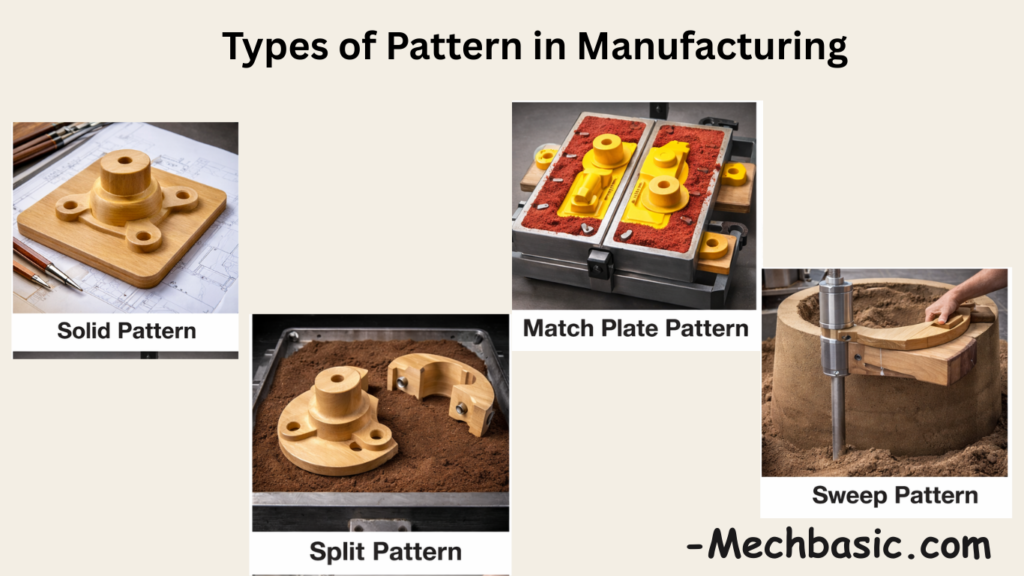
In this article:
Four Types of Patterns
In manufacturing and casting processes, patterns are used to form mould cavities. Based on design and method of use, patterns are commonly classified into four main types, each suited to specific production requirements and component complexity.
1. Solid (Single-Piece) Pattern
Description
- Made as one single piece without joints or separations.
- Simplest form of pattern.
Construction
- Made of wood, metal, or plastic.
- Entire shape of the casting is included in one piece.
Applications
- Simple castings with no undercuts.
- Low production quantities.
Advantages
- Easy to design and manufacture.
- Low cost.
- Easy handling.
Limitations
- Not suitable for complex shapes.
- Difficult to withdraw from mould for intricate castings.
2. Split (Two-Piece) Pattern
Description
- Pattern is divided into two parts along the parting line.
- One half is placed in the cope, the other in the drag.
Construction
- Halves are aligned using dowel pins.
- Made of wood or metal.
Applications
- Medium complexity castings.
- Widely used in foundries.
Advantages
- Easy removal from mould.
- Better dimensional accuracy.
- Can produce more complex shapes than solid pattern.
Limitations
- Slightly higher cost than solid pattern.
- Requires proper alignment.
3. Match-Plate Pattern
Description
- Both halves of the split pattern are mounted on opposite sides of a common plate (match plate).
- Gating and runner systems are often built into the plate.
Construction
- Plate made of metal or plywood.
- Pattern halves permanently fixed.
Applications
- Mass production.
- High-speed machine moulding.
Advantages
- High production rate.
- Accurate alignment.
- Uniform mould quality.
- Reduced moulding time.
Limitations
- High initial cost.
- Not economical for small batches.
4. Sweep Pattern
Description
- A shaped board (sweep) rotated about a central axis to form the mould cavity.
- Used instead of a full pattern.
Construction
- Sweep board + central spindle.
- Made of wood or metal.
Applications
- Large, symmetrical castings.
- Small production quantities.
Advantages
- Very economical for large castings.
- Simple construction.
- Saves pattern material.
Limitations
- Applicable only to circular or axisymmetric shapes.
- Lower dimensional accuracy.
- Requires skilled labour.
Comparison Table
| Pattern Type | Construction | Best Used For |
|---|---|---|
| Solid | One piece | Simple, small castings |
| Split | Two pieces | Medium complexity |
| Match-plate | Mounted on plate | Mass production |
| Sweep | Rotating board | Large circular castings |
Conclusion
The four basic types of patterns are solid pattern, split pattern, match-plate pattern, and sweep pattern, each suited for different casting shapes and production volumes.
Other courses:





