
A blacksmith is a skilled craftsman who shapes metal by heating and hammering it into desired forms. To perform forging operations efficiently and safely, a blacksmith must possess a combination of practical skills, technical knowledge, and experience.
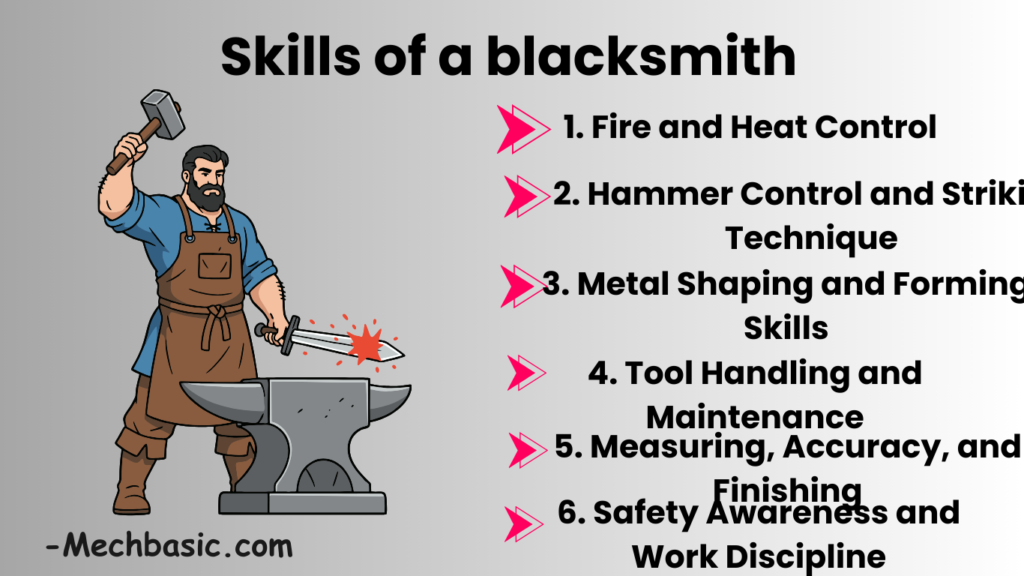
These skills help in controlling heat, shaping metal accurately, handling tools properly, and ensuring safety during work.
In this article:
7 skills of a blacksmith:
A skilled blacksmith combines technical knowledge, hand skills, and experience to shape metal efficiently and safely. The following are the seven essential skills of a blacksmith, explained in detail.
1. Fire and Heat Control
Description:
The ability to heat metal to the correct forging temperature and maintain it.
Details:
- Knowing the correct color of hot metal (red, orange, yellow, white heat)
- Avoiding overheating and burning of metal
- Controlling air supply and fuel in the forge
Importance:
Proper heat ensures good metal flow, prevents cracks, and improves work quality.
2. Hammer Control and Striking Technique
Description:
Skill in delivering accurate, controlled hammer blows.
Details:
- Correct grip and posture
- Proper striking angle and force
- Coordinating hammer blows with metal placement
Importance:
Efficient hammer control improves shape accuracy, surface finish, and reduces fatigue.
3. Metal Shaping and Forming Skills
Description:
Ability to shape metal into required forms using forging operations.
Details:
- Drawing out, upsetting, bending, tapering, twisting
- Using fullers, swages, and anvils effectively
- Understanding how metal flows under force
Importance:
This is the core skill that determines the final shape and quality of the forged product.
4. Tool Handling and Maintenance
Description:
Skill in selecting, using, and maintaining forging tools.
Details:
- Proper use of tongs, chisels, punches, and dies
- Maintaining hammer faces and anvil surfaces
- Making and repairing simple tools
Importance:
Well-maintained tools improve safety, accuracy, and productivity.
5. Measuring, Accuracy, and Finishing
Description:
Ability to produce parts with correct dimensions and finish.
Details:
- Measuring hot and cold metal
- Maintaining symmetry and uniformity
- Filing, grinding, and smoothing surfaces
Importance:
Ensures the forged item meets functional and aesthetic requirements.
6. Material Knowledge and Metallurgy Basics
Description:
Understanding the behavior of different metals during forging.
Details:
- Knowing properties of iron, steel, and alloys
- Effects of carbon content and heat treatment
- Awareness of hardening, tempering, and annealing
Importance:
Helps prevent defects and improves strength and durability of products.
7. Safety Awareness and Work Discipline
Description:
Ability to work safely and systematically in a high-temperature environment.
Details:
- Safe handling of hot metal
- Use of protective equipment
- Maintaining a clean and organized workspace
Importance:
Prevents accidents and ensures long-term working efficiency.
Summary Table
| Skill No. | Blacksmith Skill |
|---|---|
| 1 | Fire and heat control |
| 2 | Hammer control |
| 3 | Metal shaping |
| 4 | Tool handling |
| 5 | Measuring and finishing |
| 6 | Material knowledge |
| 7 | Safety awareness |
Conclusion
A blacksmith’s expertise lies not just in strength, but in control, precision, and understanding of metal behavior. Mastery of these seven skills enables the production of strong, accurate, and reliable forged components.
Other courses:





