
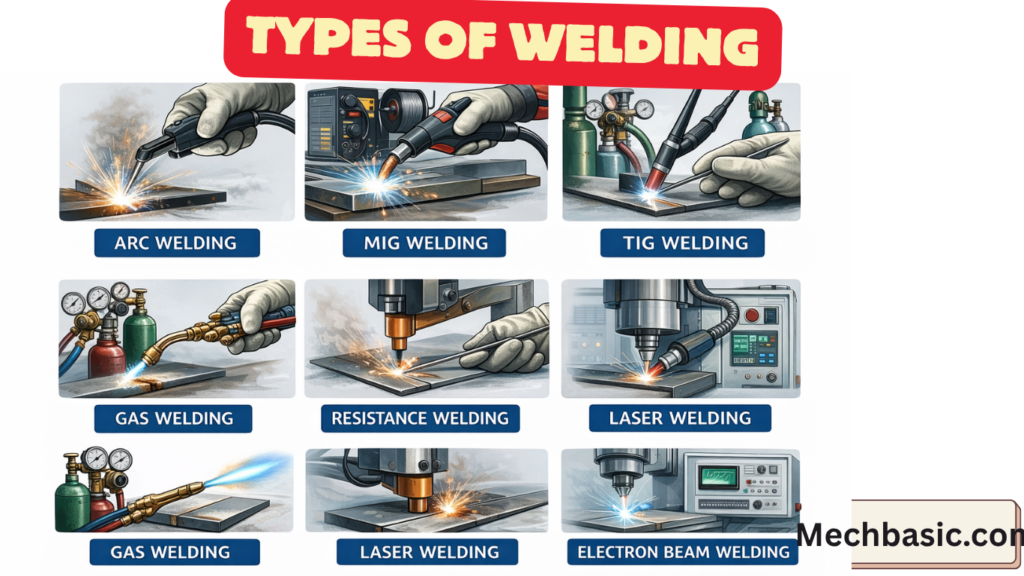
The seven basic types of welding include arc welding, MIG welding, TIG welding, gas welding, resistance welding, laser welding, and electron beam welding.
Each type uses different heat sources such as electric arc, gas flame, electrical resistance, or high-energy beams.
These processes are selected based on material, thickness, precision, and application.
In this article:
7 basic types of welding
Here are the 7 commonly accepted basic types of welding, explained in detail:
1. Arc Welding
Definition
Uses an electric arc between electrode and workpiece to generate heat and melt metal.
Types
- Shielded Metal Arc Welding (SMAW)
- MIG (Metal Inert Gas)
- TIG (Tungsten Inert Gas)
Advantages
- Strong joints
- Suitable for thick materials
- Widely used
Applications
- Construction
- Shipbuilding
- Heavy industries
2. Gas Welding
Definition
Uses a flame produced by burning fuel gas (acetylene) with oxygen.
Process
- Flame melts metal and filler rod
- Joint forms after cooling
Advantages
- Simple and portable
- No electricity required
Applications
- Repair work
- Thin sheet welding
3. Resistance Welding
Definition
Heat is generated by electrical resistance at the joint, along with pressure.
Types
- Spot welding
- Seam welding
Advantages
- Fast process
- No filler material
- Good for automation
Applications
- Automobile body manufacturing
4. Thermit Welding
Definition
Uses a chemical reaction (thermite reaction) to produce heat and molten metal.
Process
- Aluminum + iron oxide reaction
- Produces molten iron to join metals
Advantages
- No external power required
- Suitable for heavy sections
Applications
- Railway track welding
- Heavy machinery
5. Friction Welding
Definition
Heat is generated by friction between two surfaces, followed by pressure.
Process
- One part rotates
- Friction creates heat
- Pressure forms joint
Advantages
- No melting
- Strong joints
- No filler required
Applications
- Shafts
- Automotive parts
6. Ultrasonic Welding
Definition
Uses high-frequency vibrations to join materials without melting.
Process
- Vibrations + pressure
- Atomic bonding occurs
Advantages
- No heat damage
- Fast process
Applications
- Electronics
- Plastic components
7. Laser Beam Welding (LBW)
Definition
Uses a high-energy laser beam to melt and join metals.
Characteristics
- Very high precision
- Focused heat source
Advantages
- Minimal distortion
- High accuracy
- Suitable for automation
Applications
- Aerospace
- Medical devices
- Electronics
Summary Table
| Type | Heat Source | Filler | Application |
|---|---|---|---|
| Arc Welding | Electric arc | Yes | Heavy work |
| Gas Welding | Flame | Yes | Repair work |
| Resistance Welding | Electrical resistance | No | Mass production |
| Thermit Welding | Chemical reaction | Yes | Railways |
| Friction Welding | Friction | No | Shafts |
| Ultrasonic Welding | Vibrations | No | Electronics |
| Laser Welding | Laser beam | Optional | Precision work |
Summary:
“Arc, Gas, Resistance, Thermit, Friction, Ultrasonic, Laser”
Conclusion:
- These 7 types cover:
- Fusion welding (Arc, Gas, Laser, Thermit)
- Solid-state welding (Friction, Ultrasonic)
- Resistance welding (special category)
- Used across all industries
Other courses:





