
Over time, different types of suspension systems have been developed to meet the diverse requirements of passenger comfort, load-carrying capacity, performance, and cost. These systems vary in design, construction, and application, ranging from simple rigid arrangements to advanced independent and adaptive setups. Understanding the different types of suspension systems helps in appreciating how modern vehicles achieve a balance between ride comfort and road control.
In an automobile, the suspension system connects the vehicle body to the wheels and is responsible for ride comfort, road holding, and vehicle stability. Below is a detailed classification of suspension systems, from basic concepts to modern designs.
In this article:
What is a suspension system?
A suspension system is the mechanism that connects a vehicle’s wheels to its body.
It absorbs shocks and vibrations caused by uneven road surfaces.
The system helps maintain tire contact with the road for better control and safety.
It also improves ride comfort and vehicle stability during motion.
1. Based on Wheel Interdependence
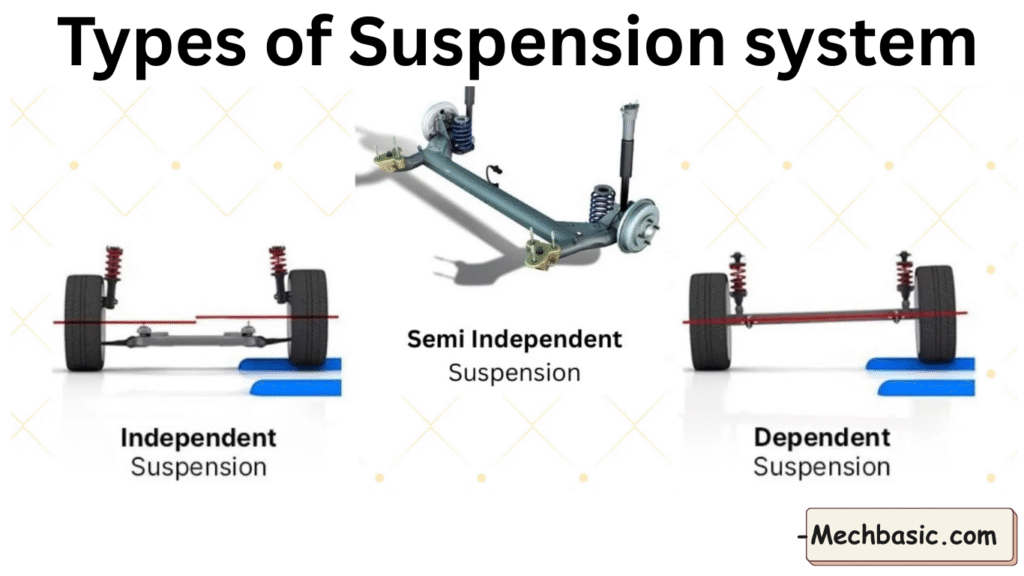
A. Dependent Suspension
In this system, both wheels on an axle are connected by a rigid beam. Movement of one wheel affects the other.
Construction
- Solid axle
- Leaf springs or coil springs
- Shock absorbers
Types
- Rigid axle with leaf springs
- Rigid axle with coil springs
Advantages
- Simple and strong
- Low cost
- Good for heavy loads
Disadvantages
- Poor ride comfort
- Less road grip on uneven surfaces
Applications
- Trucks
- Buses
- Older vehicles
- Rear suspension of some SUVs
B. Independent Suspension
Each wheel moves independently without affecting the other wheel on the same axle.
Advantages
- Better ride comfort
- Improved handling and stability
- Reduced unsprung weight
Disadvantages
- Costlier
- Complex design
Applications
- Most modern passenger cars (front and sometimes rear)
2. Types of Independent Suspension Systems
A. MacPherson Strut Suspension
Most widely used front suspension.
Components
- Strut (spring + shock absorber)
- Lower control arm
- Steering knuckle
Advantages
- Simple and compact
- Lightweight
- Low cost
Disadvantages
- Limited wheel travel
- Not ideal for high-performance cars
Applications
- Small and mid-size cars (front suspension)
B. Double Wishbone Suspension
Uses two control arms (upper and lower) shaped like a wishbone.
Advantages
- Excellent wheel control
- Better camber control
- Superior handling
Disadvantages
- More components
- Higher cost
- Requires more space
Applications
- Sports cars
- Luxury vehicles
- Performance-oriented cars
C. Multi-Link Suspension
Uses three or more control arms per wheel.
Advantages
- Best ride comfort and handling
- Precise wheel alignment control
Disadvantages
- Very complex
- Expensive to manufacture and maintain
Applications
- Premium sedans
- Luxury and high-performance vehicles
D. Trailing Arm Suspension
Wheel is attached to a trailing arm that pivots from the chassis.
Advantages
- Simple
- Good ride comfort
Disadvantages
- Limited handling performance
Applications
- Rear suspension in small cars
- Older vehicle designs
E. Semi-Trailing Arm Suspension
Modified trailing arm angled to vehicle centerline.
Advantages
- Better handling than trailing arm
- Compact design
Disadvantages
- Camber and toe change under load
Applications
- Older BMW and European cars
3. Based on Springing Medium
A. Leaf Spring Suspension
- Uses metal leaves stacked together
Advantages
- Can carry heavy loads
- Acts as both spring and locating member
Disadvantages
- Heavy
- Poor comfort
Applications
- Trucks
- Buses
- Pick-up vehicles
B. Coil Spring Suspension
- Helical steel springs
Advantages
- Better comfort
- Lightweight
Disadvantages
- Needs additional control arms
Applications
- Most passenger cars
C. Torsion Bar Suspension
- Uses a steel rod that twists to absorb shocks
Advantages
- Adjustable ride height
- Compact
Disadvantages
- Limited comfort compared to coils
Applications
- SUVs
- Military vehicles
- Older cars
D. Air Suspension
- Uses air-filled rubber bags
Advantages
- Adjustable ride height
- Excellent comfort
- Self-leveling
Disadvantages
- Expensive
- Maintenance intensive
Applications
- Luxury cars
- Buses
- Premium SUVs
E. Hydropneumatic Suspension
- Uses hydraulic fluid and nitrogen gas
Advantages
- Very smooth ride
- Automatic leveling
Disadvantages
- Highly complex
- Expensive repairs
Applications
- High-end luxury vehicles (e.g., Citroën)
4. Based on Damping Control
A. Passive Suspension
- Fixed spring and damper characteristics
Applications
- Most standard vehicles
B. Semi-Active Suspension
- Adjustable dampers (electronically controlled)
Advantages
- Balances comfort and handling
Applications
- Modern premium cars
C. Active Suspension
- Uses sensors and actuators to control wheel movement
Advantages
- Best comfort and stability
Disadvantages
- Very expensive
- High energy consumption
Applications
- Advanced luxury and performance vehicles
5. Summary Table
| Type | Comfort | Cost | Complexity | Application |
|---|---|---|---|---|
| Dependent | Low | Low | Low | Trucks |
| MacPherson | Good | Low | Medium | Small cars |
| Double Wishbone | Very Good | High | High | Sports cars |
| Multi-Link | Excellent | Very High | Very High | Luxury cars |
| Air Suspension | Excellent | Very High | High | Premium vehicles |
Other courses:





