
Rolling is a type of body movement where a person or object turns over itself along a surface. It is commonly used in physical activities and sports to improve coordination, balance, and control.
“Rolling” can mean different things depending on the field, but most commonly it refers to the metal forming process used in manufacturing. Below is a clear, detailed breakdown of the main types of rolling, with sub-types and practical examples.
In this article:
Types of rolling
1. Hot Rolling
Rolling performed above the metal’s recrystallization temperature
Key features
- Metal is heated (e.g., steel ~1100–1300 °C)
- Lower rolling forces required
- Removes internal defects and improves ductility
- Rough surface finish and less precise dimensions
Products
- Plates
- Sheets
- Rails
- I-beams
- Structural sections
Advantages
- Large thickness reductions possible
- Economical for bulk production
- Improves grain structure
Disadvantages
- Poor surface finish
- Oxidation (scale formation)
- Lower dimensional accuracy
2. Cold Rolling
Rolling below recrystallization temperature (often at room temperature)
Key features
- Higher rolling forces required
- Produces strain hardening
- Very good surface finish
- High dimensional accuracy
Products
- Automobile body sheets
- Appliance panels
- Precision strips
Advantages
- Better strength and hardness
- Excellent surface quality
- Tight tolerances
Disadvantages
- Reduced ductility
- Requires annealing after rolling
- Higher power consumption
3. Warm Rolling
Rolling at temperatures between hot and cold rolling
Key features
- Temperature below recrystallization but above room temperature
- Balance between strength and ductility
Advantages
- Lower forces than cold rolling
- Better surface finish than hot rolling
- Reduced cracking risk
Applications
- Special alloys
- Magnesium and aluminum alloys
4. Flat Rolling
Most common rolling process
Description
- Metal is passed between two rotating rolls
- Thickness is reduced while width remains almost constant
Products
- Sheets
- Plates
- Strips
Used in
- Steel mills
- Aluminum plants
5. Shape Rolling (Section Rolling)
Used to produce structural shapes
Description
- Rolls have grooves matching the desired shape
Products
- I-beams
- T-sections
- Channels
- Angles
- Rails
Application
- Construction and infrastructure
6. Ring Rolling
Rolling to increase diameter while reducing thickness
Description
- A thick ring is expanded using radial and axial rolls
Products
- Bearing rings
- Gears
- Turbine rings
- Aerospace components
Advantages
- No material waste
- Excellent strength due to grain flow
7. Thread Rolling
Cold forming of threads on fasteners
Description
- Threads formed by plastic deformation, not cutting
Products
- Bolts
- Screws
- Studs
Advantages
- Stronger threads
- Smooth surface finish
- No material loss
8. Roll Forging
Combination of rolling and forging
Description
- Metal is passed through grooved rolls to gradually shape it
Products
- Axles
- Crankshafts
- Hand tools
Advantages
- Good mechanical properties
- High production rate
9. Skew Rolling
Rolling using inclined rolls
Description
- Rolls are placed at an angle
- Used to form round or spherical parts
Products
- Steel balls (bearings)
- Tapered components
10. Cross Rolling
Metal is rolled in perpendicular directions
Purpose
- Improve mechanical properties
- Control grain orientation
Applications
- Specialty sheets
- Discs
11. Pack Rolling
Multiple sheets rolled together as a pack
Used for
- Very thin sheets
- Aluminum foil
- Precious metals
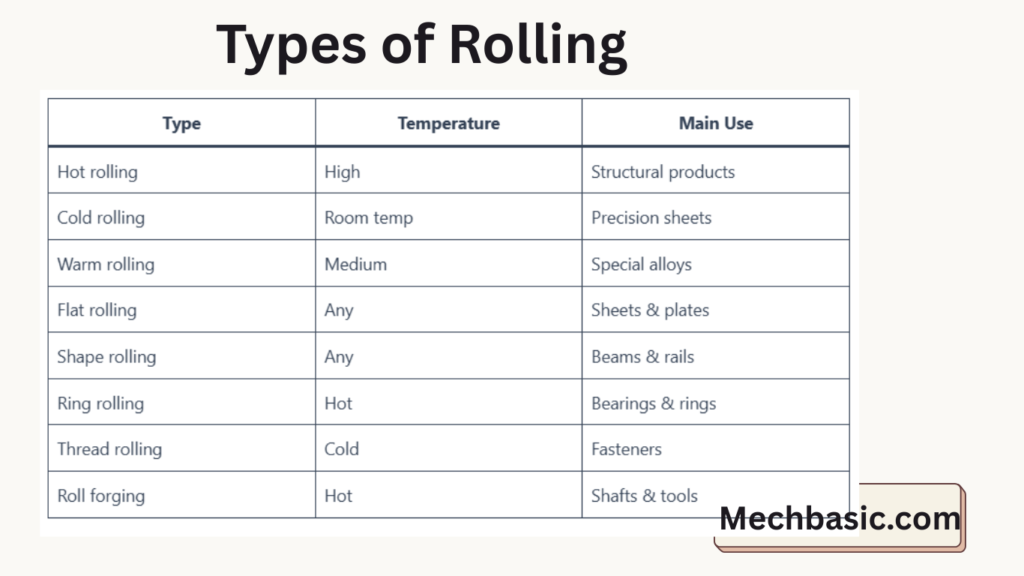
Summary Table
| Type | Temperature | Main Use |
|---|---|---|
| Hot rolling | High | Structural products |
| Cold rolling | Room temp | Precision sheets |
| Warm rolling | Medium | Special alloys |
| Flat rolling | Any | Sheets & plates |
| Shape rolling | Any | Beams & rails |
| Ring rolling | Hot | Bearings & rings |
| Thread rolling | Cold | Fasteners |
| Roll forging | Hot | Shafts & tools |
Other courses:





