
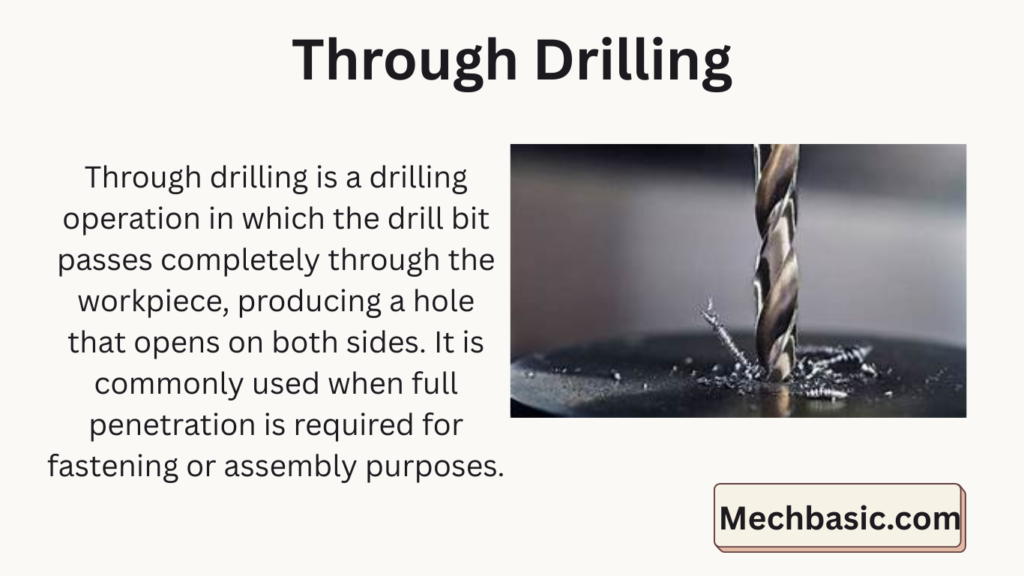
Through drilling is a drilling operation in which the drill bit passes completely through the workpiece, producing a hole that opens on both sides. It is commonly used when full penetration is required for fastening or assembly purposes.
In this article:
Through Drilling:
Through drilling is a machining operation in which a rotating cutting tool (drill bit) produces a hole that passes completely through the workpiece, entering from one side and exiting the opposite side. It is one of the most common drilling operations in manufacturing, fabrication, and maintenance.
1. Definition and Purpose
- Definition: A drilling process where the hole fully penetrates the material thickness.
- Purpose:
- Fastening (bolts, screws, rivets)
- Assembly alignment
- Fluid or air passage
- Weight reduction
- Preparation for tapping, reaming, or countersinking
2. Machines Used
Through drilling can be performed on:
- Drill Press (Bench / Pillar / Radial)
- CNC Drilling or Machining Centers
- Lathe (workpiece rotates, drill is stationary)
- Hand Drills (low-precision applications)
3. Cutting Tools (Drill Bits)
Common drill types:
- Twist Drill (most widely used)
- Step Drill
- Gun Drill (for deep through holes)
- Carbide Drill (high-speed, hard materials)
Drill Geometry:
- Point angle: Typically 118° (general use) or 135° (hard materials)
- Helix angle: Helps chip evacuation
- Flutes: Carry chips out of the hole
4. Process Steps
- Marking / Centering
- Center punch or spotting drill used to prevent drill wandering
- Clamping the Workpiece
- Fixed firmly using vice, fixture, or clamps
- Tool Selection
- Proper drill size and material
- Setting Parameters
- Spindle speed (RPM)
- Feed rate
- Coolant selection
- Drilling Operation
- Drill enters the workpiece
- Material is cut and chips are removed via flutes
- Breakthrough
- Drill exits the opposite side
- Requires reduced feed to avoid burrs and tool damage
- Deburring
- Burrs removed from exit side
5. Cutting Parameters
a) Spindle Speed (RPM)
Depends on:
- Drill diameter
- Material type
Formula:
RPM=π×D1000×V
Where:
- V = cutting speed (m/min)
- D = drill diameter (mm)
b) Feed Rate
- Measured in mm/rev
- Too high → tool breakage
- Too low → poor cutting, heat buildup
6. Coolant and Lubrication
- Purpose:
- Reduces heat
- Improves surface finish
- Extends tool life
- Types:
- Water-based emulsions
- Cutting oil
- Dry drilling (some aluminum or cast iron)
7. Chip Formation and Removal
- Chips must flow freely out of the hole
- For deep through holes:
- Peck drilling is used (intermittent drilling to clear chips)
- Poor chip removal leads to:
- Tool breakage
- Overheating
- Poor accuracy
8. Accuracy and Surface Finish
- Through drilling typically gives moderate accuracy
- Tolerances: ±0.1 mm (standard drilling)
- For high precision:
- Reaming after drilling
- CNC machines preferred
9. Common Defects and Problems
| Defect | Cause | Prevention |
|---|---|---|
| Burrs at exit | High feed at breakthrough | Reduce feed near exit |
| Drill breakage | Excess feed / poor chip removal | Correct parameters |
| Oversized hole | Worn tool / vibration | Replace tool, improve clamping |
| Poor surface finish | Dull drill / no coolant | Sharpen tool, use coolant |
10. Advantages
- Simple and fast process
- Low equipment cost
- Suitable for mass production
- Can be automated easily (CNC)
11. Limitations
- Exit-side burr formation
- Limited accuracy compared to boring
- Not ideal for very deep holes without special tools
12. Applications
- Mechanical assemblies
- Automotive components
- Aerospace structures
- Sheet metal fabrication
- Structural frames
Other courses:





