
Tapping is a machining process used in manufacturing to create internal threads inside a pre-drilled hole. It is performed using a cutting tool called a tap, which removes material to form threads that allow bolts or screws to be fastened securely.
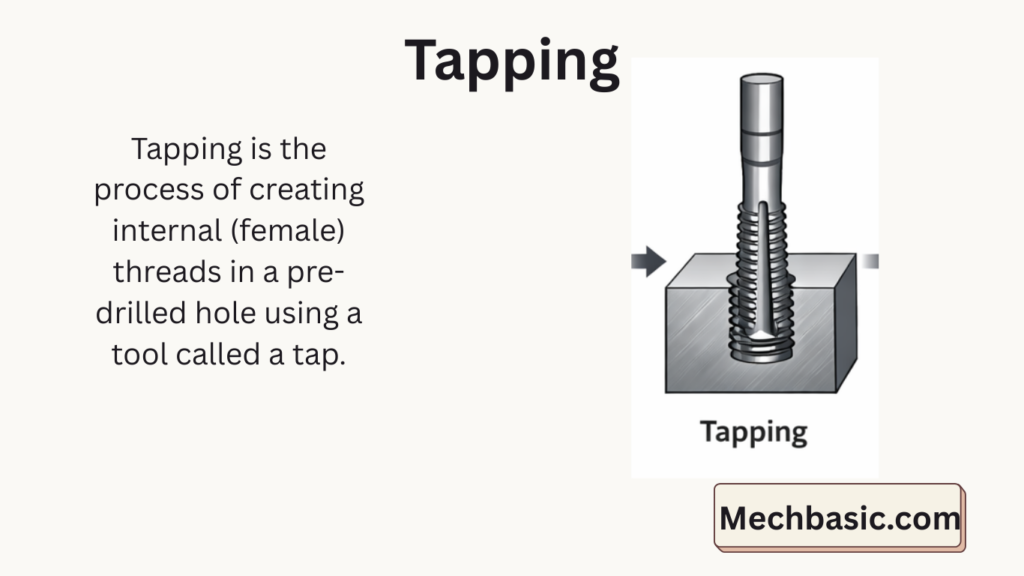
Tapping can be done manually or using machines such as drilling machines, CNC machines, or tapping machines, and it is widely used in industries for producing accurate and strong threaded components.
In this article:
Tapping
Tapping is a machining process used to cut internal threads in a pre-drilled hole so that screws or bolts can mate with the workpiece. It is one of the most common threading operations in manufacturing, metalworking, and assembly work.
1. Definition
Tapping is the process of creating internal (female) threads in a pre-drilled hole using a tool called a tap.
- Taps can produce metric, imperial, or custom threads.
- The hole prepared for tapping is called a tap drill hole.
2. Purpose of Tapping
- Provide internal threads for fastening
- Enable bolted connections in machinery and structures
- Allow maintenance or assembly of threaded components
- Used in both metal and plastic parts
3. Types of Taps
| Type | Description | Use |
|---|---|---|
| Hand Tap | Used manually with a T-handle | Small production or repair work |
| Machine Tap | Used in drilling/milling machines | High-volume production |
| Bottoming Tap | Cuts threads near the bottom of a blind hole | Blind holes |
| Plug Tap | General-purpose, easier starting | Through holes and blind holes |
| Taper Tap | Gradual thread cutting | Initial threading in blind holes |
4. Tap Design
- Shank: Held by T-handle, chuck, or machine spindle
- Threaded portion: Cuts internal threads
- Flutes: Helical grooves for chip evacuation
- Chamfer: Gradual taper at start of tap for easy entry
Chamfer types:
- Taper tap: 8–10 threads chamfered
- Plug tap: 3–5 threads chamfered
- Bottoming tap: 1–2 threads chamfered
5. Machines / Tools Used
- Hand tapping: T-handle wrench or tap wrench
- Drill press / pillar drill (with tapping attachment)
- CNC machining centers (high-volume precision threads)
- Lathes (internal threading attachment)
6. Process Steps
- Pre-Drill Hole (Tap Drill)
- Diameter = major thread diameter minus pitch
- Formula for tap drill size (metric threads):
Dtap drill=Dmajor−P - P (pitch) means:
- 👉 Pitch is the distance between two adjacent threads, measured parallel to the axis of the screw or tap.
- Workpiece Setup
- Clamp firmly to avoid movement
- Align tap axis perpendicular to hole
- Lubrication
- Apply cutting fluid for metals
- Reduces friction and prevents tap breakage
- Tapping Operation
- Insert tap into hole
- Turn clockwise (right-hand thread)
- Every few turns, reverse 1/4–1/2 turn to break chips
- Chip Removal
- Critical for blind holes
- Use plug, taper, or bottoming tap based on hole type
- Completion
- Withdraw tap carefully
- Remove burrs using countersink or deburring tool
7. Types of Thread Cuts
| Cut Type | Description |
|---|---|
| Through Thread | Tap passes completely through hole |
| Blind Thread | Tap stops before reaching bottom of hole |
| Spiral Flute Tap | For difficult chips (aluminum, stainless) |
| Spiral Point Tap (“gun tap”) | Pushes chips forward in through holes |
8. Cutting Parameters
| Material | RPM / Speed | Feed | Lubricant |
|---|---|---|---|
| Steel | 10–50 m/min | Moderate | Cutting oil |
| Aluminum | 30–100 m/min | Moderate | Minimal oil |
| Brass / Copper | 30–80 m/min | Moderate | Cutting oil |
| Plastic | 15–30 m/min | Light | None / air |
Note: Speed depends on material, tap size, and machine rigidity.
9. Advantages of Tapping
- Creates accurate internal threads
- Can be performed manually or on machines
- Suitable for small and large production
- Can handle through or blind holes
- Produces threads for metal, plastic, and composites
10. Limitations
- Tap is brittle and can break if mishandled
- Requires accurate alignment to prevent tap breakage
- Depth of thread is limited by tool length
- Chip clogging may occur in blind holes
- Manual tapping is slow for high-volume production
11. Applications
- Machine parts requiring screws and bolts
- Automotive and aerospace components
- Hydraulic and pneumatic fittings
- Fixtures, jigs, and tooling
- Plastic parts requiring threaded inserts
12. Best Practices
- Use correct tap drill size
- Align tap precisely with hole axis
- Apply cutting fluid for metal
- Reverse periodically to break chips
- Use appropriate tap type: taper → plug → bottoming for blind holes
Tip: For blind holes, always start with a taper tap, then finish with plug or bottoming tap to ensure full thread depth without breaking the tap.
Other courses:





