
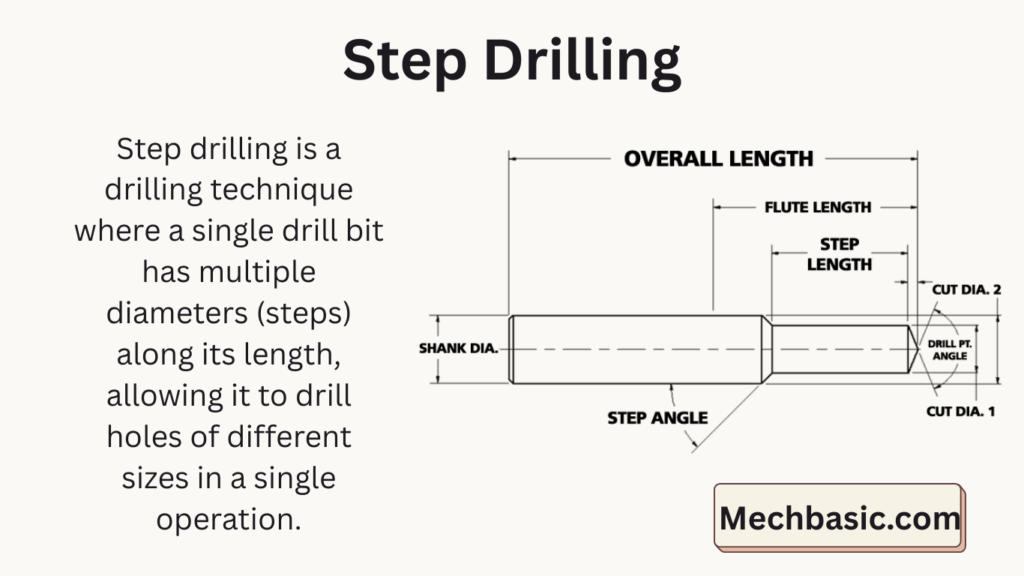
Step drilling is a drilling technique where a single drill bit has multiple diameters (steps) along its length, allowing it to drill holes of different sizes in a single operation.
It is commonly used for thin materials, such as sheet metal, to create holes with varying diameters without changing tools. Step drilling reduces tool changes, saves time, and produces clean, burr-free holes.
In this article:
Step Drilling:
1. Definition
Step drilling is a drilling process where a hole is drilled in multiple incremental diameters using a single step drill or multiple drills to gradually reach the final hole size. This is especially useful when:
- Drilling large-diameter holes
- The workpiece is thick
- Using a single-stage drill would cause high torque, tool deflection, or excessive heat
Step drilling is commonly used in both metal and plastic machining.
2. Purpose of Step Drilling
- Reduces cutting force by gradually enlarging the hole.
- Prevents drill wandering in large holes.
- Improves surface finish and hole accuracy.
- Extends tool life.
- Suitable for thin or thick plates where a large-diameter drill may fail in a single step.
3. Machines Used
- Drill press (bench, radial)
- CNC machining centers
- Lathe with drilling attachment
- Milling machines for guided holes
4. Tools Used in Step Drilling
a) Step Drill Bit (Single Tool)
- Conical or tiered shape with increasing diameters
- Each step has a cutting edge
- Commonly used in sheet metal and thin plates
b) Multi-Drill Step Drilling (Multiple Tools)
- Drill a pilot hole first (small diameter)
- Gradually use larger drills to reach final size
5. Process Steps
- Marking / Center Punch
- Optional but improves accuracy
- Pilot Hole (if using multiple tools)
- Start with a small-diameter twist drill
- Step Drilling
- Gradually increase drill size in steps
- For single-step drill bits, each step cuts progressively larger diameter
- Depth Control
- Ensure each step reaches proper depth
- Chip Removal
- Clear chips after each step to prevent binding
- Deburring
- Smooth edges for a clean hole
6. Cutting Parameters
- Speed (RPM): Lower for larger diameters
- Feed: Moderate; increase slightly with each step
- Coolant: Recommended for metals
Example (Metal drilling):
- Start with Ø6 mm pilot
- Next drill Ø10 mm
- Final drill Ø16 mm
- Each step reduces cutting force and heat
7. Advantages of Step Drilling
- Reduces drill breakage
- Improves dimensional accuracy
- Reduces heat generation
- Allows drilling larger holes on thin plates
- Minimizes vibration and chatter
8. Limitations
- More time-consuming than single-stage drilling
- Requires multiple tools if not using step drill bit
- Not suitable for very deep holes unless specialized drill is used
9. Applications
- Sheet metal fabrication (electrical panels, enclosures)
- Aerospace components (aluminum and thin alloys)
- Pipe and flange drilling
- Plastic fabrication
- Thick metal plates for machinery
10. Step Drilling vs Single-Stage Drilling
| Feature | Step Drilling | Single-Stage Drilling |
|---|---|---|
| Hole Size | Large diameters | Small to medium |
| Tool Stress | Low | High |
| Heat Generation | Low | High |
| Accuracy | High | Moderate |
| Tool Life | Longer | Shorter |
| Time | Slightly longer | Shorter |
11. Best Practices
- Always start with a small pilot hole to guide larger drills.
- Use peck drilling for deep holes to clear chips.
- Use coolant or cutting fluid for metals.
- Avoid excessive feed to prevent tool deflection.
Step drilling is widely used in sheet metal work, aerospace, and thick metal plate machining, where both accuracy and tool life are critical.
Other courses:





