
Here is a clear, complete, and detailed explanation of steering in a car, covering how it works, its components, types, modern systems, and more.
In this article:
Steering in a Car:
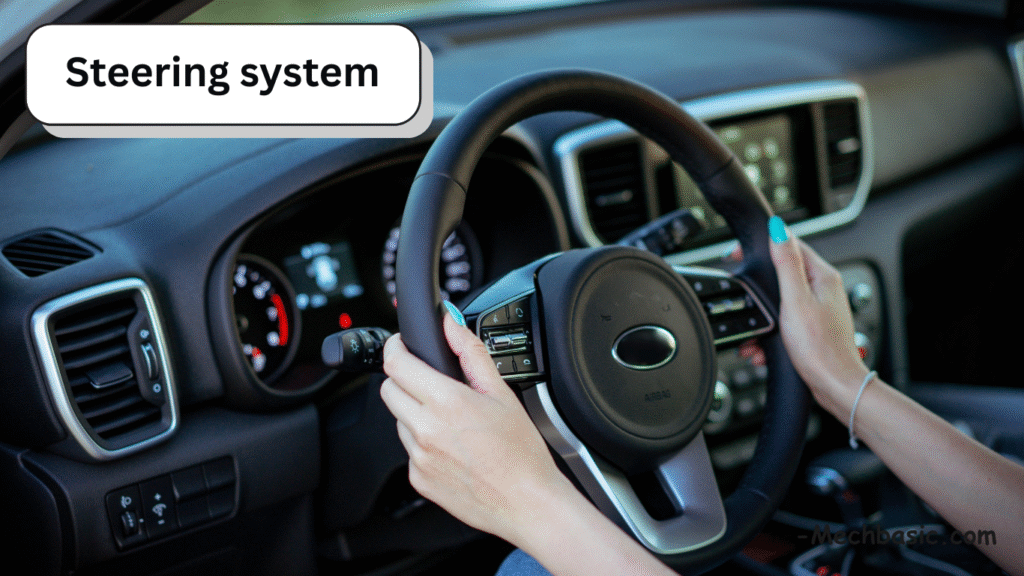
Car steering is the system that allows the driver to control the direction of the vehicle. It converts the driver’s movement on the steering wheel into the turning of the front wheels.
1. Purpose of the Steering System
A proper steering system must:
- Provide directional control
- Allow smooth turning
- Offer stability at high speed
- Reduce driver effort
- Absorb shocks from road irregularities
- Provide feedback to the driver (road feel)
2. Main Components of a Car Steering System
a) Steering Wheel
The driver’s control interface.
b) Steering Column
Connects the wheel to the steering mechanism. Includes:
- Steering shaft
- Collapsible column for crash safety
- Universal joints
c) Steering Gearbox
Converts rotary motion → linear motion.
Two major types:
- Rack-and-pinion (most common in cars today)
- Recirculating ball (used in trucks, SUVs earlier)
d) Rack and Pinion Mechanism
- Pinion gear attached to steering shaft
- Rack is a linear gear
When the driver turns the wheel, the pinion rotates, moving the rack left or right → turning the wheels.
e) Tie Rods
Connect the rack to the wheel hubs. Allow movement through ball joints.
f) Steering Knuckles
The part of the suspension connected to the wheels. They pivot to allow turning.
3. How the Steering System Works (Step-by-Step)
- Driver turns the steering wheel.
- Motion is transmitted through the steering column to the pinion gear.
- Pinion rotates and moves the rack.
- The rack pushes/pulls the tie rods.
- Tie rods move the steering knuckles.
- The front wheels turn to the desired direction.
4. Types of Steering Systems
1. Manual Steering
Purely mechanical. Older cars. Requires more effort.
2. Power Steering (Hydraulic)
Uses hydraulic fluid under pressure.
- Pump driven by the engine
- Easier steering
- More maintenance
- Older technology
3. Electric Power Steering (EPS)
Uses an electric motor to assist steering.
- More fuel-efficient
- Variable steering feel
- Used in most modern cars
- Integrates easily with ADAS systems (lane keep assist, autopilot)
4. Electro-Hydraulic Steering
Hybrid between hydraulic and electric.
5. Steer-by-Wire (Modern / Electric Cars)
No mechanical link between steering wheel and wheels.
- Electronic signals control steering
- More precise
- Allows new interior designs
- Used in some new EVs (e.g., Lexus, Infiniti)
5. Key Steering Concepts
a) Ackermann Steering Geometry
Ensures inner and outer wheels turn at different angles during a turn (inner wheel turns more).
Prevents tire scrubbing and improves handling.
b) Steering Ratio
Number of degrees the steering wheel must turn to rotate the wheels by 1°.
- Low ratio = fast steering
- High ratio = smoother, more stable steering
c) Caster, Camber, Toe Angles
Wheel alignment parameters that affect stability, handling, and tire wear:
- Caster – affects stability and steering return
- Camber – affects cornering grip
- Toe – affects straight-line stability and tire wear
6. Modern Steering Features
1. Variable Assist Steering
EPS adjusts power assist based on speed:
- Light steering at low speed
- Heavy, stable feel at high speed
2. Active Rear-Wheel Steering
Rear wheels turn slightly to reduce turning radius and improve stability.
3. Lane Keeping Assist / Autopilot Steering
ADAS uses:
- Cameras
- Radar
- Electric power steering
to apply small steering corrections.
7. Common Steering Problems
- Loose steering (too much play)
- Hard steering (low power assist)
- Pulling to one side (alignment issue)
- Steering wheel vibration (unbalanced tires or suspension issues)
- Noisy steering (low fluid, worn joints)
8. Steering Maintenance Tips
- Check power steering fluid (if hydraulic)
- Maintain correct wheel alignment
- Keep tires properly inflated
- Inspect tie rods, ball joints, and bushings
- Service EPS sensors if needed
Summary
Car steering is a complex system combining mechanical, hydraulic, and electrical components to provide safe and controlled vehicle direction. Modern systems like EPS and steer-by-wire add intelligence, safety, and comfort to traditional steering mechanisms.
Other courses:





