
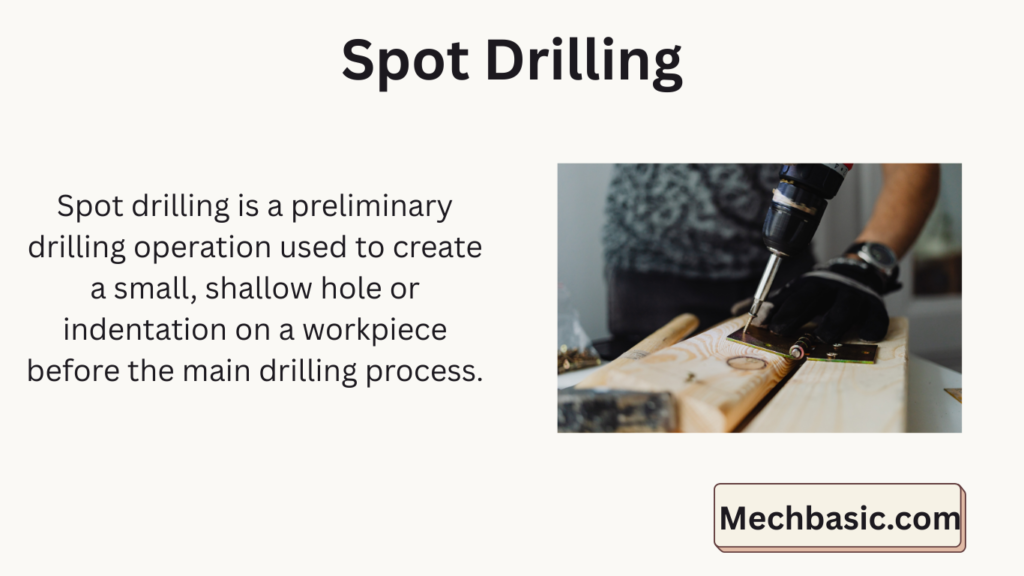
Spot drilling is a preliminary drilling operation used to create a small, shallow hole or indentation on a workpiece before the main drilling process.
Its primary purpose is to accurately locate the drill bit, prevent the drill from wandering, and ensure that subsequent holes are drilled precisely at the desired position. Spot drilling also reduces the risk of off-center holes, drill breakage, and surface damage.
In this article:
Spot Drilling:
1. Definition
Spot drilling is a machining operation used to make a shallow, small-diameter hole at the exact location where a main hole will be drilled later.
Unlike center drilling, its purpose is only to mark the drilling position and prevent drill wandering. The hole created is shallow and not intended for a lathe center.
2. Purpose of Spot Drilling
- Provides a precise starting point for subsequent drilling.
- Prevents drill wandering, especially for large or long drills.
- Ensures positional accuracy of the main hole.
- Can create a countersink for screw heads in some applications.
- Helps in reducing workpiece damage by guiding the twist drill.
3. Machines Used
Spot drilling can be performed on:
- Drill press (bench or pillar)
- CNC machining center
- Milling machines (for angled or complex surfaces)
4. Spot Drill Tool (Spotting Drill)
Features of Spot Drill
- Short and rigid tool
- Small tip angle: typically 90° to 120°
- Shallow penetration: only a few millimeters deep
- Made from high-speed steel (HSS) or carbide
Differences from Center Drill
| Feature | Spot Drill | Center Drill |
|---|---|---|
| Angle | 90°–120° | 60° |
| Purpose | Marks drill location | Supports lathe center & guides drill |
| Depth | Very shallow | Shallow but slightly deeper |
| Use on lathe | No | Yes |
5. Process Steps
- Mark the Drill Position
- Using a center punch or layout tools.
- Workpiece Clamping
- Firmly in vice or fixture to prevent movement.
- Tool Selection
- Spot drill of appropriate diameter and tip angle.
- Speed and Feed Setup
- Low RPM recommended for HSS
- Light feed to prevent wandering or chatter
- Spot Drilling Operation
- Drill just enough depth to guide the main drill (~1–2 × drill diameter)
- Retraction and Cleaning
- Remove chips, ensure the spot is visible and clean
- Main Drilling
- Use twist drill guided by the spot
6. Cutting Parameters
- Speed (RPM): Low to medium
- Feed: Light (to prevent tip breakage)
- Coolant: Optional for soft materials; recommended for steel
7. Advantages of Spot Drilling
- Prevents drill walking or wandering
- Increases accuracy of main holes
- Extends tool life of twist drills
- Simple and fast operation
- Reduces surface damage
8. Limitations
- Only creates shallow hole
- Cannot support lathe centers (unlike center drilling)
- Not suitable for deep hole alignment
9. Applications
- Pre-drilling for bolt holes in assemblies
- Positioning of large diameter twist drills
- CNC machining as a starting point for precise holes
- Sheet metal and plate work
10. Spot Drilling vs Center Drilling
| Feature | Spot Drilling | Center Drilling |
|---|---|---|
| Purpose | Guide main drill | Support lathe center + guide drill |
| Tip Angle | 90°–120° | 60° |
| Depth | Very shallow | Slightly deeper |
| Lathe Use | No | Yes |
| Tool Rigidity | Short & rigid | Short & rigid |
11. Best Practices
- Always use a spot drill slightly larger than the punch mark.
- Avoid excessive depth to prevent unnecessary material removal.
- Use coolant for steel to reduce tool wear.
- Clamp workpiece firmly to avoid chatter.
Other courses:





