
Spinning is a sheet metal forming process in which a circular metal blank is rotated at high speed and shaped over a mandrel using a tool.
It is mainly used to produce round or cylindrical parts.
Examples include lampshades, kitchen utensils, and cones.
In this article:
Metal Spinning in Sheet Metal
What is Spinning?
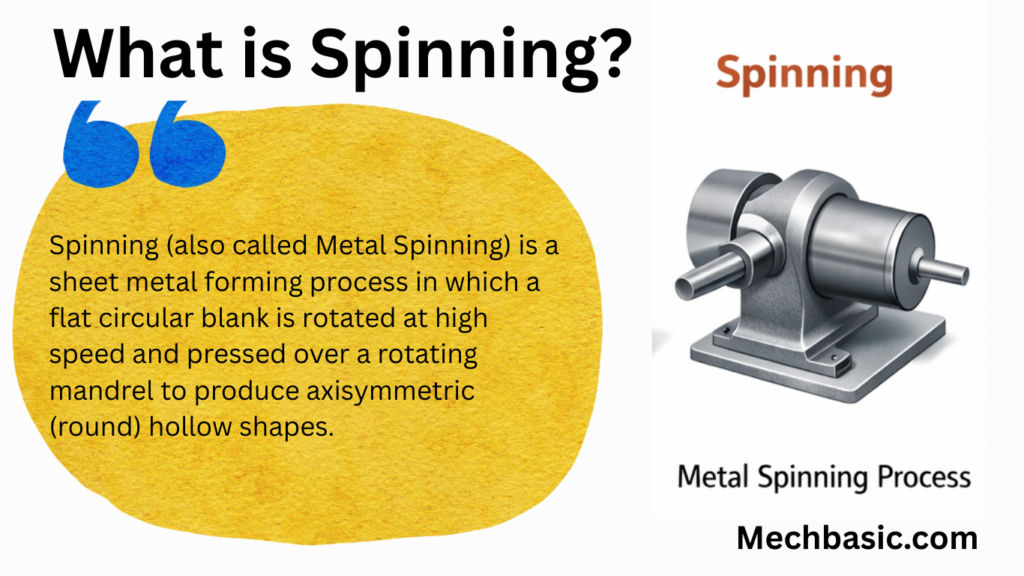
Spinning (also called Metal Spinning) is a sheet metal forming process in which a flat circular blank is rotated at high speed and pressed over a rotating mandrel to produce axisymmetric (round) hollow shapes.
👉 No material is removed
👉 Thickness may slightly reduce (in conventional spinning)
👉 Used for circular and symmetrical components
Working Principle
Step-by-step Process:
- A circular blank is clamped against a mandrel.
- The blank rotates at high speed.
- A roller tool applies pressure gradually.
- The sheet flows over the mandrel shape.
- Final hollow component is formed.
Main Components
1️⃣ Mandrel (Form Block)
- Has required final shape
- Mounted on spindle
2️⃣ Roller Tool
- Applies forming pressure
3️⃣ Tailstock
- Holds blank tightly
4️⃣ Spinning Machine (Lathe-like machine)
Types of Spinning
1. Conventional Spinning
- Thickness remains nearly constant
- Diameter reduces
2. Shear Spinning
- Thickness intentionally reduced
- Used for conical shapes
3. Tube Spinning
- Used for cylindrical tubes
Important Characteristics
- Suitable only for axisymmetric parts
- Requires ductile materials
- Gradual deformation prevents cracking
Spinning Force (General Idea)
Force depends on:
- Material strength
- Thickness
- Feed rate of roller
- Mandrel shape
Higher:
✔ Thickness → Higher force
✔ Strength → Higher force
Applications
- LPG gas cylinders
- Cooking utensils
- Reflectors
- Satellite dishes
- Lampshades
- Aerospace nose cones
Advantages
✔ Smooth surface finish
✔ No seams
✔ Low material waste
✔ Suitable for small and medium production
Disadvantages
✖ Limited to circular shapes
✖ Requires skilled operator (manual spinning)
✖ Not suitable for very complex shapes
Spinning vs Deep Drawing
| Feature | Spinning | Deep Drawing |
|---|---|---|
| Production Volume | Low to medium | High |
| Tooling Cost | Low | High |
| Shape | Axisymmetric | Various hollow shapes |
| Thickness | Slight change | Slight variation |
Summary
- Spinning is a rotational forming process.
- Used for hollow circular components.
- Mandrel determines final shape.
- No material removal occurs.
- Can be manual or CNC controlled.
Other courses:





