
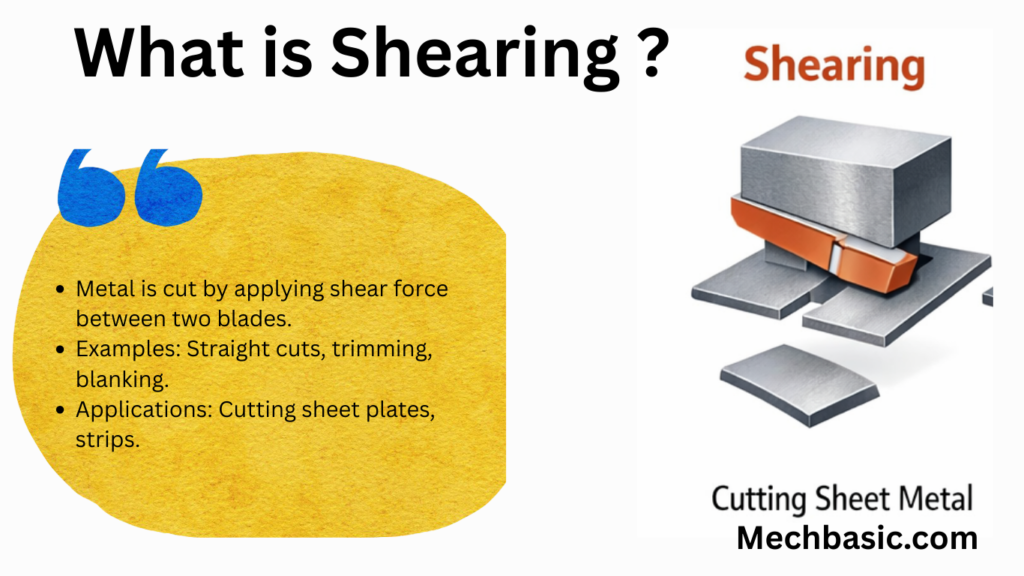
Shearing is a sheet metal cutting operation in which material is separated by applying shear force using two blades without producing chips.
In this article:
- Shearing Sheet Metal Operation
- 1. What is Shearing?
- 2. Basic Working Principle
- 3. Main Components of Shearing Setup
- 4. Stages of Shearing Process
- 5. Important Terminologies
- 6. Types of Shearing Operations
- 7. Shearing Force Calculation (Example)
- 8. Machines Used for Shearing
- 9. Advantages
- 10. Disadvantages
- 11. Factors Affecting Shearing Quality
- 12. Applications
- 13. Summary
Shearing Sheet Metal Operation
Shearing is a sheet metal cutting process used to cut straight lines on flat metal sheets without forming chips or using heat. It works by applying a high compressive force with two sharp blades—one fixed and one moving.
1. What is Shearing?
Shearing is a cold working process in which a sheet is cut by subjecting it to shear stress using a punch and die or upper and lower blades.
✔ No melting
✔ No chips produced
✔ High production rate
✔ Suitable for straight cuts
2. Basic Working Principle
When force is applied:
- The upper blade (or punch) moves downward.
- The sheet is clamped.
- Stress increases beyond shear strength.
- The material fractures along the cutting line.
- The separated piece falls off.
3. Main Components of Shearing Setup
1. Punch
- Moving cutting tool
- Applies force on sheet
2. Die
- Fixed tool
- Supports material
- Has an opening equal to required shape
3. Hold-down / Clamp
- Prevents sheet movement
4. Frame & Drive System
- Mechanical or hydraulic system
4. Stages of Shearing Process
- Elastic Deformation
Material slightly bends under pressure. - Plastic Deformation
Permanent deformation begins. - Penetration
Punch penetrates ~20–40% of thickness. - Fracture
Cracks initiate and propagate until separation.
5. Important Terminologies
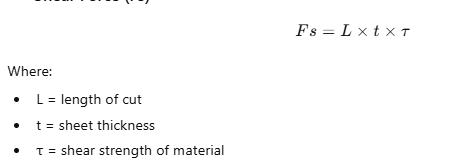
Shear Force (Fs)
Clearance (C)
Gap between punch and die.
Typical clearance:
- 5–10% of sheet thickness
Too small → Tool wear
Too large → Rough edges & burrs
Burr
Small rough edge left after cutting.
6. Types of Shearing Operations
1. Blanking
- Cut piece is the required product.
- Remaining sheet is scrap.
Example: Coin manufacturing.
2. Punching (Piercing)
- Removed part is scrap.
- Sheet with hole is product.
Example: Making holes in brackets.
3. Notching
Cutting from sheet edge.
4. Slitting
Cutting sheet into strips.
5. Nibbling
Making complex shapes with repeated punches.
7. Shearing Force Calculation (Example)
Suppose:
- Thickness = 4 mm
- Length of cut = 100 mm
- Shear strength = 300 MPa
Fs = 100 × 4 × 300 = 120,000 N
So, required force = 120 kN
8. Machines Used for Shearing
Mechanical Shear
- Fast
- Used for thin sheets
Hydraulic Shear
- High force capacity
- Used for thick plates
Power Press
- Used for blanking & punching
9. Advantages
✔ High production rate
✔ Smooth cut edges
✔ No material loss as chips
✔ Economical for mass production
10. Disadvantages
✖ Limited to straight cuts (in basic shearing)
✖ Tool wear occurs
✖ Burr formation
✖ Noise in mechanical presses
11. Factors Affecting Shearing Quality
- Clearance
- Blade sharpness
- Material hardness
- Sheet thickness
- Cutting speed
12. Applications
- Automobile panels
- Electrical enclosures
- Aircraft sheet components
- Household appliances
- Coin manufacturing
13. Summary
- Shearing is a chipless cutting process.
- Clearance is crucial.
- Force depends on shear strength and thickness.
- Occurs in four stages (Elastic → Plastic → Penetration → Fracture).
- Burr forms on exit side.
Other courses:





