
Seaming is a sheet metal joining operation where the edges of two sheets are folded and interlocked.
It creates a tight and secure joint without welding or riveting.
It is commonly used in cans, containers, and ductwork.
In this article:
Seaming in Sheet Metal
What is Seaming?
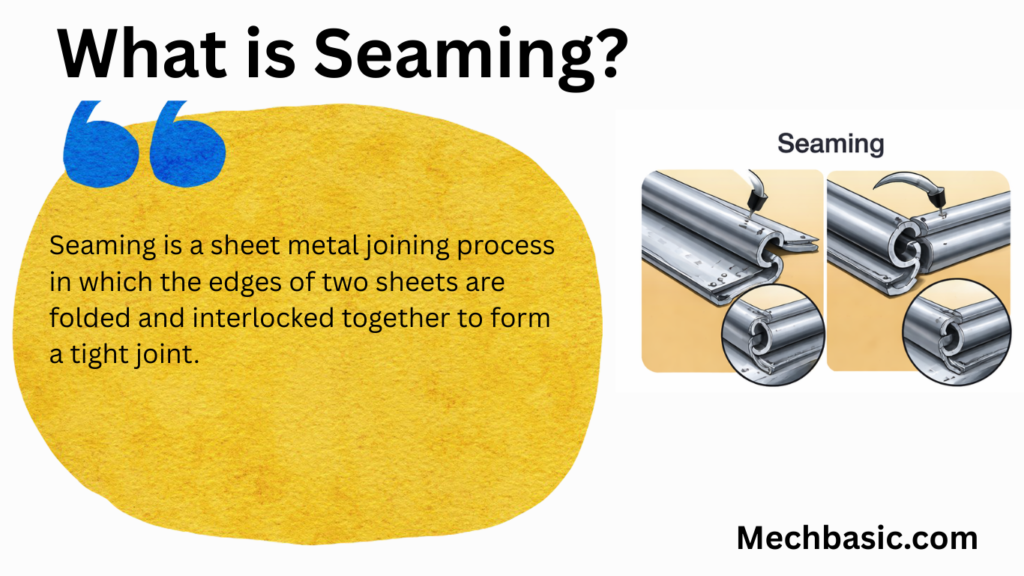
Seaming is a sheet metal joining process in which the edges of two sheets are folded and interlocked together to form a tight joint.
👉 No additional fasteners required
👉 No material removal
👉 Can be air-tight or liquid-tight
Seaming is widely used in can manufacturing, ducts, and containers.
Working Principle
Step-by-step Process:
- Edges of sheets are first flanged or curled.
- The edges are overlapped.
- A seaming roller or die folds and compresses them.
- The joint is locked tightly.
In can manufacturing, a double seam is commonly used.
Main Components
1. Seaming Rollers
- Gradually fold and compress metal edges
2. Chuck
- Supports can body during operation
3. Seaming Machine
- Rotational or press-type machine
Types of Seams
1. Single Seam
Simple fold joint.
2. Double Seam
Used in cans (body and lid connection).
3. Grooved Seam
Edges interlocked with groove.
4. Knocked-up Seam
Partially locked seam.
5. Lock Seam
Common in air ducts.
Important Characteristics
- Improves joint strength
- Provides leak-proof connection (with sealant)
- Requires ductile material
- Multiple forming stages
Applications
- Food and beverage cans
- Oil containers
- HVAC ducts
- Drums and barrels
- Metal pipes
Advantages
✔ Strong mechanical joint
✔ Leak-proof (with sealing compound)
✔ No welding required
✔ Suitable for thin sheets
Disadvantages
✖ Additional forming operation
✖ Limited to edge joining
✖ Requires precise machine setup
Seaming vs Hemming
| Feature | Seaming | Hemming |
|---|---|---|
| Purpose | Join two sheets | Fold one sheet edge |
| Interlocking | Yes | No |
| Application | Cans, ducts | Auto panels |
Summary:
- Seaming is an edge interlocking process.
- Commonly used in can manufacturing.
- Double seam ensures leak-proof joint.
- No external fastener required.
- Requires ductile materials.
Other courses:





