
Rolling is a manufacturing process in which metal is passed between rotating rollers to reduce its thickness and change its shape. It is widely used to produce sheets, plates, and structural sections.
In this article:
- Rolling in Manufacturing Process
- 1. Definition of Rolling
- 2. Principle of Rolling
- 3. Rolling Mill Components
- 4. Types of Rolling Mills
- 5. Types of Rolling Based on Temperature
- 6. Rolling Operations
- 7. Rolling Parameters
- 8. Rolling Defects
- 9. Advantages of Rolling
- 10. Limitations of Rolling
- 11. Applications of Rolling
- 12. Comparison: Rolling vs Forging
- 13. Summary
Rolling in Manufacturing Process
Rolling is a metal forming process in which metal stock is passed through rotating rolls to reduce thickness, improve uniformity, and shape the material. It is widely used to produce sheets, plates, bars, and structural sections with improved surface finish and mechanical properties. Rolling can be performed as hot rolling or cold rolling, depending on the temperature of the metal during deformation.
1. Definition of Rolling
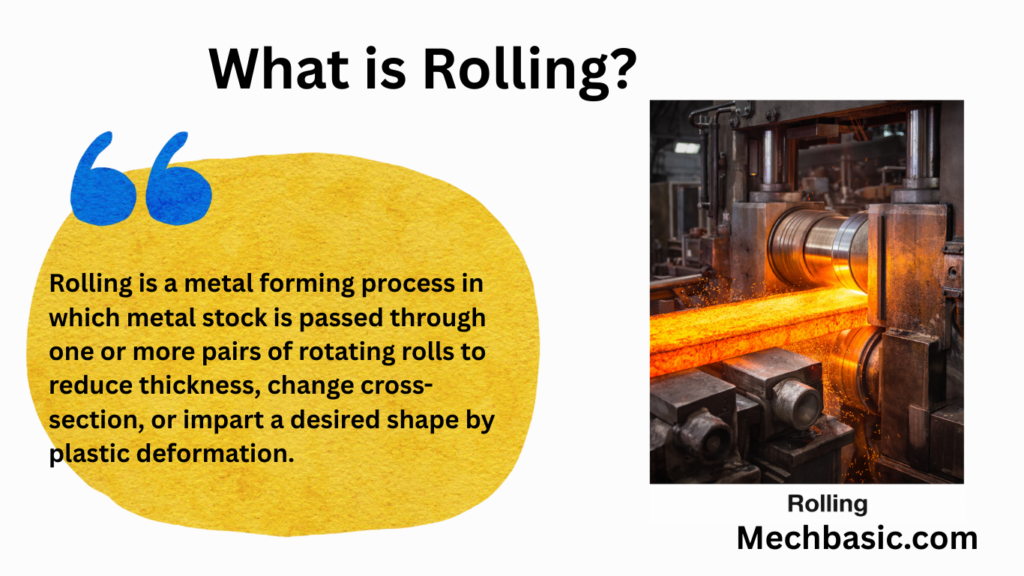
Rolling is a metal forming process in which metal stock is passed through one or more pairs of rotating rolls to reduce thickness, change cross-section, or impart a desired shape by plastic deformation.
- Deformation occurs due to compressive forces
- Volume of metal remains constant
- No material removal → high productivity
2. Principle of Rolling
- Two rolls rotate in opposite directions
- Friction between rolls and workpiece pulls the metal into the roll gap
- Thickness is reduced from initial thickness (h₀) to final thickness (h₁)
- Length increases, width remains nearly constant
Condition for Biting (Gripping)

Where:
- μ (mu) = coefficient of friction
- α (alpha) = angle of bite
3. Rolling Mill Components
- Rolls
- Made of cast iron or alloy steel
- Plain or grooved
- Rolling Stand
- Holds rolls in position
- Drive System
- Motors, gears, flywheels
- Roll Gap Adjustment
- Controls thickness reduction
- Guides
- Direct the metal into rolls
4. Types of Rolling Mills
(A) Two-High Rolling Mill
- Two rolls only
- Simple design
- Used for roughing operations
(B) Three-High Rolling Mill
- Three rolls arranged vertically
- Allows rolling in both directions without reversing roll rotation
(C) Four-High Rolling Mill
- Two small work rolls + two backup rolls
- Used for thin sheets
(D) Cluster (Sendzimir) Mill
- Multiple backup rolls
- Very thin sheets and foils
(E) Tandem Rolling Mill
- Multiple stands in series
- High production rate
5. Types of Rolling Based on Temperature
Hot Rolling
- Above recrystallization temperature
- Large deformation
- Low rolling forces
- Rough surface finish
Cold Rolling
- Below recrystallization temperature
- High strength and accuracy
- Requires annealing
Warm Rolling
- Intermediate temperature
- Balance of properties
6. Rolling Operations
Flat Rolling
- Produces plates, sheets, strips
Shape Rolling
- Produces I-sections, channels, rails
Ring Rolling
- Produces seamless rings
Thread Rolling
- Produces screws and bolts
Roll Forging
- Produces axles, crankshafts
7. Rolling Parameters
- Roll diameter
- Draft (Δh)
- Roll speed
- Coefficient of friction
- Material flow stress
8. Rolling Defects
- Wavy edges
- Edge cracks
- Zipper cracks
- Alligatoring
(These occur due to non-uniform deformation, improper temperature, or excessive reduction.)
9. Advantages of Rolling
- High production rate
- Excellent mechanical properties
- Good dimensional accuracy (especially cold rolling)
- Minimal material wastage
- Economical for mass production
10. Limitations of Rolling
- High initial equipment cost
- Limited to simple cross-sections
- Rolling defects if not properly controlled
- Not suitable for small batch production
11. Applications of Rolling
- Structural steel (beams, rails)
- Automobile body panels
- Sheets and plates
- Aluminum foils
- Pipes and tubes (with additional processes)
12. Comparison: Rolling vs Forging
| Aspect | Rolling | Forging |
|---|---|---|
| Deformation | Continuous | Intermittent |
| Shape | Uniform | Complex |
| Productivity | Very high | Medium |
| Material waste | Low | Moderate |
13. Summary
- Rolling is the most widely used metal forming process
- Uses compressive forces
- Can be hot, cold, or warm
- Produces high-quality structural and sheet products
Other courses:





