
Riveting is a permanent fastening process used to join two or more metal sheets using a rivet.
The rivet is inserted into a hole and its end is deformed to hold the sheets tightly together.
It is widely used in aircraft structures, bridges, and sheet metal assemblies.
In this article:
Riveting in Sheet Metal
What is Riveting?
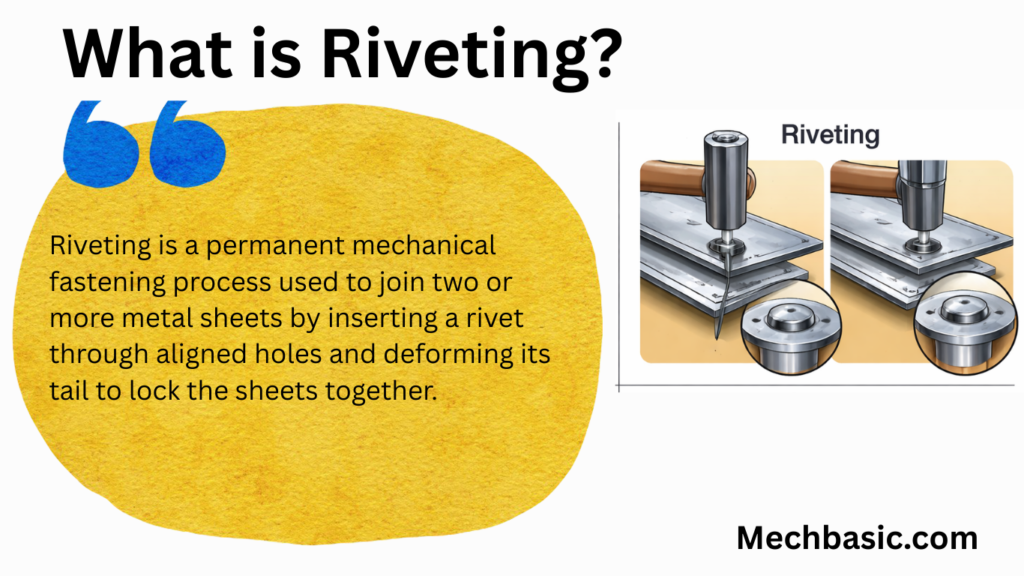
Riveting is a permanent mechanical fastening process used to join two or more metal sheets by inserting a rivet through aligned holes and deforming its tail to lock the sheets together.
👉 It is a permanent joint
👉 No heating required (in cold riveting)
👉 Widely used in sheet metal fabrication
Working Principle
Step-by-step Process:
- Holes are drilled or punched in sheets.
- Rivet is inserted through aligned holes.
- The tail (shank end) is hammered or pressed.
- A second head (shop head) is formed.
- Sheets are permanently fastened.
Main Components
1. Rivet
- Cylindrical shank
- Factory head (pre-formed)
- Tail end (deformed during riveting)
2. Riveting Tool
- Hammer (manual)
- Rivet gun
- Hydraulic riveting machine
3. Anvil / Dolly
- Supports rivet head during forming
Types of Rivets
1. Solid Rivet
Used in heavy-duty structures.
2. Blind Rivet (Pop Rivet)
Used when access is from one side only.
3. Tubular Rivet
Hollow inside, easier to deform.
4. Split Rivet
Used for light-duty applications.
Types of Riveted Joints
Lap Joint
Sheets overlap each other.
Butt Joint
Sheets are joined edge-to-edge using cover plate.
Important Terms
- Pitch (P) → Distance between rivets
- Margin (M) → Distance from edge
- Diameter (D) → Rivet diameter

Where t = thickness of sheet (mm)
Applications
- Aircraft structures
- Bridges
- Shipbuilding
- Boilers
- Metal cabinets
- Automotive panels
Advantages
✔ Strong and reliable joint
✔ No heat distortion
✔ Simple process
✔ Suitable for thin sheets
Disadvantages
✖ Permanent joint (cannot be disassembled)
✖ Requires hole drilling (weakens sheet slightly)
✖ Adds weight
✖ Labor intensive (manual riveting)
Riveting vs Welding
| Feature | Riveting | Welding |
|---|---|---|
| Type | Mechanical joint | Fusion joint |
| Heat Required | No (cold) | Yes |
| Disassembly | Difficult | Very difficult |
| Strength | Good | Very high |
Summary
- Riveting is a permanent mechanical fastening process.
- Used widely in aerospace and structural applications.
- Requires hole preparation.
- Lap and butt joints are common types.
- Rivet tail forms second head during operation.
Other courses:





