
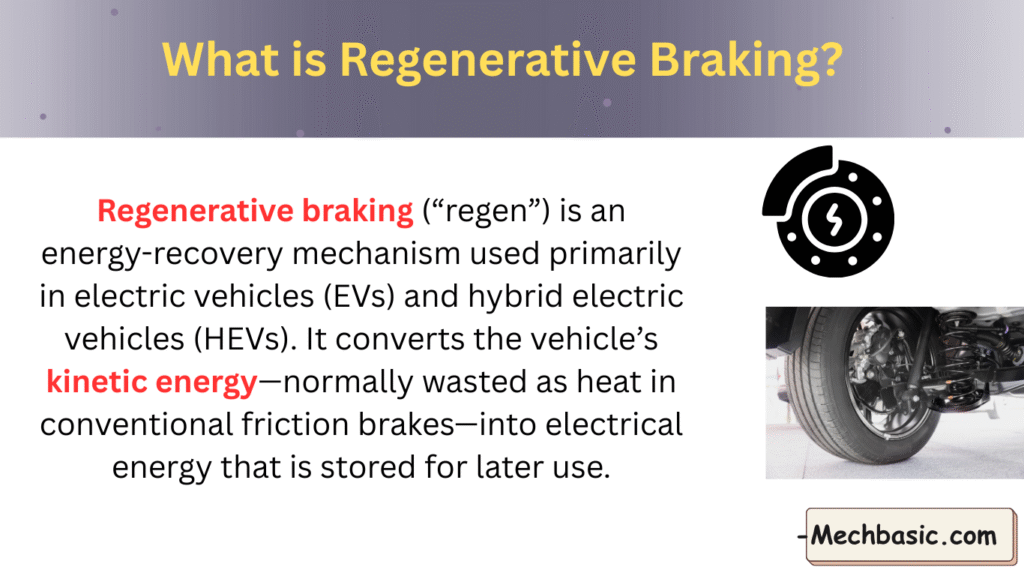
Regenerative braking is a system that captures and converts a vehicle’s kinetic energy into electrical energy during braking. Instead of wasting energy as heat, it stores the recovered power in a battery or capacitor.
This technology improves efficiency and extends the driving range of electric and hybrid vehicles.
In this article:
- What is a Regenerative Braking System?
- 1. Basic Principle of Regenerative Braking System
- 2. Components of Regenerative Braking System
- 3. How Regenerative Braking Works — Step-by-Step
- 4. Types of Regenerative Braking Strategies
- 5. Efficiency and Energy Recovery
- 6. Limitations of Regenerative Braking
- 7. Advantages
- 8. Applications Beyond Cars
- 9. Emerging Advancements
- 1. Basic Principle of Regenerative Braking System
- Summary
What is a Regenerative Braking System?
Regenerative braking (“regen”) is an energy-recovery mechanism used primarily in electric vehicles (EVs) and hybrid electric vehicles (HEVs). It converts the vehicle’s kinetic energy—normally wasted as heat in conventional friction brakes—into electrical energy that is stored for later use.
1. Basic Principle of Regenerative Braking System
1.1 Conventional Braking
- In a standard hydraulic friction brake system, brake pads create friction against a rotor.
- Kinetic energy → thermal energy (heat), all of it wasted.
- The brake system requires constant dissipation of heat and regular wear-component maintenance.
1.2 Regenerative Braking
- Uses the electric motor as a generator during deceleration.
- When the driver lifts off the accelerator or presses the brake pedal:
- The inverter changes the motor’s operation from motoring (using electricity) to generating (producing electricity).
- The rotating wheels drive the motor, which converts mechanical energy → electrical energy → stored in the battery.
- The motor, now acting as a generator, provides resistive torque that slows the vehicle down.
2. Components of Regenerative Braking System
2.1 Electric Motor / Generator
- Acts as both propulsion and energy-recovery device.
- Two common types:
- Permanent Magnet Synchronous Motor (PMSM) — High efficiency, excellent for regen.
- Induction Motor — Robust, slightly lower regen efficiency but still widely used.
2.2 Power Electronics / Inverter
- Controls the motor’s switching patterns.
- Reverses current flow during regeneration to feed energy back to the battery.
2.3 Battery Pack
- Must be capable of accepting high charge rates during short regen events.
- EV batteries have limits: temperature, State of Charge (SOC), and current acceptance rate affect regen strength.
2.4 Brake Controller (e-Booster or BCU)
- Coordinates friction brakes and regenerative braking.
- Implements brake-by-wire logic to provide smooth, consistent pedal feel.
2.5 Hydraulic Friction Brakes
- Still essential for:
- Emergency braking
- Low-speed stops
- When battery is full or too cold to accept regen
- High-deceleration demands
3. How Regenerative Braking Works — Step-by-Step
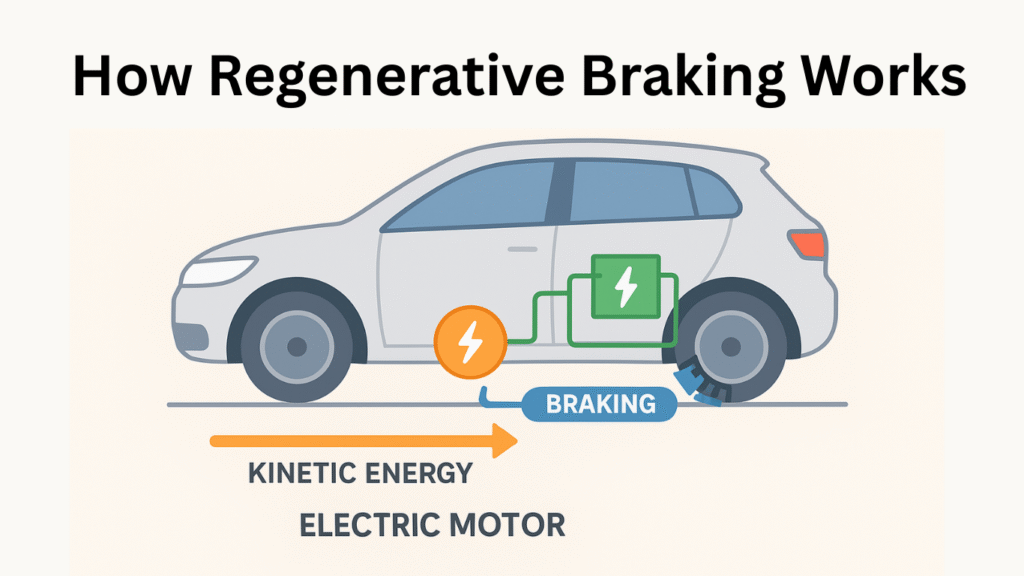
3.1 Driver lifts off the accelerator
- In EVs with “one-pedal driving,” lift-off automatically initiates regen.
- The motor generates electrical energy proportional to wheel rotation.
3.2 Driver presses the brake pedal
- The brake controller first commands the motor to increase regenerative torque.
- Only when regen is insufficient (based on driver request), friction brakes engage.
3.3 Energy Flow
- Wheel rotation → spins motor.
- Motor generates 3-phase AC electricity.
- Inverter converts AC → DC.
- Battery management system (BMS) regulates charging.
- Energy stored in battery.
4. Types of Regenerative Braking Strategies
4.1 Coasting Regen (Lift-off Regen)
- Initiated automatically when accelerator pedal is released.
- Creates the “engine braking” feel many EVs have.
4.2 Brake Pedal Regen (Blended Braking)
- Regen activated when brake pedal is applied.
- Brake controller mixes regenerative and mechanical braking seamlessly.
4.3 Predictive Regen
- Uses:
- Radar
- Camera
- GPS map data
- Traffic data
- Anticipates deceleration scenarios and maximizes recovery.
5. Efficiency and Energy Recovery
Typical Recovery Rates
- Real-world EVs recover 10–30% of total driving energy through regen.
- Efficiency depends on:
- Vehicle mass
- Driving cycle (city > highway)
- Battery temperature and SOC
- Motor type
Why City Driving Benefits More
- Frequent stop-and-go allows many regen events.
- Highway driving has fewer braking opportunities.
6. Limitations of Regenerative Braking
6.1 Battery Constraints
- Battery cannot accept high regen power when:
- SOC is near 100%
- Temperature is too low
- Temperature is too high
6.2 Low-speed Performance
- Motor generates little power below ~5–10 km/h.
- Friction brakes are required for final stop.
6.3 Maximum Deceleration Limits
- Regen alone cannot provide very high braking forces (~0.3 g typical).
- Hard braking always uses friction brakes.
6.4 Pedal Feel Challenges
- Brake-by-wire systems must mimic mechanical feel.
- Ensuring smooth blending is a complex control problem.
7. Advantages
- Higher energy efficiency and extended driving range.
- Reduced brake wear—fewer pad/rotor replacements.
- Reduced heat generation, improving system durability.
- Improved control with regeneration integrated into stability systems.
8. Applications Beyond Cars
8.1 Electric Bicycles / e-Scooters
- Limited regen due to low kinetic energy.
8.2 Trains & Light Rail
- Regen feeds energy back into the grid or on-board storage.
- Very high recovery rates.
8.3 Industrial Machinery
- Cranes, elevators, and hoists often regenerate energy while lowering loads.
9. Emerging Advancements
- Ultracapacitors for rapid charge–discharge cycles.
- Improved silicon carbide (SiC) inverters increasing regen efficiency.
- Four-motor EVs (e.g., torque-vectoring systems) allow highly optimized regen on each wheel.
- Mechanical kinetic energy storage (flywheels) used experimentally in motorsport.
Summary
Regenerative braking is a key enabler of EV efficiency. It recovers kinetic energy normally lost to heat and converts it into usable electrical energy. The system relies on coordinated operation between the motor, inverter, battery, and friction brakes, with modern vehicles using sophisticated controls to blend braking methods smoothly and maximize efficiency.
FAQ Section:
Here are 10 FAQs on Regenerative Braking Systems:
- What is a regenerative braking system?
It is a technology that recovers kinetic energy during braking and converts it into electrical energy for storage and reuse. - How does regenerative braking work?
The electric motor runs in reverse during braking, acting as a generator that produces electricity. - Which vehicles use regenerative braking?
It is commonly used in electric vehicles (EVs), hybrid vehicles, and some modern plug-in hybrids. - Does regenerative braking replace traditional brakes?
No. It works alongside conventional friction brakes for safety and additional stopping power. - What are the benefits of regenerative braking?
It improves energy efficiency, extends driving range, and reduces wear on mechanical brakes. - Does regenerative braking affect driving feel?
Yes. Drivers may feel stronger deceleration when lifting off the accelerator, depending on the system’s setting. - How much energy can be recovered?
Typically 10–30% of the vehicle’s energy, depending on driving conditions and system design. - Is regenerative braking effective at all speeds?
It is most effective at moderate to high speeds; at very low speeds, friction brakes take over. - Can regenerative braking improve battery life?
Yes. It reduces charging frequency and stress on the battery, indirectly contributing to longer battery life. - Does regenerative braking require special maintenance?
The regenerative system itself requires minimal maintenance, but the conventional braking system still needs regular checks.
Other courses:





