
Here is a complete and easy-to-understand explanation of Plug-in Hybrid Electric Vehicles (PHEVs) in detail:
In this article:
Plug-in Hybrid Electric Vehicle (PHEV):
A Plug-in Hybrid Electric Vehicle (PHEV) is a hybrid vehicle that has both:
- an internal combustion engine (ICE) and
- an electric motor with a rechargeable battery,
but unlike regular hybrids (HEVs), a PHEV can be charged by plugging into an external power source (home outlet or charging station).
This allows PHEVs to run significant distances on electric-only mode, reducing fuel consumption.
Examples: Toyota Prius Prime, Mitsubishi Outlander PHEV, Volvo XC90 T8, Hyundai Ioniq Plug-in.
1. How a PHEV Works
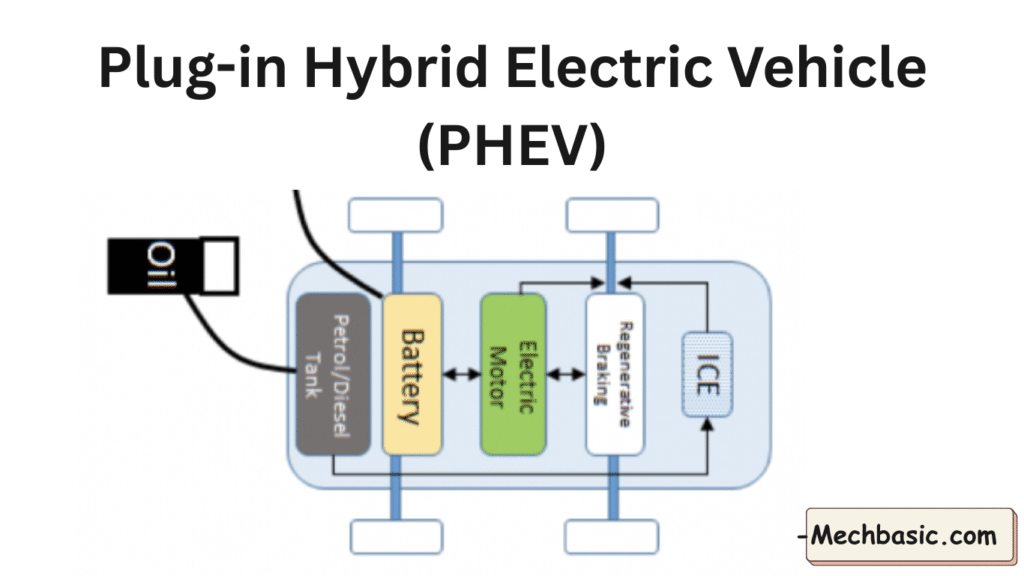
PHEVs combine the best of hybrid and electric systems:
1.1 High-Capacity Battery Pack
- Typically 8–20 kWh (much larger than HEVs).
- Provides 30–80 km of pure electric driving (varies by model).
- Lithium-ion battery usually.
1.2 Electric Motor
- Handles low-speed and medium-speed driving.
- Can power the car alone in EV mode.
1.3 Internal Combustion Engine
- Used when:
- Battery is depleted
- Higher power is needed
- Driver selects hybrid mode
1.4 Onboard Charger
- Converts AC from the grid to DC for charging the battery.
1.5 Charging Port
Supports:
- AC charging (Level 1 and Level 2)
- No DC fast charging for most PHEVs, because battery is small.
1.6 Power Electronics
Includes inverter, DC-DC converter, and hybrid control units.
2. Driving Modes in PHEVs
Most PHEVs provide multiple drive settings:
2.1 EV Mode (Electric-only)
- Motor uses battery power only.
- Zero emissions while driving.
- Range: 30–80 km (varies by vehicle).
2.2 Hybrid Mode (Combined)
- Engine + motor work together.
- Optimizes fuel efficiency.
2.3 Charge-Sustaining Mode
- Engine maintains battery at a minimum level.
- Used for long-distance travel.
2.4 Regenerative Braking
- Converts kinetic energy → electricity
- Recharges the battery during braking or coasting.
3. Types of PHEV Architectures
3.1 Series PHEV
- Engine does not power wheels.
- Engine generates electricity for motor and battery.
- Example: BMW i3 REx (range extender).
3.2 Parallel PHEV
- Engine and motor can both power the wheels.
- Very common layout.
3.3 Series-Parallel (Power-Split) PHEV
- Uses planetary gear system.
- Either or both power sources can drive wheels.
- Example: Toyota Prius Prime.
4. Charging PHEVs
AC Charging Levels
Level 1:
- Standard home outlet
- 1–2 kW
- Charging time: 5–10 hours
Level 2:
- Wall charger
- 3.7–7.4 kW
- Charging time: 2–4 hours
🔍 Note:
Most PHEVs do not support DC fast charging, because battery packs are small.
5. Advantages of PHEVs
5.1 Significant Fuel Savings
- Daily short trips can be 100% electric.
- Many people drive weeks without using gasoline.
5.2 Lower Emissions
- EV mode produces zero tailpipe emissions.
5.3 No Range Anxiety
- Even if the battery is empty, engine powers the car normally.
5.4 Flexible for All Driving Styles
- Best of both worlds: electric for city, hybrid for long trips.
5.5 Lower Running Costs
- Cheaper energy (electricity vs. gasoline) for daily commuting.
6. Limitations of PHEVs
6.1 Higher Purchase Price
- Larger battery + hybrid system increases cost.
6.2 Requires Charging for Best Benefits
- If not plugged in regularly, fuel economy is similar to HEVs.
6.3 More Complex Powertrain
- Engine + motor + larger battery = more components.
6.4 Heavier
- Larger battery adds weight → may reduce efficiency when battery is empty.
6.5 Emissions Still Exist
- Not a fully electric vehicle.
- Engine still produces CO₂ and pollutants.
7. Battery Technology in PHEVs
Most PHEVs use:
- Lithium-ion batteries
- Energy capacity: 8–20 kWh
- Air-cooled or liquid-cooled systems, depending on model.
Battery characteristics:
- Designed for both energy storage and power delivery
- More durable than HEV batteries
- Typically covered by long warranties (8–10 years)
8. Future of PHEVs
- Increasing electric-only range (50–100+ km)
- Faster AC charging systems
- Improved battery life and cooling
- Transition toward BEVs in many markets
- Governments reducing incentives for PHEVs in favor of BEVs
Summary
A Plug-in Hybrid Electric Vehicle (PHEV):
- Uses a motor + engine.
- Has a large battery that can be charged from external power.
- Offers electric-only driving for daily distances.
- Reduces fuel consumption and emissions.
- Still uses gasoline and has a more complex system than BEVs.
Other courses:





