
Parting, also known as cut-off, is a lathe operation used to separate a finished part from the remaining workpiece. A thin, narrow cutting tool is fed radially into the rotating workpiece until the material is completely cut through.
This operation is commonly used at the final stage of machining and requires precise tool alignment to ensure a clean and accurate separation.
In this article:
- Parting (Cut-Off) Operation in Lathe Machining
- 1. What is Parting (Cut-Off)?
- 2. Purpose of Parting
- 3. Principle of Parting
- 4. Parting Tools
- 5. Parting Operation Setup
- 6. Steps in Parting Operation (Manual Lathe)
- 7. Cutting Parameters (Typical)
- 8. Common Problems & Remedies
- 9. Advantages
- 10. Limitations
- 11. Applications
- 12. Difference Between Parting and Grooving
- 13. Safety Precautions
Parting (Cut-Off) Operation in Lathe Machining
1. What is Parting (Cut-Off)?
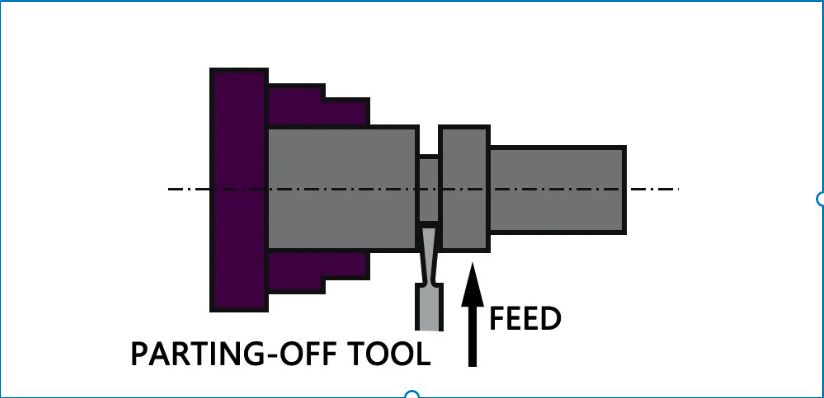
Parting, also called cut-off, is a lathe machining operation used to separate a finished component from the parent bar or workpiece.
The cutting tool is fed radially inward until the workpiece is completely cut through.
2. Purpose of Parting
- To cut a workpiece to required length
- To separate finished parts
- To remove excess material
- To prepare blanks for further machining
3. Principle of Parting
- The workpiece rotates in the spindle.
- A narrow parting tool is fed perpendicular to the axis of rotation.
- Material is removed progressively until separation occurs.
4. Parting Tools
- Single-Point Parting Tool
- Very narrow cutting edge
- HSS or carbide
- Blade-Type Parting Tool
- Replaceable blade
- Better rigidity
- Indexable Insert Parting Tool
- Used in CNC lathes
- High precision and tool life
Tool geometry:
- Tool width as small as possible
- Proper clearance angles
- Sharp cutting edge
- Slight front rake
5. Parting Operation Setup
- Work holding: 3-jaw chuck (short overhang preferred)
- Tool setting:
- Tool tip at exact center height
- Tool must be perfectly perpendicular to work axis
- Tool overhang: Minimum possible
- Coolant: Strongly recommended
6. Steps in Parting Operation (Manual Lathe)
- Secure the workpiece firmly in the chuck.
- Set the parting tool at center height.
- Position the tool at required cut-off location.
- Start the lathe at suitable speed (lower than turning).
- Feed the tool slowly and steadily inward.
- Apply coolant continuously.
- Reduce feed near the center.
- Complete the cut and stop the machine.
7. Cutting Parameters (Typical)
- Cutting speed: 30–50% of turning speed
- Feed: 0.03–0.08 mm/rev
- Depth of cut: Full radius (gradual feed)
- Coolant: Essential to prevent tool seizure
8. Common Problems & Remedies
| Problem | Cause | Remedy |
|---|---|---|
| Tool breakage | Excess feed, misalignment | Reduce feed, align tool |
| Chatter | Poor rigidity | Reduce overhang, tighten setup |
| Tool jamming | Chip clogging | Use coolant, peck cutting |
| Rough cut surface | Blunt tool | Sharpen or replace tool |
9. Advantages
- Accurate separation of parts
- Simple and economical
- Suitable for mass production (CNC)
10. Limitations
- High cutting forces
- Risk of tool breakage
- Requires careful setup
11. Applications
- Cutting rods and bars
- Mass production of small components
- Automotive and machine parts
12. Difference Between Parting and Grooving
| Parting | Grooving |
|---|---|
| Separates workpiece | Produces a groove |
| Full depth cut | Partial depth cut |
| Final operation | Intermediate operation |
13. Safety Precautions
- Always use coolant
- Stand slightly away during cut-off
- Do not stop feed suddenly
- Keep tool sharp and rigid
Other courses:





