
Here’s a clear and useful comparison between old (traditional) helms and modern helms:
In this article:
Old Helms Vs Modern Helms:
The helm is the entire system used to steer a ship or boat. It includes the controls, mechanisms, and sometimes even the person steering. Here’s a detailed breakdown:
1. Steering Mechanism
Old Helms
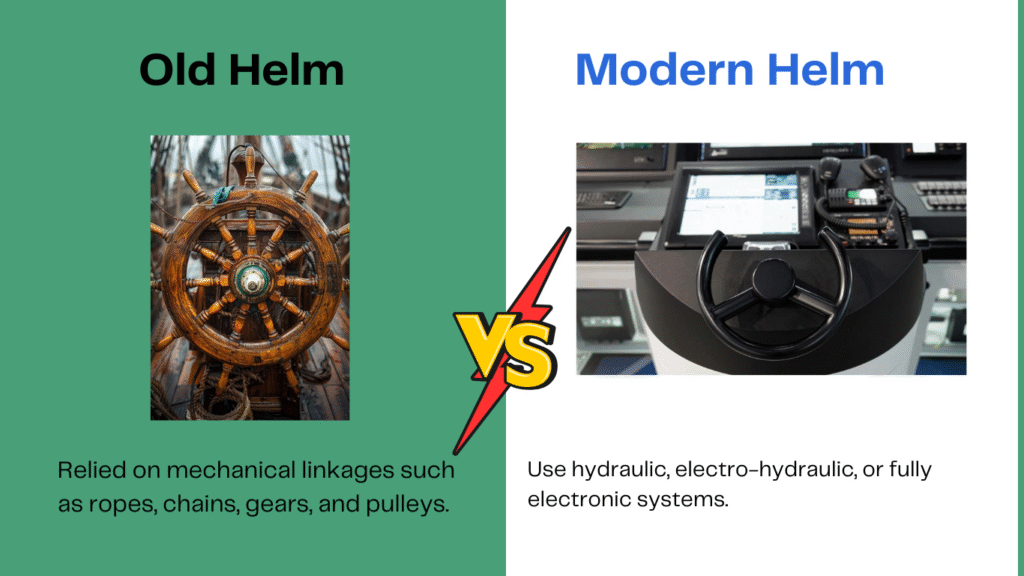
- Relied on mechanical linkages such as ropes, chains, gears, and pulleys.
- Steering was manual and required physical effort.
- Movement of the wheel had a direct, mechanical effect on the rudder.
- Response time was slower and less precise, especially on large ships.
Modern Helms
- Use hydraulic, electro-hydraulic, or fully electronic systems.
- Often include servo motors and hydraulic rams to move the rudder.
- Steering is usually power-assisted, making it effortless.
- Provides fast, precise rudder angles even on massive vessels.
2. Helm Controls
Old Helms
- Classic wooden ship’s wheel with multiple spokes.
- No electronic screens or instruments attached.
- The helmsman relied on compass, lookout, and verbal commands.
Modern Helms
- Often resemble a car-like wheel, a joystick, or a small ergonomic wheel.
- Integrated with:
- GPS navigation
- Radar
- Sonar
- Autopilot systems
- Electronic engine controls
- Everything is centralized at a helm console.
3. Navigation and Information
Old Helms
- Relied on:
- Magnetic compass
- Stars (celestial navigation)
- Landmarks
- Helmsman’s experience
- Little to no real-time data.
Modern Helms
- Digital displays: GPS charts, AIS (ship identification), depth sounders.
- Real-time weather, route planning, radar overlays.
- Autopilot maintains course with high precision.
4. Location and Structure
Old Helms
- Often located on open decks or in exposed positions.
- Vulnerable to weather (wind, sea spray).
- Sometimes placed far from the captain’s quarters.
Modern Helms
- Located in a protected wheelhouse or bridge.
- Climate-controlled, comfortable, with multiple stations.
- Often includes backup helm positions fore and aft.
5. Steering Role
Old Helms
- Required a skilled helmsman dedicated to steering.
- Commands were given verbally or through a ship’s bell system.
Modern Helms
- Autopilot handles most of the steering.
- Human helmsman steers only during:
- Docking
- Emergency maneuvers
- Narrow passages
- Officers control navigation from bridge consoles.
6. Reliability & Safety
Old Helms
- Mechanical systems could break, jam, or be damaged in storms.
- Weather could directly affect the helmsman and controls.
Modern Helms
- Redundant systems (backup electronics, manual overrides).
- Steering remains operational even if a component fails.
- Better visibility and real-time awareness.
Summary Table
| Feature | Old Helm | Modern Helm |
|---|---|---|
| Steering Type | Mechanical | Hydraulic/Electronic |
| Controls | Wooden wheel | Wheel, joystick, screens |
| Navigation Tools | Compass, stars | GPS, radar, autopilot |
| Location | Exposed deck | Protected bridge |
| Effort Required | High | Low |
| Precision | Moderate | Very high |
| Reliability | Simple but vulnerable | Redundant and robust |
Other courses:





