In this article:
Non ferrous metals
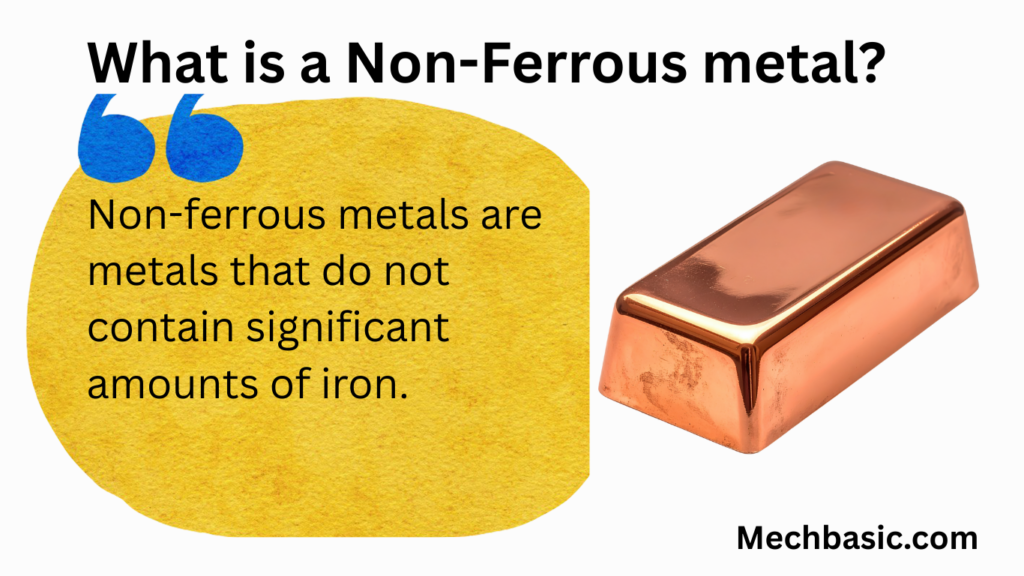
Non-ferrous metals are metals that do not contain significant amounts of iron.
They are usually corrosion-resistant, lightweight, and good conductors of heat and electricity.
Common examples include aluminum, copper, lead, zinc, and gold.
Non-ferrous metals are widely used in aerospace, electrical, construction, and jewelry industries.
Here’s a detailed explanation of non-ferrous metals, covering definitions, types, properties, examples, uses, and comparisons with ferrous metals.
1. Definition of Non-Ferrous Metals
Non-ferrous metals are metals that do not contain significant amounts of iron (Fe).
Key characteristics:
- Do not rust like iron or steel
- Usually lighter than ferrous metals
- Good electrical and thermal conductivity
- Corrosion-resistant
- Often malleable and ductile
Examples: Aluminum, copper, lead, zinc, tin, nickel, gold, silver, platinum, titanium
2. Types of Non-Ferrous Metals
2.1 Light Metals
- Aluminum (Al)
- Lightweight, corrosion-resistant, good conductivity
- Applications: Aircraft bodies, automobile parts, packaging (cans, foils)
- Magnesium (Mg)
- Extremely lightweight, low density
- Applications: Aerospace, automotive, laptop casings
2.2 Heavy Metals
- Copper (Cu)
- Excellent electrical and thermal conductivity
- Applications: Electrical wiring, pipes, roofing
- Lead (Pb)
- Heavy, soft, corrosion-resistant
- Applications: Batteries, radiation shielding, soldering
- Zinc (Zn)
- Corrosion-resistant, used for galvanizing
- Applications: Coatings, die-casting, alloys (brass)
- Tin (Sn)
- Soft, corrosion-resistant
- Applications: Coatings (tin cans), alloys (bronze)
2.3 Precious Metals
- Gold (Au)
- Non-corrosive, malleable, ductile
- Applications: Jewelry, electronics, investment, dentistry
- Silver (Ag)
- Excellent electrical and thermal conductivity
- Applications: Jewelry, electronics, coins, mirrors
- Platinum (Pt)
- High melting point, corrosion-resistant
- Applications: Catalysts, jewelry, laboratory equipment
- Rhodium (Rh)
- Extremely rare, very high corrosion resistance
- Applications: Catalytic converters, plating jewelry
2.4 Special Metals / High-Performance
- Titanium (Ti)
- Strong, lightweight, corrosion-resistant
- Applications: Aerospace, medical implants, sports equipment
- Nickel (Ni)
- Corrosion-resistant, high melting point
- Applications: Stainless steel alloying, batteries, coins
3. Properties of Non-Ferrous Metals
- Corrosion Resistance: Do not rust like iron
- Lightweight: Aluminum, magnesium
- High Conductivity: Copper, silver
- High Malleability & Ductility: Gold, silver, copper
- High Melting Points: Titanium, platinum
- Non-Magnetic: Most non-ferrous metals are non-magnetic (except nickel and cobalt)
- Recyclable: Many non-ferrous metals can be reused
4. Advantages of Non-Ferrous Metals
- Lightweight (important in aerospace & transport)
- Excellent corrosion resistance
- Good electrical & thermal conductivity
- Non-magnetic for certain applications
- High strength-to-weight ratio (aluminum, titanium)
- Can be alloyed to improve properties
5. Disadvantages of Non-Ferrous Metals
- Generally more expensive than ferrous metals
- Lower tensile strength (except for alloys like titanium)
- Some metals (like copper and lead) are heavy and soft
- High cost for precious metals (gold, platinum, rhodium)
- Some are difficult to machine (titanium)
6. Common Applications
| Metal | Key Properties | Applications |
|---|---|---|
| Aluminum | Lightweight, corrosion-resistant | Aircraft, packaging, automotive |
| Copper | Excellent conductivity | Electrical wiring, plumbing |
| Lead | Heavy, corrosion-resistant | Batteries, radiation shielding |
| Zinc | Corrosion-resistant | Galvanizing, die-casting |
| Tin | Soft, corrosion-resistant | Coatings, bronze alloy |
| Nickel | Corrosion-resistant, high temp | Stainless steel, batteries |
| Titanium | Strong, lightweight | Aerospace, implants |
| Gold | Malleable, corrosion-resistant | Jewelry, electronics |
| Silver | Conductive, reflective | Electronics, mirrors, coins |
| Platinum | Corrosion-resistant | Catalysts, jewelry |
| Rhodium | Rare, corrosion-resistant | Catalytic converters, plating |
7. Difference Between Ferrous and Non-Ferrous Metals
| Feature | Ferrous Metals | Non-Ferrous Metals |
|---|---|---|
| Iron Content | High | Negligible |
| Rusting | Prone to rust | Corrosion-resistant |
| Density | Usually high | Varies (light/heavy) |
| Magnetic Properties | Magnetic (mostly) | Usually non-magnetic |
| Strength | High tensile strength | Moderate to high (depends on alloy) |
| Cost | Usually lower | Higher |
| Examples | Iron, steel, cast iron | Aluminum, copper, gold, titanium |
8. Conclusion
Non-ferrous metals are critical for modern engineering, electronics, aerospace, and jewelry due to their corrosion resistance, lightweight nature, and excellent conductivity.
They are more expensive than ferrous metals but are preferred where performance, durability, or weight savings are important.
Other courses: