
In this article:
Milling Process
What is Milling?
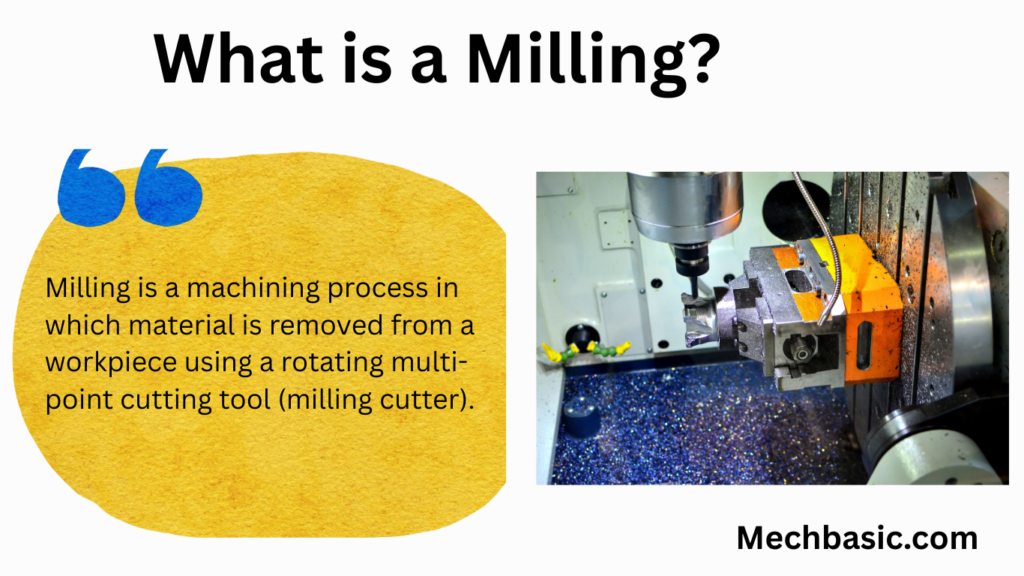
Milling is a machining process in which material is removed from a workpiece using a rotating multi-point cutting tool (milling cutter).
The cutter rotates at high speed, and the workpiece is fed against it to produce flat, stepped, contoured, or complex surfaces.
Milling can be performed on manual milling machines or CNC milling machines.
Principle of Milling
- The cutting tool rotates
- The workpiece remains stationary or moves slowly
- Material is removed in the form of chips
- Cutting occurs due to relative motion between tool and workpiece
Main Motions in Milling
1. Cutting Motion
- Rotary motion of the milling cutter
- Provided by the spindle
2. Feed Motion
- Linear motion of the workpiece or tool
- Can be in X, Y, or Z direction
3. Depth of Cut
- Thickness of material removed in one pass
Types of Milling Machines
1. Column and Knee Type
- Vertical milling machine
- Horizontal milling machine
- Universal milling machine
2. Bed Type Milling Machine
- Simplex
- Duplex
- Triplex
3. CNC Milling Machine
- 3-axis, 4-axis, and 5-axis machines
- High accuracy and automation
Types of Milling Operations
1. Plain (Slab) Milling
- Produces flat horizontal surfaces
- Cutter axis parallel to workpiece surface
2. Face Milling
- Produces flat surfaces using face mill
- Cutter axis perpendicular to surface
3. End Milling
- Uses end mills
- Can produce slots, pockets, and profiles
4. Side Milling
- Used to cut slots and grooves
- Cutter has teeth on sides
5. Slot Milling
- Produces keyways, T-slots, and straight slots
6. Angular Milling
- Produces angled surfaces
- Uses single or double-angle cutters
7. Form Milling
- Produces irregular profiles using form cutters
8. Gang Milling
- Multiple cutters mounted on one arbor
- High productivity
9. Straddle Milling
- Two side cutters machine parallel surfaces simultaneously
Types of Milling Cutters
- Plain milling cutter
- Face milling cutter
- End mill
- Side and face cutter
- T-slot cutter
- Angle cutter
- Form cutter
- Fly cutter
Milling Parameters
1. Cutting Speed (V)
- Speed at which cutter rotates
- Depends on material and cutter type
2. Feed Rate (f)
- Distance moved per revolution or per tooth
3. Depth of Cut (d)
- Thickness of material removed
Up Milling vs Down Milling
| Feature | Up Milling (Conventional) | Down Milling (Climb) |
|---|---|---|
| Feed direction | Against cutter rotation | Same as cutter rotation |
| Tool wear | More | Less |
| Surface finish | Poor | Better |
| Machine requirement | Low rigidity | High rigidity |
Advantages of Milling
✔ High accuracy
✔ Versatile operation
✔ Suitable for complex shapes
✔ High material removal rate
Disadvantages of Milling
❌ High machine cost
❌ Tool wear
❌ Skilled operator required
Applications of Milling
- Automotive parts
- Aerospace components
- Mold and die making
- Slots, gears, and profiles
- Flat and contoured surfaces
Milling in CNC Machines
- Fully automated
- High repeatability
- Complex toolpaths possible
- CAD/CAM integration
Conclusion:
Milling removes material using a rotating cutter to create flat or complex shapes.
Other courses:





