
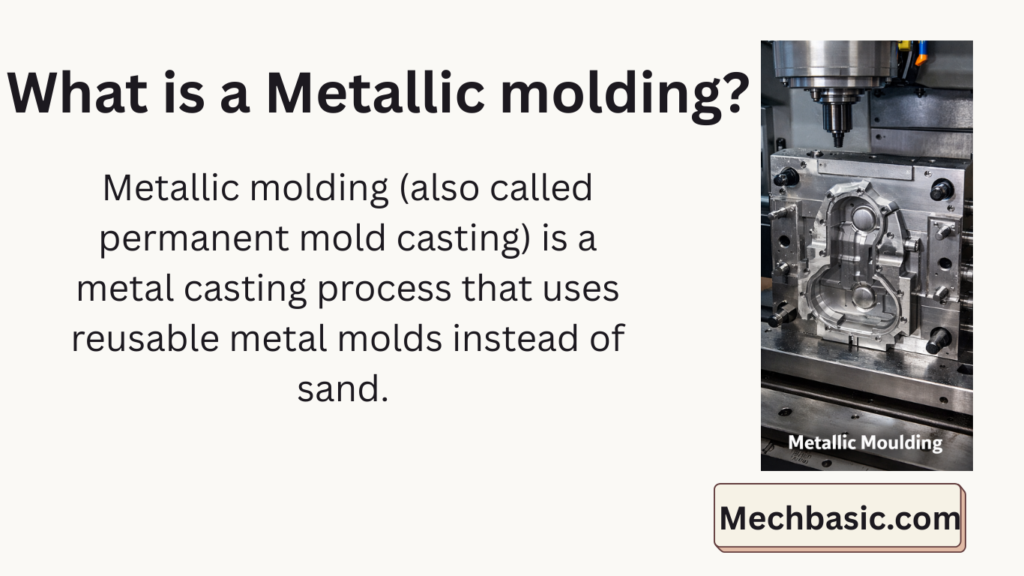
Metallic molding (also called permanent mold casting) is a metal casting process that uses reusable metal molds instead of sand.
Molten metal is poured into the metallic mold, where it cools and solidifies quickly, producing castings with better surface finish, higher accuracy, and improved mechanical properties. This method is well-suited for high-volume production of non-ferrous metal parts like aluminum and magnesium.
In this article:
- Metallic Moulding (Permanent Mould Casting)
- Materials Used for Metallic Moulds
- Construction of a Metallic Mould
- Metallic Moulding Process (Step-by-Step)
- Types of Metallic Moulding
- Advantages of Metallic Moulding
- Disadvantages
- Metals Commonly Used
- Applications
- Comparison: Sand Moulding vs Metallic Moulding
- Defects in Metallic Moulding
- Other courses:
Metallic Moulding (Permanent Mould Casting)
Metallic moulding is a casting process in which the mould is made of metal (usually cast iron or steel) and is reusable. Molten metal is poured into the metallic mould, allowed to solidify, and then the casting is removed without destroying the mould.
👉 Because the mould is permanent, this process is also called Permanent Mould Casting.
Materials Used for Metallic Moulds
- Cast iron
- Steel
- Copper alloys (for high thermal conductivity)
- Sometimes graphite inserts (for wear resistance)
Construction of a Metallic Mould
A metallic mould generally consists of:
- Two or more halves (split mould)
- Gating system (sprue, runner, gate)
- Risers (if required)
- Ejector pins (to remove casting)
- Core inserts (metal or sand cores for hollows)
- Cooling channels (in some designs)
- Mould coating (graphite, silica, or refractory coating)
Metallic Moulding Process (Step-by-Step)
1️⃣ Mould Preparation
- Mould surfaces are cleaned.
- Refractory coating is applied to:
- Prevent sticking
- Control cooling rate
- Improve surface finish
2️⃣ Preheating of Mould
- Mould is preheated (150–300°C approx.)
- Prevents thermal shock
- Ensures smooth metal flow
3️⃣ Assembly of Mould
- Two halves are closed and clamped.
- Cores (if any) are positioned.
4️⃣ Pouring of Molten Metal
- Molten metal is poured by gravity or low pressure.
- Metal fills the cavity quickly due to smooth walls.
5️⃣ Solidification & Cooling
- Faster cooling compared to sand moulds.
- Results in fine grain structure.
6️⃣ Opening of Mould
- Mould halves are separated.
- Casting is ejected using ejector pins.
7️⃣ Finishing Operations
- Removal of gates and risers
- Minor machining
- Surface finishing
Types of Metallic Moulding
- Gravity Die Casting
- Molten metal flows by gravity only
- Low Pressure Die Casting
- Metal is forced upward using low air pressure
- Slush Casting
- Used for hollow decorative parts
- Die Casting (special case)
- Molten metal injected under high pressure
Advantages of Metallic Moulding
✔ Reusable mould
✔ Good surface finish
✔ High dimensional accuracy
✔ Faster production rate
✔ Fine grain structure
✔ Less machining required
Disadvantages
❌ High initial mould cost
❌ Not suitable for very complex shapes
❌ Limited to low-melting metals
❌ Difficult to cast steel or cast iron
Metals Commonly Used
- Aluminium alloys
- Magnesium alloys
- Zinc alloys
- Copper alloys
Applications
- Pistons
- Cylinder heads
- Automotive wheels
- Pump bodies
- Electrical fittings
- Cookware
Comparison: Sand Moulding vs Metallic Moulding
| Feature | Sand Moulding | Metallic Moulding |
|---|---|---|
| Mould type | Disposable | Reusable |
| Surface finish | Poor | Good |
| Accuracy | Low | High |
| Production rate | Low | High |
| Cost (initial) | Low | High |
Defects in Metallic Moulding
- Hot tears
- Shrinkage porosity
- Misrun
- Sticking of casting
- Thermal fatigue cracks in mould
Other courses:





