
Metal Drawing Process is a metal forming operation in which a sheet metal blank is pulled into a die cavity using a punch to produce hollow or cup-shaped components.
In this process, the metal undergoes plastic deformation without significant change in thickness. It is commonly used to manufacture parts like cans, kitchen sinks, automobile body panels, and cylindrical containers.
Metal drawing is widely used in mass production because it provides high accuracy, smooth surface finish, and efficient material utilization.
In this article:
- Metal Drawing Process
- 1. Principle of Metal Drawing
- 2. Types of Metal Drawing
- 3. Metal Drawing Equipment
- 4. Working Steps in Metal Drawing
- 5. Drawing Dies
- 6. Parameters Affecting Metal Drawing
- 7. Defects in Metal Drawing
- 8. Advantages of Metal Drawing
- 9. Limitations
- 10. Applications
- 11. Comparison with Extrusion
Metal Drawing Process
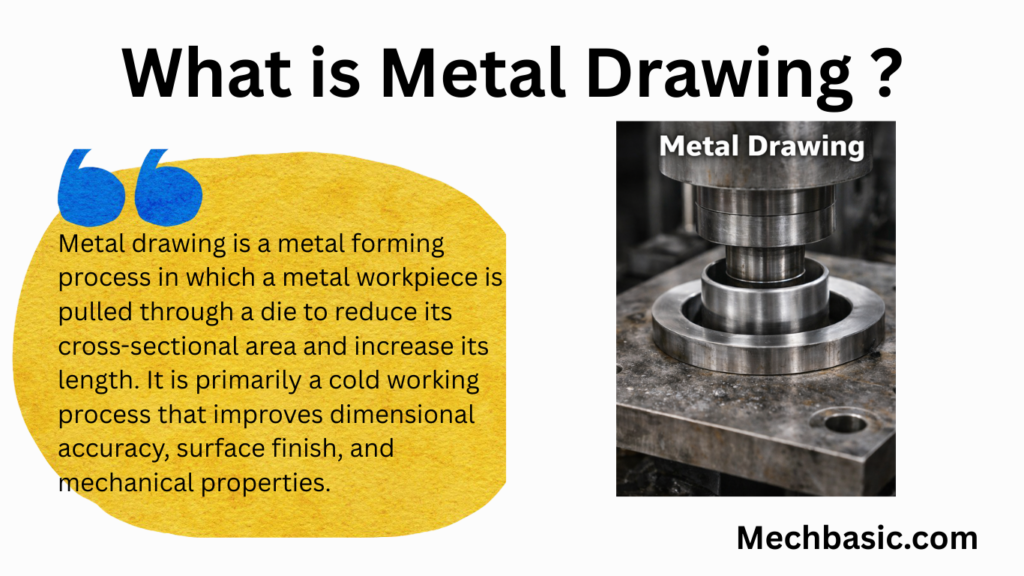
Metal drawing is a metal forming process in which a metal workpiece is pulled through a die to reduce its cross-sectional area and increase its length. It is primarily a cold working process that improves dimensional accuracy, surface finish, and mechanical properties.
Unlike extrusion, which uses compressive forces, metal drawing relies on tensile forces applied to the workpiece.
1. Principle of Metal Drawing
- Metal is subjected to tensile stress.
- Workpiece is pulled through a converging die.
- Plastic deformation reduces cross-sectional area.
- Material flows along the axis of drawing.
- For wires, rods, and tubes, the die shape determines the final dimensions.
2. Types of Metal Drawing
Metal drawing can be classified based on product type and drawing method:
2.1 Wire Drawing
- Produces small-diameter wires.
- Wire is drawn through successive dies to achieve the desired size.
- Intermediate annealing restores ductility.
- Applications: Electrical wires, cables, springs, fasteners.
2.2 Rod and Bar Drawing
- Produces larger diameter rods or bars.
- Drawn on a drawing bench using single or multiple passes.
- Applications: Shafts, structural bars, bolts, rods.
2.3 Tube Drawing
- Produces hollow tubes.
- Can be done with or without mandrel/plug.
- Applications: Heat exchanger tubes, automotive tubes, boiler tubes.
2.4 Sheet or Deep Drawing
- Produces hollow shapes from flat sheets.
- Involves punch and die.
- Applications: Beverage cans, automotive panels, kitchen utensils.
2.5 Hydrostatic Drawing
- Uses pressurized fluid around the workpiece.
- Reduces friction and allows brittle materials to be drawn.
- Applications: Tungsten wires, special alloys.
2.6 Continuous Drawing
- High-speed automatic process.
- Multiple dies arranged in sequence.
- Applications: Industrial wires, fine metal rods.
3. Metal Drawing Equipment
Common Components:
- Die: Controls final shape.
- Drawing bench or machine: Pulls metal through die.
- Gripping mechanism: Tongs or clamps.
- Lubrication system: Reduces friction and wear.
- Mandrel/plug: Used for tubes to control ID and wall thickness.
4. Working Steps in Metal Drawing
- Preparation
- Metal cleaned, pointed, or tapered for entry.
- Lubrication
- Applied to reduce friction and improve finish.
- Drawing
- Workpiece pulled through die.
- Intermediate Annealing
- Done for work-hardened materials to restore ductility.
- Finishing
- Straightening, cutting, coiling, inspection.
5. Drawing Dies
Materials:
- Tungsten carbide
- Diamond (for fine wires)
- Tool steel
Die Geometry:
- Entry angle (cone): Controls force
- Bearing length: Controls dimensional accuracy
- Exit angle: Smooths metal flow
6. Parameters Affecting Metal Drawing
| Parameter | Effect |
|---|---|
| Reduction per pass | Limits thinning and prevents cracking |
| Die angle | Affects drawing force and surface quality |
| Lubrication | Reduces friction and improves finish |
| Speed | Affects surface quality and temperature |
| Temperature | Cold drawing increases strength via work hardening |
7. Defects in Metal Drawing
| Defect | Cause |
|---|---|
| Central bursting | Excessive reduction per pass |
| Surface scratches | Poor lubrication or dirty die |
| Die marks | Worn die or misalignment |
| Fracture | High tensile stress |
| Eccentricity | Misaligned setup |
8. Advantages of Metal Drawing
- Excellent dimensional accuracy
- Improved surface finish
- Enhanced mechanical properties (work hardening)
- High production rate for wires and tubes
- Material conservation
9. Limitations
- Limited reduction per pass
- Intermediate annealing required
- High initial tooling cost
- Tensile stresses can cause failure
- Not suitable for brittle metals (unless hydrostatic)
10. Applications
- Wire Drawing: Electrical cables, springs, musical strings
- Rod/Bar Drawing: Shafts, bolts, structural bars
- Tube Drawing: Heat exchangers, automotive, medical tubing
- Sheet Drawing: Cans, cups, automotive panels
- Hydrostatic Drawing: Tungsten or brittle alloys
11. Comparison with Extrusion
| Aspect | Metal Drawing | Extrusion |
|---|---|---|
| Stress | Tensile | Compressive |
| Force direction | Pulling | Pushing |
| Cross-section | Constant | Constant |
| Surface finish | Excellent | Moderate |
| Dimensional accuracy | High | Moderate |
12. Summary
Metal drawing is a precision forming process widely used to produce wires, rods, bars, tubes, and hollow components. By pulling the metal through a die under tensile stress, dimensional accuracy, surface finish, and mechanical properties are significantly improved. Proper control of die design, lubrication, and reduction per pass ensures defect-free components.
Other courses:





