
“MC engine” and “MCC engine” are terms used in the marine engineering world, especially with MAN B&W two-stroke low-speed diesel engines (the huge engines used on container ships, tankers, and bulk carriers).
These are not automotive engines—they are ship propulsion engines.
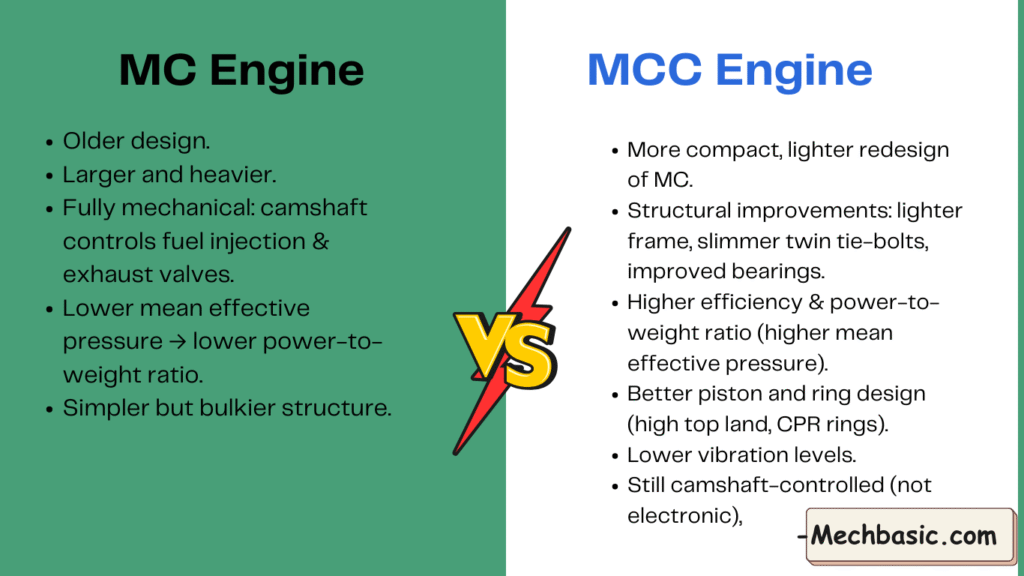
Below is a clear and detailed explanation.
In this article:
1. What is an MC engine?
MC stands for Mechanically Controlled.
It refers to an older generation of MAN B&W low-speed two-stroke marine diesel engines
where Control of:
- Fuel injection
- Exhaust valve timing
- Cylinder lubrication
- Governor operation
…is done mechanically, mostly via:
- Camshaft
- Mechanical pumps
- Linkages
- Timing gears
Typical design characteristics:
- Large camshaft running the length of the engine
- Fuel pumps driven by cams
- Exhaust valves actuated mechanically
- No electronic control of timing
- Lower flexibility for fuel efficiency improvements
Production era:
1980s through early 2000s (though many remain in service today).
Example engine models:
- S50MC
- S60MC
- S70MC
- S80MC
- K98MC
These engines power thousands of merchant ships.
2. What is an MCC engine?
MCC stands for MC-C, meaning Mechanically Controlled – Camshaft (sometimes written MC-C).
It is the improved version of the MC engine.
The “C” version included upgrades:
- Improved fuel consumption
- Lower NOₓ emissions
- Enhanced turbocharging
- Better cylinder lubrication systems
- Improved combustion chamber geometry
- Higher efficiency
- Revised exhaust system
- Improved materials for longer component life
Still mechanically controlled
MCC engines still use a camshaft, but they incorporate more modern mechanical and hydraulic systems compared to early MC engines.
Era:
Late 1990s to mid-2000s
Eventually replaced by ME and ME-C (electronically controlled) engines.
Example models:
- S60MC-C
- S70MC-C
- K98MC-C
3. MC VS MCC engine- 8 Differences:
1. Size / Compactness
MC-C engines are more compact: the block height is reduced, and the overall engine design is made for more space-efficient installation.
This compactness helps for ships with limited engine-room space, e.g., container vessels.
2. Power-to-Weight Ratio
MC-C engines have higher mean effective pressure for the same bore and speed, meaning more power output relative to their size.
Use of thinner-walled bearings (in MC-C) reduces weight.
3. Structural Design / Components
MC-C has simplified frame structure, making it easier to manufacture (weld, assemble).
The number and design of tie-bolts are optimized in MC-C: reduced-diameter twin tie-bolts instead of larger ones.
High piston top land: MC-C uses a piston with a “high top land” to protect the top piston ring from very high combustion temperatures.
Piston rings in MC-C are Controlled-Pressure-Relief (CPR) type, reducing pressure drop across the ring gap, preventing ring collapse, and improving sealing.
4. Camshaft and Valve / Injection Control
Both MC and MC-C use a mechanical camshaft: this camshaft controls fuel injection timing (via cam-operated fuel pumps) and exhaust valves.
In MC-C, the camshaft system is retained; there is no full electronic or hydraulic control as in more modern “ME” engines.
Fuel injection: each cylinder has its own plunger-type injection pump, driven by the cam.
Exhaust valves are actuated hydraulically (open via hydraulics) and closed by an air spring.
5. Lubrication System
MC-C offers flexibility in lubrication: either a uni-lube oil system (serving crankshaft, camshaft, piston cooling, chain drive) or a system with separate lube for camshaft + main lube oil system.
For cylinder lubrication, MC-C uses Alpha lubricators (electronically controlled) for lower lube oil consumption; mechanical lubricators can also be used.
6. Vibration / Dynamics
Because of reduced mass (lighter moving parts in MC-C), the second-order vibrational moments are lower (~8% reduction mentioned), improving engine vibration characteristics.
7. Cost / Efficiency
MC-C was designed to reduce both material cost (lighter, simpler structure) and operational cost, while maintaining or improving efficiency.
The design changes (bearings, tie-rods, simpler frame) lead to better maintenance / assembly economy.
8. Flexibility / Control
MC-C (being mechanically controlled) has more limited flexibility compared to electronically controlled engines (like ME-C). For example, injection timing and valve timing are fixed by cam geometry; you can tune only to a limited extent (some MC-C types support variable injection timing via VIT fuel pumps).
Because of this, MC-C engines are less flexible in response to changing load or in achieving very low emissions compared to electronically controlled engines.
4. MC vs MCC (MC-C)-Differences Table:
| Feature | MC Engine | MCC (MC-C) Engine |
|---|---|---|
| Control type | Purely mechanical | Mechanical + improved hydraulic systems |
| Camshaft | Yes | Yes (refined system) |
| Fuel injection | Mechanical cam-driven | Improved mechanical fuel system w/ better timing control |
| Emissions | Higher | Lower (better compliance with IMO levels for the time) |
| Efficiency | Lower | Higher (better combustion design) |
| Materials | Older alloys | Newer wear-resistant materials |
| Cylinder lubrication | Basic | Alpha-type lubricators (better control and lower oil use) |
| Design | Earlier generation | Upgraded second-generation MC architecture |
5. What came after MC / MCC engines?
The successor line is:
ME Engines (Electronically Controlled)
- No camshaft
- Electronic fuel injection
- Electronic exhaust valve control
- Lower fuel consumption
- Much cleaner emissions
- Optimized for slow steaming and modern ship operations
Examples:
- S60ME-C
- S70ME-C
- G-type ME-C (long-stroke, very efficient)
6. Where MC and MCC engines are used today
They are widely found on:
- Container ships
- Tankers
- Bulk carriers
- Ro-ro ships
- LNG and LPG carriers
Many MC/MCC engines remain operational because they are extremely reliable and have long lifespans (20–30+ years).
7. Advantages & Disadvantages 0f MC and MCC
Advantages of MC-C over MC:
- More compact → useful for constrained engine-room space
- Better power-to-weight ratio
- Reduced material cost (lighter structure, fewer/well-designed tie rods)
- Improved vibration behavior (due to lower moving mass)
- Better sealing and ring performance (CPR rings, high top land)
- Familiar, proven mechanical camshaft technology → potentially simpler maintenance for crews used to MC type
Disadvantages / Limitations (vs more modern engines):
- Potentially less efficient in part-load conditions
- Less flexibility in combustion control (because of mechanical cam)
- Limited optimization under varying load / speed
- Harder to meet very tight emission norms compared to fully electronically controlled systems (e.g., “ME” series)
Summary:
MC engines (MAN B&W)
- Older design.
- Larger and heavier.
- Fully mechanical: camshaft controls fuel injection & exhaust valves.
- Lower mean effective pressure → lower power-to-weight ratio.
- Simpler but bulkier structure.
MC-C engines (Compact MC)
- More compact, lighter redesign of MC.
- Structural improvements: lighter frame, slimmer twin tie-bolts, improved bearings.
- Higher efficiency & power-to-weight ratio (higher mean effective pressure).
- Better piston and ring design (high top land, CPR rings).
- Lower vibration levels.
- Still camshaft-controlled (not electronic), but with optimized components and lower operating cost
Other courses:





