
In this article:
Manufacturing – Definition and Importance
Definition of Manufacturing
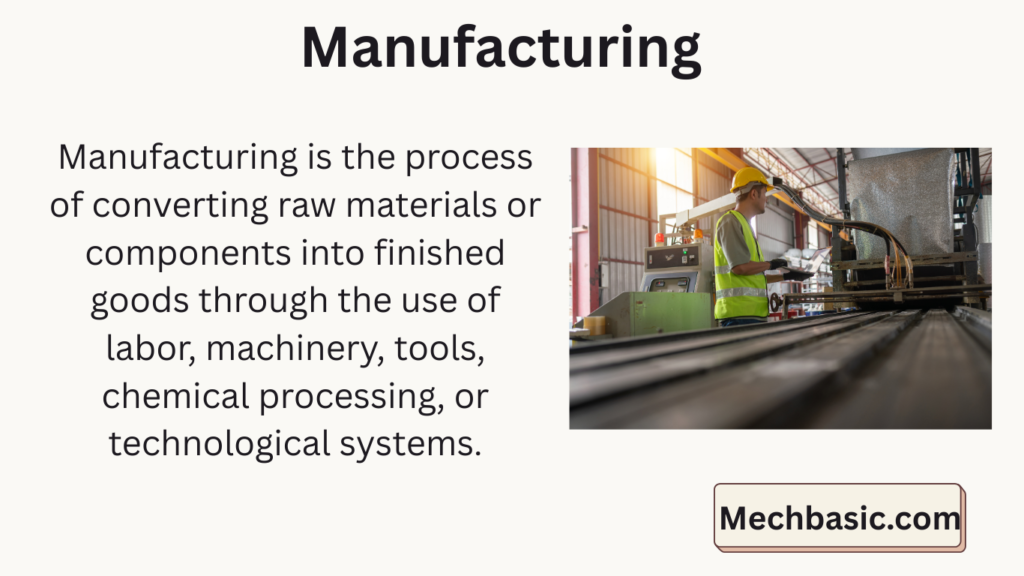
Manufacturing is the process of converting raw materials or components into finished goods through the use of labor, machinery, tools, chemical processing, or technological systems.
In simple terms:
Manufacturing is the transformation of materials into usable products on a large scale.
It involves a series of organized steps such as:
- Designing the product
- Selecting raw materials
- Processing and shaping materials
- Assembling components
- Quality testing
- Packaging and distribution
Key Elements of Manufacturing
- Raw Materials – Metals, plastics, wood, chemicals, etc.
- Labor – Skilled and unskilled workers
- Machinery & Tools – CNC machines, robots, assembly lines
- Energy – Electricity, fuel, renewable energy
- Technology – Automation, AI, CAD/CAM systems
- Quality Control – Inspection and testing systems
Types of Manufacturing
1. Job Production
- Customized products
- Small quantity
- Example: Tailor-made furniture
2. Batch Production
- Products made in groups
- Example: Bakery items, pharmaceuticals
3. Mass Production
- Large-scale standardized production
- Example: Cars, mobile phones
4. Continuous Production
- 24/7 production process
- Example: Oil refining, cement manufacturing
Importance of Manufacturing
Manufacturing plays a critical role in economic, social, and technological development.
1. Economic Growth
Manufacturing:
- Contributes significantly to GDP
- Generates national income
- Increases export earnings
- Strengthens industrial development
Countries with strong manufacturing sectors (e.g., Germany, Japan, China, USA) have strong economies.
2. Employment Generation
Manufacturing:
- Creates direct jobs (engineers, operators, managers)
- Creates indirect jobs (logistics, suppliers, maintenance)
- Supports small and medium enterprises (SMEs)
It provides employment across different skill levels.
3. Industrial Development
Manufacturing:
- Encourages infrastructure development
- Promotes technological advancement
- Boosts innovation and research
Example:
Automobile manufacturing promotes steel, rubber, electronics, and software industries.
4. Technological Advancement
Modern manufacturing uses:
- Robotics
- Artificial Intelligence
- 3D Printing
- Automation
- Internet of Things (IoT)
This leads to:
- Higher productivity
- Better product quality
- Lower production costs
5. Value Addition
Raw materials have low value.
Manufacturing increases their value significantly.
Example:
- Iron ore → Steel → Car parts → Automobile
Each stage adds economic value.
6. Export Promotion
Manufactured goods:
- Increase foreign exchange earnings
- Improve trade balance
- Enhance global competitiveness
7. Improved Standard of Living
Manufacturing provides:
- Affordable goods
- Better quality products
- Access to modern technology
This improves living standards and quality of life.
8. National Security
A strong manufacturing base ensures:
- Self-reliance in defense production
- Reduced dependence on imports
- Economic stability during crises
9. Development of Infrastructure
Manufacturing industries lead to:
- Development of roads
- Ports and transport systems
- Power generation facilities
- Industrial zones
Modern Trends in Manufacturing
- Smart Manufacturing
- Industry 4.0
- Sustainable Manufacturing
- Lean Manufacturing
- Green Manufacturing
- Digital Twin Technology
Conclusion
Manufacturing is the backbone of industrial and economic development. It transforms raw materials into valuable products, generates employment, drives technological progress, and contributes significantly to national income and global trade.
In short:
Manufacturing converts resources into wealth and supports overall economic development.
Other courses:





