
The automobile lighting system is one of the most important safety and functional systems in a vehicle. It provides visibility for the driver, signals to other road users, and illumination for different driving conditions. Here’s a detailed breakdown:
1. Purpose of the Automotive Lighting System
The main purposes of vehicle lighting are:
- Illumination: Help the driver see the road in low-light conditions (night, fog, rain).
- Signaling: Communicate vehicle movements to other drivers (turning, braking, reversing).
- Safety: Reduce accidents by making the vehicle visible to others.
- Aesthetics / Legal Compliance: Ensure the vehicle meets legal standards for visibility.
2. Components of the Lighting System
The lighting system consists of several primary and auxiliary lights:
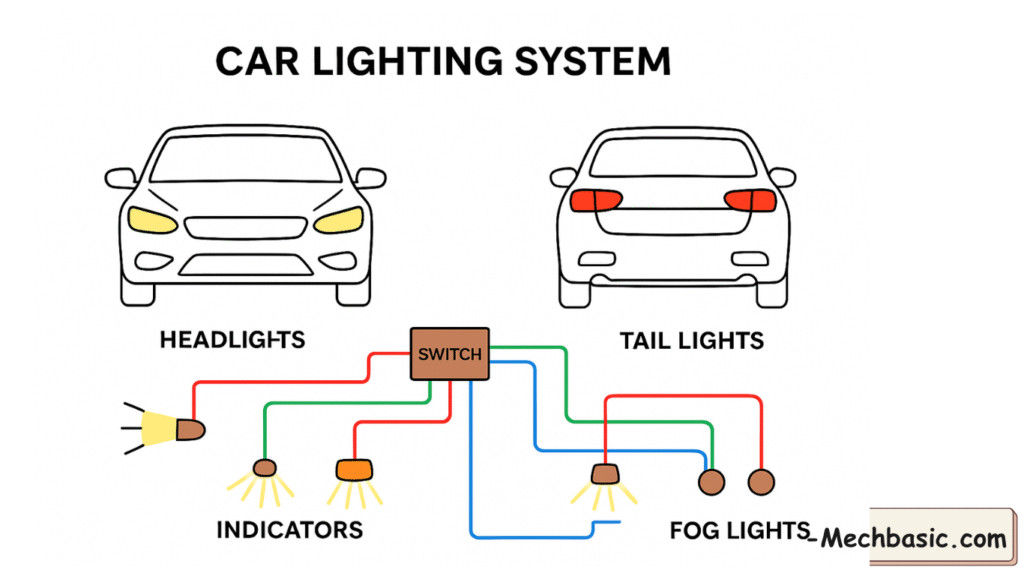
A. Headlights (Front Lights)
- Function: Illuminate the road ahead for the driver.
- Types:
- Low Beam (Dipped Beam): For normal night driving, avoids blinding oncoming traffic.
- High Beam (Main Beam): For open road, provides maximum illumination.
- Technologies:
- Halogen
- HID (High-Intensity Discharge)
- LED (Light Emitting Diode)
- Laser lights (high-end cars)
B. Tail Lights / Rear Lights
- Function: Make the vehicle visible from behind.
- Components:
- Tail Lamps: Glow when headlights are on.
- Brake Lights: Brighten when the brake pedal is pressed.
- Turn Signals / Indicators: Flash to show turning intentions.
- Reverse Lights: Illuminate when reversing.
- Fog Lamps (Rear): Improve visibility in heavy fog.
C. Turn Signals / Indicators
- Function: Signal a turn or lane change.
- Location: Front, rear, and sometimes side of the vehicle.
- Operation: Flashing lights controlled by a flasher relay or ECU.
D. Hazard Warning Lights
- Function: Warn other drivers of a vehicle hazard or emergency stop.
- Operation: Activate all turn indicators simultaneously.
E. Fog Lights
- Function: Improve visibility in fog, rain, or snow.
- Types:
- Front fog lights: Mounted low, wide beam to illuminate road edges.
- Rear fog lights: Bright red light to increase visibility to following traffic.
F. Interior / Cabin Lights
- Dome lights, dashboard illumination, and courtesy lights help see inside the vehicle and display important information.
G. Auxiliary / Daytime Running Lights (DRL)
- Function: Increase vehicle visibility during daytime.
- Often LED-based and automatically powered when ignition is on.
3. Electrical Circuit of the Lighting System
The automotive lighting system is generally divided into low-current control and high-current load circuits:
- Power Source: Battery (12V for most cars, 24V in trucks).
- Switches: Control headlights, fog lights, indicators, etc.
- Relays: High-current devices to prevent switch burnout.
- Fuses: Protect circuits from overcurrent.
- Wiring Harness: Connects all lights to battery, switches, and relays.
- Control Module / ECU (modern cars): Controls DRLs, automatic lights, and adaptive lighting.
4. Types of Lighting Circuits
- Series Circuit: Rare; if one light fails, the circuit breaks.
- Parallel Circuit: Common; each light receives full voltage independently.
- Flasher Circuit: Used in indicators and hazard lights to create blinking effect.
5. Modern Lighting Features
- Automatic Headlights: Turn on/off based on ambient light.
- Adaptive / Cornering Lights: Adjust beam direction with steering.
- LED / Matrix Lights: Selectively dim parts of the beam to avoid blinding others.
- Daytime Running Lights (DRL): Enhance vehicle visibility in daylight.
6. Common Problems in Vehicle Lighting System
- Burnt bulbs
- Blown fuses
- Faulty relays
- Damaged wiring
- Oxidized connectors
- Malfunctioning automatic light sensors
7. Safety Considerations
- Always replace bulbs with correct voltage and wattage.
- Check all lights regularly, especially brake lights and indicators.
- Keep lenses clean and transparent for proper illumination.
Summary Table of Vehicle Lights
| Light Type | Purpose | Location | Notes |
|---|---|---|---|
| Headlights | Illuminate road ahead | Front | Low/high beam, HID/LED |
| Tail Lights | Rear visibility | Rear | Brake, running, reverse |
| Turn Signals | Indicate turning | Front & Rear | Flashing via relay |
| Fog Lights | Improve visibility in fog | Front & Rear | Low-mounted, wide beam |
| Hazard Lights | Emergency warning | Front & Rear | All indicators flash |
| DRL | Daytime visibility | Front | Often LED, automatic |
| Interior Lights | Cabin illumination | Inside | Dome, dashboard, courtesy |
💡 Key Point:
The lighting system is both safety and communication equipment — it ensures the driver sees the road and is seen by others. Modern cars integrate it with sensors and ECUs for adaptive, automatic, and energy-efficient operation.
Other courses:





