
Lathe operations are machining processes performed on a lathe machine where the workpiece rotates against a cutting tool to produce cylindrical and symmetrical shapes such as turning, facing, drilling, and threading.
In this article:
Lathe Operations
A lathe is one of the most fundamental machine tools used in manufacturing. It rotates the workpiece against a cutting tool to remove material and produce a desired shape. Lathe operations can create cylindrical, conical, threaded, and complex components.
1. Definition of Lathe
A lathe is a machine tool in which the workpiece rotates on its axis while a single-point cutting tool is fed along it to perform various machining operations.
Key Features:
- Workpiece rotates; tool may be stationary or moving.
- Produces rotationally symmetrical parts.
- High versatility and widely used in manufacturing.
2. Basic Parts of a Lathe Machine
| Part | Function |
|---|---|
| Headstock | Holds the spindle and provides rotational power to the workpiece. |
| Spindle | Rotates the workpiece; speed controlled via gears or electronics. |
| Tailstock | Supports the free end of the workpiece; can hold tools for drilling or reaming. |
| Carriage | Moves cutting tool along or across the workpiece. |
| Cross-slide | Moves the tool perpendicular to workpiece axis. |
| Compound rest | For angular cuts and taper turning. |
| Lead screw & Feed rod | For thread cutting and automatic feed. |
| Bed | Base supporting all components. |
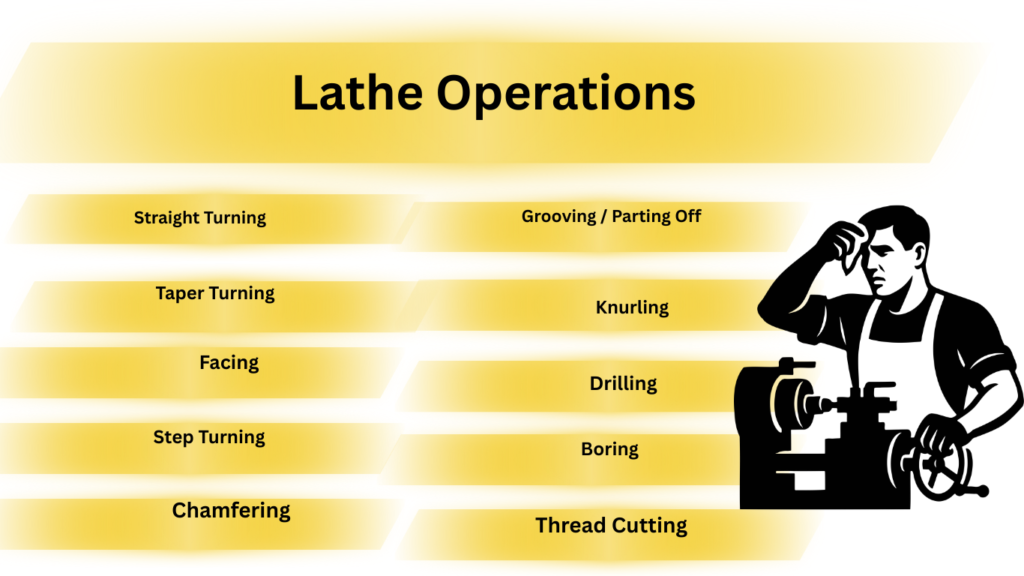
3. Lathe Operations
Lathe operations are divided into turning operations (to reduce diameter) and non-turning operations (e.g., drilling, threading).
A. Turning Operations
1. Straight Turning
- Reduces diameter uniformly along a cylindrical workpiece.
- Tool moves parallel to the axis of rotation.
- Used to make shafts and rods.
2. Taper Turning
- Produces a conical shape.
- Methods:
- Tailstock set over method – tailstock offset.
- Compound rest method – cross-slide angled.
- Taper attachment method – machine attachment guides tool.
- Applications: Machine tool spindles, shafts.
3. Facing
- Tool moves perpendicular to the axis, cutting the end of the workpiece.
- Produces a flat surface at the end.
- Used for end preparation, squaring shafts.
4. Step Turning
- Produces cylindrical steps of different diameters along the length.
- Each step is turned sequentially.
- Applications: Shafts with bearings and collars.
5. Chamfering
- Produces angled edge at end of a shaft or hole.
- Improves assembly fit and appearance.
6. Grooving / Parting Off
- Grooving: Creates narrow recess on workpiece.
- Parting off: Cuts workpiece completely into two parts.
- Uses special grooving tools.
7. Knurling
- Creates cross-hatched pattern on cylindrical surfaces.
- Improves grip on handles or knobs.
B. Drilling and Boring on Lathe
1. Drilling
- Tailstock holds a drill bit.
- Creates holes along the axis of rotation.
- Used for center holes, pilot holes.
2. Boring
- Enlarges an existing hole.
- Achieves high accuracy and smooth finish.
C. Thread Cutting
- Produces internal or external threads.
- Uses single-point tool or dies/taps.
- Feed of the carriage synchronized with spindle rotation via lead screw.
D. Form Turning
- Produces complex shapes using a profiled cutting tool.
- Tool contour matches workpiece profile.
4. Types of Tools Used in Lathe
- Single-point cutting tools – general turning.
- Thread cutting tools – for threads.
- Boring tools – internal holes.
- Knurling tool – create grip patterns.
- Parting tool – cut-off operations.
- Form tool – shaped cutting profile.
5. Lathe Operations Summary Table
| Operation | Tool Movement | Workpiece Motion | Application |
|---|---|---|---|
| Straight turning | Parallel to axis | Rotates | Shafts, rods |
| Taper turning | Angular / Tailstock offset | Rotates | Shafts, spindles |
| Facing | Perpendicular to axis | Rotates | Squaring ends |
| Step turning | Parallel, incremental | Rotates | Shafts with collars |
| Chamfering | Angular feed | Rotates | Edge finishing |
| Grooving / Parting | Radial / axial | Rotates | Recesses, cutting off |
| Knurling | Radial pressing | Rotates | Handles, grips |
| Drilling | Axial feed (tailstock) | Rotates | Holes |
| Boring | Axial feed | Rotates | Hole enlargement |
| Threading | Synchronized axial | Rotates | Threads |
| Form turning | Tool matches profile | Rotates | Complex shapes |
6. Advantages of Lathe Operations
✔ High precision and accuracy
✔ Versatile – can perform multiple operations
✔ Produces symmetrical cylindrical parts
✔ Can work on variety of materials
✔ Can perform threading, drilling, and boring
7. Limitations
❌ Limited to rotationally symmetric parts
❌ Not suitable for complex 3D shapes
❌ Requires skilled operators for precision
❌ Manual lathes are slower than CNC
Conclusion
Lathe operations rotate a workpiece while a cutting tool shapes it, producing shafts, rods, threads, grooves, and finished surfaces with high accuracy.
Other courses:





