
Industrial revolutions have shaped modern manufacturing by introducing new technologies and production methods.
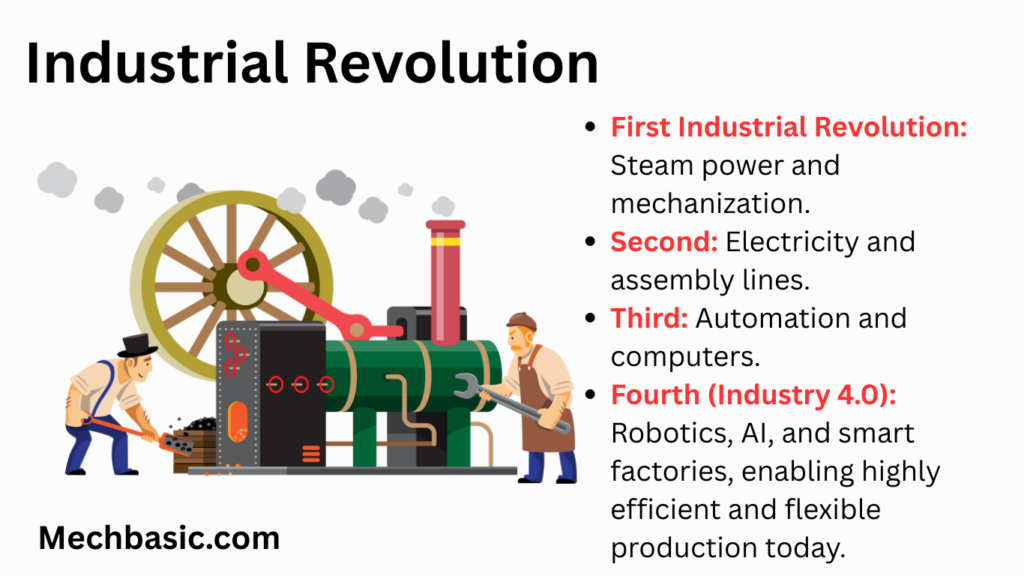
- First Industrial Revolution: Steam power and mechanization.
- Second: Electricity and assembly lines.
- Third: Automation and computers.
- Fourth (Industry 4.0): Robotics, AI, and smart factories, enabling highly efficient and flexible production today.
Here’s a detailed explanation of the Industrial Revolutions and modern manufacturing, tracing how each revolution transformed manufacturing practices, technologies, and production systems up to today’s smart factories.
1. First Industrial Revolution (1760–1840)
Overview
- Originated in Britain; marked the shift from manual labor to mechanized production.
- Focused on textiles, iron, and steam power.
Key Innovations
- Steam engine (James Watt): Powered machines and factories.
- Spinning Jenny & Power Loom: Mechanized textile production.
- Blast furnace improvements: Increased iron production.
- Water-powered mills: Enabled mechanized manufacturing.
Impact on Manufacturing
- Factories replaced home workshops.
- Increased production speed and volume.
- Products became more standardized.
- Urbanization occurred as labor shifted to factories.
2. Second Industrial Revolution (1870–1914)
Overview
- Also called the Technological Revolution.
- Focused on steel, electricity, and chemical industries.
Key Innovations
- Bessemer process: Cheaper, mass production of steel.
- Electricity: Powered factories continuously and allowed flexible production.
- Telegraph & telephone: Improved coordination and supply chains.
- Automobile assembly lines: Henry Ford introduced mass production (1913).
Impact on Manufacturing
- Mass production became standard.
- Interchangeable parts increased efficiency.
- Large-scale factories emerged.
- Growth of consumer goods and transportation industries.
3. Third Industrial Revolution (1960s–2000s)
Overview
- Known as the Digital Revolution.
- Introduction of computers, electronics, and automation in manufacturing.
Key Innovations
- Computer-Aided Design (CAD): Digital designing of components.
- Computer-Aided Manufacturing (CAM): Automated control of machining tools.
- Industrial Robots: Welding, assembly, and material handling automated.
- Just-in-Time (JIT) Production: Reduced inventory costs.
Impact on Manufacturing
- High precision and quality in products.
- Reduced labor costs and human error.
- Lean manufacturing became widespread.
- Increased flexibility for producing multiple product variants.
4. Fourth Industrial Revolution (2000s–Present)
Overview
- Called Industry 4.0.
- Focuses on smart, interconnected factories using digital technology and AI.
Key Innovations
- Cyber-Physical Systems: Machines integrated with digital control.
- Internet of Things (IoT): Real-time data from sensors for predictive maintenance.
- Artificial Intelligence & Machine Learning: Optimized production, quality control.
- Additive Manufacturing (3D Printing): On-demand, customized production.
- Advanced Materials: Composites, nanomaterials, lightweight alloys.
Impact on Manufacturing
- Highly flexible and efficient factories.
- Reduced energy use and waste.
- Real-time monitoring and predictive maintenance reduce downtime.
- Mass customization is possible for individual customer requirements.
- Global supply chains are integrated digitally.
Comparison of Industrial Revolutions in Manufacturing
| Era | Years | Key Technology | Manufacturing Focus | Impact on Production |
|---|---|---|---|---|
| 1st IR | 1760–1840 | Steam engines, mechanization | Textiles, iron | Mechanized production, early factories, increased output |
| 2nd IR | 1870–1914 | Electricity, steel, assembly line | Steel, automobiles, chemicals | Mass production, standardized parts, large factories |
| 3rd IR | 1960s–2000s | Computers, robots, automation | Electronics, machinery | High precision, flexible production, reduced labor cost |
| 4th IR (Industry 4.0) | 2000s–present | AI, IoT, 3D printing, smart sensors | Advanced manufacturing, custom products | Smart, efficient, connected factories, mass customization, predictive maintenance |
Modern Manufacturing Features (Post-Industry 4.0)
- Automation and Robotics
- Machines handle repetitive, dangerous, or precise tasks.
- Digital Integration
- Real-time monitoring of production via IoT and cloud systems.
- Data-Driven Decision Making
- AI and analytics optimize production schedules, reduce defects.
- Mass Customization
- Flexible systems allow for producing unique products on a large scale.
- Sustainable Manufacturing
- Reduced energy consumption, recycling, and minimal waste.
- Advanced Materials
- Use of composites, high-performance alloys, and nanomaterials.
- Global Supply Chain Integration
- Digital tools coordinate production, inventory, and shipping worldwide.
Conclusion:
- The Industrial Revolutions transformed manufacturing from small-scale handcrafts to large-scale, automated, and intelligent factories.
- Each revolution brought new technologies, materials, and processes:
- 1st IR: Mechanization
- 2nd IR: Mass production
- 3rd IR: Automation & computers
- 4th IR: Smart manufacturing & Industry 4.0
- Modern manufacturing emphasizes flexibility, efficiency, quality, and sustainability.
Other courses:





