
Weight distribution in a vehicle can be easily calculated by entering the inputs using the following website link: Vehicle weight distribution calculator.
Calculating weight distribution in a car can be done with some basic measurements.
We will explain how to calculate weight distribution in a vehicle in a step by step approach along with some examples.
How to calculate weight distribution in a car?(Step by step)
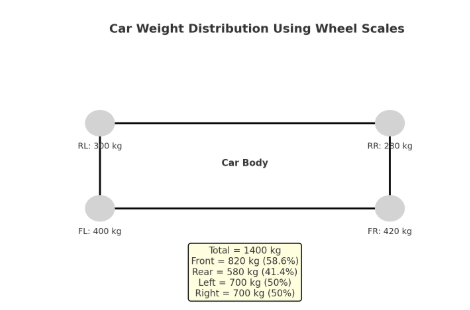
🔹 Step 1: Put the Car on Scales
You need four corner scales (one under each wheel). These are often used in motorsport (“corner weighting”).
You’ll measure:
- WFL = Weight on Front Left wheel
- WFR = Weight on Front Right wheel
- WRL = Weight on Rear Left wheel
- WRR = Weight on Rear Right wheel
🔹 Step 2: Total Vehicle Weight
Wtotal=WFL+WFR+WRL+WRR
🔹 Step 3: Front vs Rear Distribution
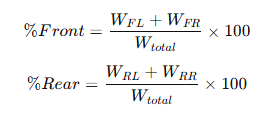
🔹 Step 4: Left vs Right Distribution
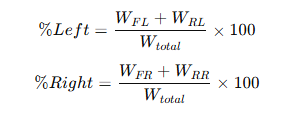
🔹 Example Calculation
Suppose we measure:
- FL = 400 kg, FR = 420 kg
- RL = 300 kg, RR = 280 kg
Total Weight
Wtotal=400+420+300+280=1400 kg
Front/Rear
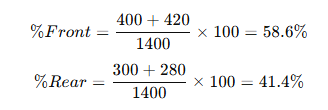
Left/Right
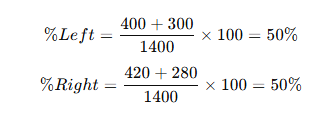
👉 So this car has a 58.6:41.4 (front:rear) weight distribution, with perfect left/right balance.
✅ In short:
- Put the car on four scales.
- Add up front vs rear, left vs right.
- Express as percentages.
Conclusion:
The centre of gravity and weight distribution of a vehicle play a crucial role in its stability, handling, braking, and safety. Cars generally have a lower centre of gravity and more balanced weight distribution, which makes them more stable and responsive, while SUVs and trucks often have a higher centre of gravity and more front-heavy weight balance, making them more prone to rollover and understeer.
By carefully calculating and optimizing weight distribution—through smart placement of the engine, fuel tank, batteries, passengers, and cargo—engineers and drivers can achieve better performance, safety, and driving comfort.
👉 In short: A well-balanced vehicle with a low centre of gravity and optimized weight distribution is always safer, more stable, and more enjoyable to drive.
Other courses:





