
To become a die cast engineer, one typically needs a degree or diploma in mechanical or manufacturing engineering, knowledge of die casting processes and materials, and hands-on experience with tooling, machines, and quality control through training or industry work.
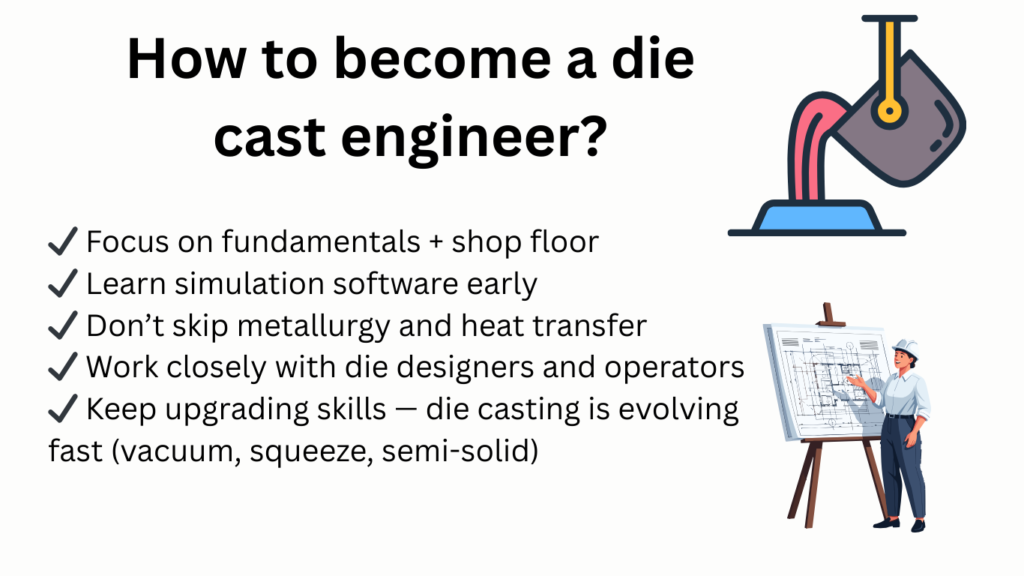
How to Become a Die Cast Engineer (Roadmap)
Die casting engineering is a solid, in-demand manufacturing career, especially in automotive, aerospace, EVs, consumer electronics, and industrial components.
1. Educational Qualification (Foundation)
Required Degree (Most Common)
- B.E. / B.Tech in:
- Mechanical Engineering
- Production / Manufacturing Engineering
- Metallurgical Engineering
Diploma Route (Also Valid)
- Diploma in Mechanical / Production Engineering
- Many die casting engineers start as shop-floor engineers and grow upward.
Core Subjects to Focus On
- Manufacturing Processes
- Casting & Foundry Technology
- Materials Science & Metallurgy
- Heat Transfer & Solidification
- Tool Design
- CAD/CAM
- Quality Control
2. Strong Understanding of Die Casting Basics
You must clearly understand:
Die Casting Processes
- Hot chamber die casting
- Cold chamber die casting
- High-pressure vs gravity die casting
Key Technical Knowledge
- Die design (parting line, draft, cores, slides)
- Gating and runner systems
- Overflow and vent design
- Solidification and cooling
- Shrinkage and porosity control
- Cycle time optimization
3. Learn Relevant Software (Very Important)
CAD Software (Must-Have)
- CATIA
- NX (Siemens)
- SolidWorks
- AutoCAD (basic)
Simulation Software (Highly Recommended)
- MAGMASOFT
- ProCAST
- AnyCasting
These tools help predict:
- Metal flow
- Air entrapment
- Shrinkage porosity
- Hot spots
Engineers with simulation skills earn significantly higher salaries.
4. Gain Practical Shop-Floor Experience
This is non-negotiable.
What You Must Learn on the Shop Floor
- Die setup and clamping
- Shot sleeve operation
- Plunger speed control
- Furnace and melting practice
- Lubrication (die spray)
- Ejection systems
- Defect identification & correction
Common Die Casting Defects You Must Master
- Porosity
- Cold shut
- Misrun
- Flash
- Blister
- Soldering
- Die erosion
5. Learn Die Design in Detail
A die cast engineer must understand die construction, even if not designing full dies.
Key Die Components
- Fixed die half
- Moving die half
- Slides and cores
- Ejector system
- Cooling channels
- Venting system
Design Rules
- Draft angles (0.5°–2° typical)
- Uniform wall thickness
- Rib and boss design
- Fillet radii
- Avoid sharp corners
6. Understand Materials & Alloys
Common Die Casting Alloys
- Aluminium (ADC12, A380, A360)
- Zinc (Zamak series)
- Magnesium
- Copper alloys (limited)
Metallurgy Knowledge
- Solidification behavior
- Heat treatment
- Grain refinement
- Effect of impurities
7. Quality & Inspection Skills
Learn:
- Dimensional inspection (CMM)
- X-ray inspection for porosity
- Dye penetrant testing
- Pressure leak testing
- Statistical Process Control (SPC)
Standards to Know:
- ISO 9001
- IATF 16949 (Automotive)
- PPAP, APQP, FMEA
8. Certifications (Highly Beneficial)
International / Industry Certifications
- NADCA (North American Die Casting Association)
- Foundry Technology Certification
- Six Sigma (Green Belt)
Online Platforms
- Coursera (Manufacturing specialization)
- Udemy (Die casting & tooling courses)
- NPTEL (Indian context – excellent)
9. Entry-Level Roles to Target
Start with:
- Die Casting Engineer (Trainee)
- Process Engineer
- Production Engineer
- Quality Engineer (Die Casting)
Industries:
- Automotive OEMs & suppliers
- EV manufacturers
- Aerospace suppliers
- Appliance and electronics companies
10. Career Growth Path
| Experience | Typical Role |
|---|---|
| 0–2 years | Die Casting Engineer / Trainee |
| 3–5 years | Senior Process Engineer |
| 6–10 years | Die Design / Project Engineer |
| 10+ years | Plant Head / Technical Manager |
11. Salary Outlook (Approximate)
- Entry-level: ₹3–6 LPA
- Mid-level: ₹8–15 LPA
- Senior expert / simulation engineer: ₹20+ LPA
(Global opportunities pay more)
12. Key Skills That Make You Stand Out ⭐
- Defect troubleshooting ability
- Simulation-driven decision making
- Cost reduction and cycle time optimization
- Communication with toolmakers
- Continuous improvement mindset
Summary
✔ Focus on fundamentals + shop floor
✔ Learn simulation software early
✔ Don’t skip metallurgy and heat transfer
✔ Work closely with die designers and operators
✔ Keep upgrading skills — die casting is evolving fast (vacuum, squeeze, semi-solid)
Conclusion
To become a die cast engineer, one must build strong fundamentals in manufacturing and metallurgy, gain hands-on shop-floor experience, master die design and defect control, and develop skills in CAD and casting simulation software.
Other courses:





