
Here’s a detailed explanation of how a dynamic propeller shaft balancing system works:
In this article:
Dynamic Propeller Shaft Balancing
A dynamic balancing system balances a rotating propeller shaft while it is spinning, taking into account both static and dynamic imbalances. This is especially important for long shafts, multi-piece shafts, and high-speed operation.
Unlike static balancing, which only balances the shaft at rest, dynamic balancing ensures that vibrations at operating speeds are minimized.
1️⃣ Purpose
- Correct unbalanced mass along the shaft and at its ends.
- Prevent vibration transmitted to vehicle chassis.
- Reduce wear on bearings, U-joints, and differential components.
- Ensure smooth operation at high rotational speeds.
2️⃣ Principle
Dynamic balancing is based on the principle that any rotating shaft with an uneven mass distribution will produce centrifugal forces, which generate vibration.
- Static imbalance: Mass is not evenly distributed along the shaft’s center of gravity.
- Couple or dynamic imbalance: Mass distribution along the shaft causes twisting or end-to-end vibration at high speeds.
Dynamic balancing corrects both types of imbalance by measuring vibration while the shaft spins and adding corrective weights at specific positions.
3️⃣ Components of a Dynamic Balancing System
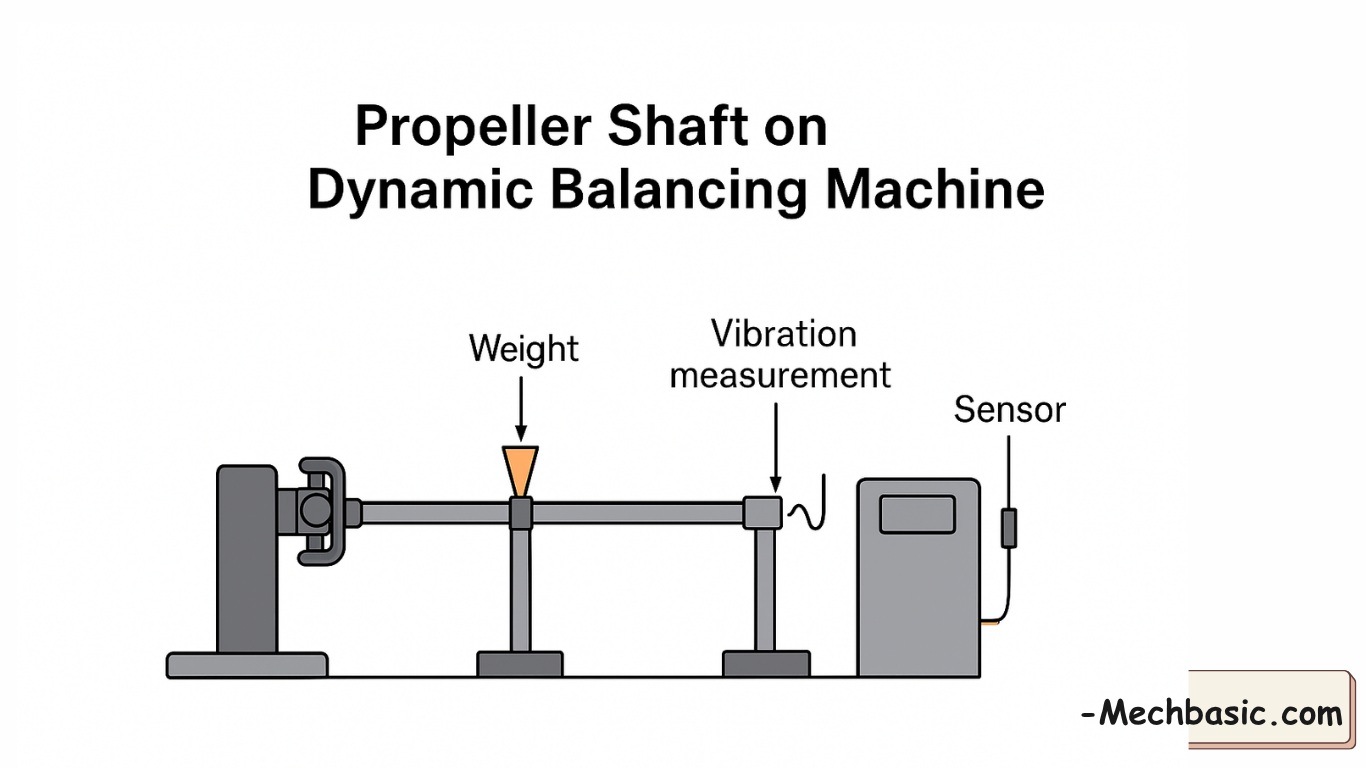
- Drive Spindles / Shaft Supports
- Hold the propeller shaft in position and allow free rotation.
- Drive Motor
- Spins the shaft at operating or test speed.
- Sensors / Accelerometers
- Detect vibration amplitude and phase at various points along the shaft.
- Control Unit / Computer
- Processes sensor signals to calculate magnitude and location of imbalance.
- Determines weight and position of balancing correction.
- Balancing Weights
- Attached to the shaft at specified locations (ends or midpoints).
4️⃣ Working Procedure
- Mount the Shaft: Place propeller shaft on balancing machine (spindles with low friction).
- Spin Shaft: Rotate the shaft at operational speed using the drive motor.
- Measure Vibration: Sensors measure radial and axial vibrations, capturing amplitude and phase.
- Analyze Data: Computer calculates exact position and amount of imbalance.
- Add Corrective Weights: Small weights are attached at calculated locations along the shaft.
- Verify: Shaft is spun again to ensure vibrations are within permissible limits.
In multi-piece shafts, both sections and the center bearing are dynamically balanced to ensure smooth operation.
5️⃣ Advantages of Dynamic Balancing
- Corrects both static and dynamic imbalances.
- Reduces vibration at high rotational speeds.
- Improves vehicle comfort and stability.
- Extends life of U-joints, bearings, and differential components.
- Essential for long or heavy-duty shafts.
6️⃣ Applications
- Automobile RWD and AWD propeller shafts.
- Trucks, buses, and long-wheelbase commercial vehicles.
- High-speed or high-performance vehicles.
- Industrial rotating machinery requiring smooth operation.
7️⃣ Summary
A dynamic propeller shaft balancing system:
- Spins the shaft at operating speed.
- Measures vibration from unbalanced mass using sensors.
- Computes exact weight and position needed to correct imbalance.
- Adds balancing weights → ensures smooth, vibration-free operation.
Also Read: Aircraft propeller balancing explained!!!
Other courses:





