
A car engine relies on the principles of thermodynamics to convert heat energy from burning fuel into the mechanical work that drives the vehicle.
In an internal combustion engine, fuel and air are ignited to produce high-pressure, high-temperature gases that push the pistons and create motion.
Throughout this process, thermodynamic laws govern how energy is transferred, how efficiently it can be converted into useful work, and how much is lost as heat.
Understanding these principles helps explain engine performance, efficiency, and the limits of how much power an engine can produce.
In this article:
- How a Car Engine Uses Thermodynamics
- 1. Thermodynamic Cycle Used by Car Engines
- 2. Application of the Laws of Thermodynamics in Engines
- 3. Thermodynamic Processes in Each Engine Stroke
- 4. Real Thermodynamic Components in a Car Engine
- 5. Thermodynamic Efficiency of Car Engines
- 6. Losses Due to Thermodynamic Limitations
- 7. How Thermodynamics Improves Engine Design
- 8. Summary
- 1. Thermodynamic Cycle Used by Car Engines
How a Car Engine Uses Thermodynamics
A car engine is essentially a thermodynamic machine. It converts the chemical energy in fuel into mechanical work using the laws and processes of thermodynamics.
Every stage of engine operation—intake, compression, combustion, and exhaust—is governed by thermodynamic principles.
1. Thermodynamic Cycle Used by Car Engines
Most car engines operate based on the Otto cycle (petrol engines) or Diesel cycle (diesel engines). These cycles describe how pressure, temperature, and volume of the working fluid (air-fuel mixture) change during each stroke.
Otto Cycle (Petrol Engine):
- Isentropic Compression
- Constant-Volume Heat Addition (Combustion)
- Isentropic Expansion (Power Stroke)
- Constant-Volume Heat Rejection (Exhaust Start)
Diesel Cycle (Diesel Engine):
- Isentropic Compression
- Constant-Pressure Heat Addition
- Isentropic Expansion
- Constant-Volume Heat Rejection
These cycles are simplified models of real engine processes.
2. Application of the Laws of Thermodynamics in Engines
First Law of Thermodynamics
Energy Cannot Be Created or Destroyed
In the engine:
- Fuel contains chemical energy.
- Combustion converts this energy into thermal energy (heat).
- The heat increases pressure in the cylinder.
- High pressure pushes the piston → mechanical work is produced.
Mathematically:
Heat added = Work output + Increase in internal energy
This law explains how fuel energy becomes the mechanical power that moves the vehicle.
Second Law of Thermodynamics
Heat Flows from Hot to Cold
The engine maintains a temperature difference:
- Very hot combustion gases (~2000°C)
- Cooler cylinder walls and coolant
- Even cooler external air
Heat flows naturally from hot gases to cooler surroundings.
Important Applications:
- Radiator removes heat from coolant.
- Exhaust system expels hot gases.
- Oil carries heat away from pistons and bearings.
Also, the second law explains why 100% efficiency is impossible—some heat is always lost.
Third Law of Thermodynamics
Entropy Considerations
Not directly applied during engine operation, but:
- Hot gases create entropy increase, leading to energy loss.
- Higher entropy = more unavailable energy.
Engineering tries to reduce entropy generation by:
- Improving combustion efficiency
- Reducing friction
- Raising compression ratio
- Using turbochargers
3. Thermodynamic Processes in Each Engine Stroke
1. Intake Stroke – Isobaric Process
- Piston moves down.
- Air (or air-fuel mixture) enters.
- Pressure remains nearly constant.
Thermodynamic role:
Fresh charge replaces exhaust gases and prepares mixture for compression.
2. Compression Stroke – Isentropic Compression
- Piston moves up.
- Air (or mixture) gets compressed.
- Pressure and temperature rise sharply.
- No heat transfer ideally.
This increases temperature for efficient combustion (especially in diesels).
3. Power Stroke – Expansion (Isentropic and Heat Release)
- Fuel ignites.
- Heat is added at constant volume (petrol) or constant pressure (diesel).
- Hot gases expand and push the piston down.
- This stroke produces all the useful work.
This is where thermodynamic heat-to-work conversion happens.
4. Exhaust Stroke – Heat Rejection
- Piston pushes exhaust gases out.
- Heat is released to the environment.
- Necessary to make room for fresh air.
Thermodynamically, this is the heat rejection phase of the cycle.
4. Real Thermodynamic Components in a Car Engine
A) Combustion Chamber
- Acts like a small heat engine.
- Rapid combustion creates high pressure and temperature.
B) Cooling System (Radiator + Coolant)
- Removes excess heat using convection.
- Maintains ideal engine temperature (~95°C).
C) Lubrication System
- Reduces friction (reducing entropy production).
- Carries heat away from moving parts.
D) Exhaust System
- Removes high-temperature exhaust gases.
- Turbochargers use exhaust heat energy (thermodynamic recovery).
E) Air Intake System
- Cold air increases density → improves thermal efficiency.
F) Turbocharger / Supercharger
- Increases mass of air entering the cylinder.
- Raises thermodynamic efficiency by improving combustion.
5. Thermodynamic Efficiency of Car Engines
The efficiency of an Otto engine is:
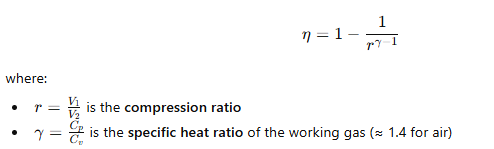
This shows:
- Higher compression ratio → higher efficiency
- But limited by knocking (in petrol engines)
Diesel engines use higher compression ratios, making them more thermodynamically efficient.
6. Losses Due to Thermodynamic Limitations
Even the best engines lose energy due to:
- Friction loss
- Heat loss to coolant
- Heat in exhaust
- Pumping loss
- Incomplete combustion
That’s why most modern engines are only 25–40% efficient.
7. How Thermodynamics Improves Engine Design
Engineers use thermodynamics to improve:
- Compression ratio
- Combustion chamber shape
- Fuel injection timing
- Turbocharging & intercooling
- Cooling system design
- Lightweight materials
Modern engines are much more thermodynamically optimized than older ones.
8. Summary
A car engine uses thermodynamics by:
- Converting heat from fuel into mechanical work (1st law).
- Managing heat flow and entropy (2nd law).
- Operating based on the Otto or Diesel thermodynamic cycle.
- Using conduction, convection, and radiation to transfer heat.
- Regulating temperatures with cooling and lubrication systems.
- Minimizing energy losses for higher efficiency.
Other courses:





