
In this article:
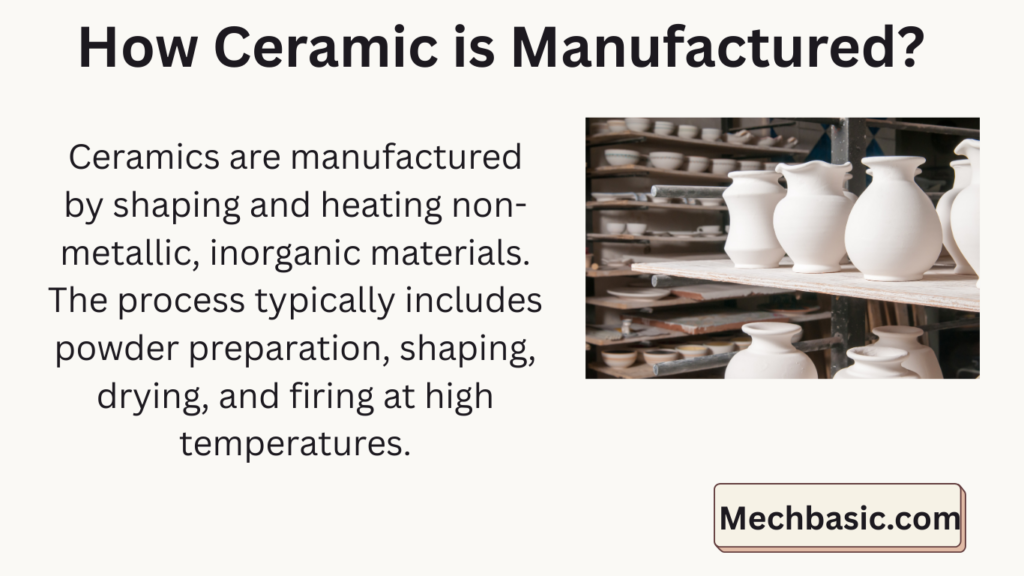
Ceramics are manufactured by shaping and heating non-metallic, inorganic materials.
The process typically includes powder preparation, shaping, drying, and firing at high temperatures.
High heat gives ceramics their hardness, strength, and heat resistance.
Ceramic manufacturing is used to produce items like tiles, bricks, and advanced engineering components.
MANUFACTURING OF CERAMICS
Ceramics are inorganic, non-metallic materials made by shaping and firing raw materials at high temperatures. Ceramic manufacturing involves a series of controlled steps to achieve desired shape, strength, and properties.
1. Raw Materials Used in Ceramics
Ceramic raw materials are generally naturally occurring minerals.
Main Raw Materials
- Clay – provides plasticity (e.g., kaolin)
- Silica (SiO₂) – provides strength and thermal stability
- Feldspar – acts as a flux (lowers melting temperature)
- Alumina (Al₂O₃) – increases hardness and refractoriness
- Magnesia, zirconia – for advanced ceramics
2. Steps in Ceramic Manufacturing Process
Step 1: Raw Material Preparation
Raw materials are:
- Mined
- Crushed
- Ground to fine powder
Objectives:
- Uniform particle size
- Removal of impurities
- Improved sintering behavior
Processes used:
- Ball milling
- Crushing and grinding
- Screening and magnetic separation
Step 2: Batching and Mixing
Prepared raw materials are weighed in correct proportions and mixed.
Purpose:
- Achieve uniform composition
- Ensure consistent properties
Methods:
- Dry mixing
- Wet mixing (slurry preparation)
Step 3: Forming (Shaping)
The mixed material is shaped into desired forms.
Common Forming Methods
a) Dry Pressing
- Powder pressed in steel dies
- High pressure applied
Used for: Tiles, electrical insulators
b) Slip Casting
- Ceramic slurry poured into plaster molds
- Mold absorbs water and forms solid layer
Used for: Complex shapes, sanitary ware
c) Extrusion
- Plastic clay forced through die
Used for: Bricks, pipes, tiles
d) Injection Molding (Advanced Ceramics)
- Ceramic powder mixed with polymer binder
- Injected into molds
Used for: Precision ceramic parts
Step 4: Drying
Formed ceramic bodies contain moisture and must be dried.
Purpose:
- Remove free water
- Prevent cracking during firing
Drying methods:
- Air drying
- Controlled chamber drying
Step 5: Firing (Sintering)
Dried ceramic pieces are heated in a kiln at high temperatures.
Temperature range:
- 900°C – 1800°C (depending on ceramic type)
Processes during firing:
- Removal of bound water
- Burning of organic materials
- Particle bonding (sintering)
- Increase in strength and hardness
Types of kilns:
- Periodic kiln
- Tunnel kiln
- Shuttle kiln
Step 6: Glazing (Optional)
Glazing involves applying a glassy coating before or after firing.
Purpose:
- Improve surface finish
- Increase water resistance
- Enhance appearance
Types of glazing:
- Raw glazing
- Frit glazing
Step 7: Finishing and Inspection
- Grinding or polishing
- Dimensional checking
- Strength and quality testing
3. Manufacturing of Advanced Ceramics
Advanced ceramics require high purity powders and precise control.
Steps include:
- Chemical powder synthesis
- Isostatic pressing
- Hot pressing or hot isostatic pressing
- Precision machining
Examples:
- Alumina ceramics
- Silicon carbide
- Zirconia ceramics
4. Properties Achieved After Manufacturing
- High hardness
- High compressive strength
- Heat resistance
- Wear resistance
- Electrical insulation
5. Applications of Manufactured Ceramics
Traditional Ceramics
- Bricks
- Tiles
- Pottery
- Sanitary ware
Advanced Ceramics
- Cutting tools
- Engine components
- Biomedical implants
- Electronic substrates
6. Advantages of Ceramic Manufacturing
- Uses abundant natural materials
- Excellent thermal stability
- Long service life
- Chemical resistance
7. Limitations
- Brittle nature
- High firing energy cost
- Difficult machining after firing
8. Flow Chart of Ceramic Manufacturing
Raw materials → Crushing & grinding → Mixing → Forming → Drying → Firing → Glazing → Finishing
9. Conclusion
Ceramic manufacturing is a multi-step process that transforms raw minerals into strong, durable, and heat-resistant products. Control at each stage is essential to prevent defects and achieve desired properties.
Other courses:





