
Grinding and finishing are machining processes used to improve the accuracy, surface quality, and appearance of a workpiece. Grinding removes small amounts of material for precision, while finishing enhances smoothness, dimensions, and overall quality.
In this article:
Grinding and Finishing :
Grinding and finishing are precision machining processes used to achieve dimensional accuracy, surface smoothness, and high-quality finishes on components. While grinding removes material using abrasive action, finishing refers to processes that improve surface quality and meet tolerance requirements.
1. Grinding
Definition:
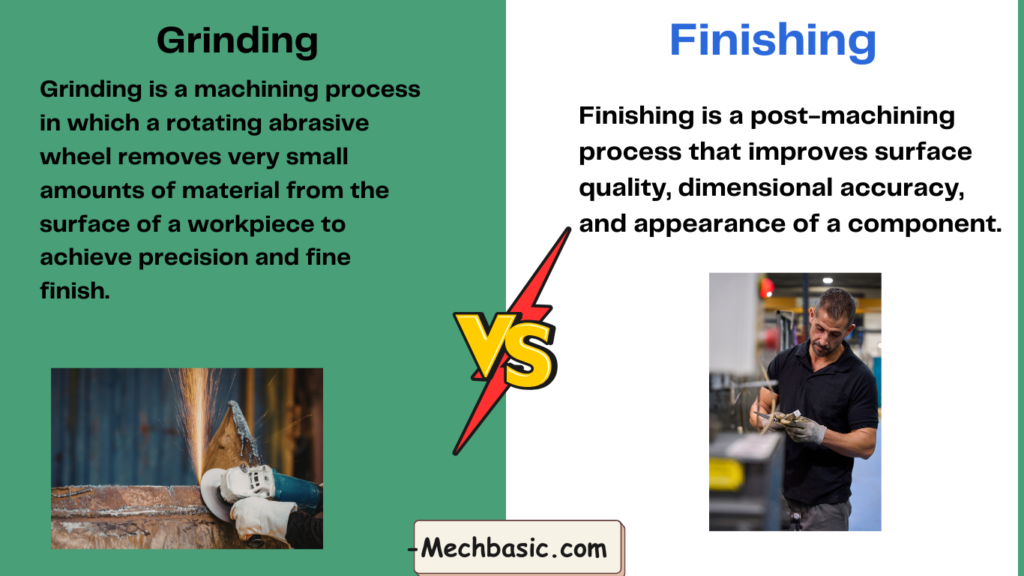
Grinding is a machining process in which a rotating abrasive wheel removes very small amounts of material from the surface of a workpiece to achieve precision and fine finish.
Key Features:
- Uses abrasive grains as cutting edges
- Material removal is very small per pass
- High accuracy and surface quality
- Can machine hard materials
Principle of Grinding
- Abrasive grains on the grinding wheel act as tiny cutting edges.
- Wheel rotates at high speed; workpiece moves relative to wheel.
- Chips are removed from workpiece, leaving a smooth surface.
- Coolant is used to prevent heat damage.
Types of Grinding Operations
- Surface Grinding – produces flat surfaces.
- Cylindrical Grinding – external or internal cylindrical surfaces.
- Centerless Grinding – for mass production of cylindrical parts.
- Internal Grinding – grinds holes or bores.
- Tool & Cutter Grinding – shapes or sharpens cutting tools.
- Form/Profile Grinding – for complex shapes and contours.
Grinding Parameters
- Wheel speed – Surface speed of grinding wheel.
- Feed rate – Movement of workpiece relative to wheel.
- Depth of cut – Amount of material removed per pass.
- Coolant – Reduces heat, improves finish and tool life.
Advantages of Grinding
- High dimensional accuracy (±0.001 mm)
- High surface finish (0.1–1 µm Ra)
- Can machine hard materials
- Produces complex shapes
- Tool sharpening and finishing
Limitations of Grinding
- Slow material removal
- High energy consumption
- Heat generation can distort workpiece
- Requires skilled operators
- Equipment cost is high
2. Finishing
Definition:
Finishing is a post-machining process that improves surface quality, dimensional accuracy, and appearance of a component.
Purpose:
- Improve surface smoothness
- Remove tool marks, burrs, and imperfections
- Achieve tight tolerances
- Enhance wear resistance and fatigue strength
Finishing Processes
Finishing can be mechanical, chemical, or thermal. Common mechanical processes include:
- Grinding – as described above; also a finishing process.
- Lapping
- Uses abrasive slurry and a lap plate.
- Produces extremely smooth surfaces.
- Tolerance: ±0.0001 mm
- Applications: Gears, valves, optical components.
- Polishing
- Smoothens surface to a mirror-like finish.
- Uses abrasive paste or compound.
- Applications: Decorative surfaces, tools, automotive parts.
- Buffing
- Uses soft wheel and compound.
- Produces glossy finish.
- Applications: Metal furniture, instruments, jewelry.
- Honing
- Abrasive stone removes small amounts of material inside holes.
- Produces precise cylindrical holes.
- Applications: Engine cylinders, hydraulic components.
- Superfinishing / Microfinishing
- Very fine abrasive stones or tapes.
- Surface finish: <0.1 µm Ra
- Applications: High-precision mechanical parts, aerospace, bearing surfaces.
Difference Between Grinding and Finishing
| Feature | Grinding | Finishing |
|---|---|---|
| Purpose | Material removal and shaping | Surface smoothness, precision, final touches |
| Material removed | Small | Very tiny |
| Surface finish | 0.1–1 µm | 0.01–0.1 µm (super finishing) |
| Tool | Abrasive wheel | Abrasives, lapping compounds, polishing tools |
| Accuracy | High | Very high |
| Applications | Shafts, tools, cylindrical parts | Gears, engine components, dies, molds |
Importance of Grinding and Finishing
- Ensures interchangeable parts in mass production.
- Increases product life by reducing friction and wear.
- Enhances appearance for decorative and precision components.
- Critical in automotive, aerospace, and tool-making industries.
Conclusion
Grinding removes small amounts of material with a rotating abrasive wheel to make a part accurate.
Finishing further smoothens, polishes, and perfects the surface, giving precise dimensions and a good finish.
Other courses:





