
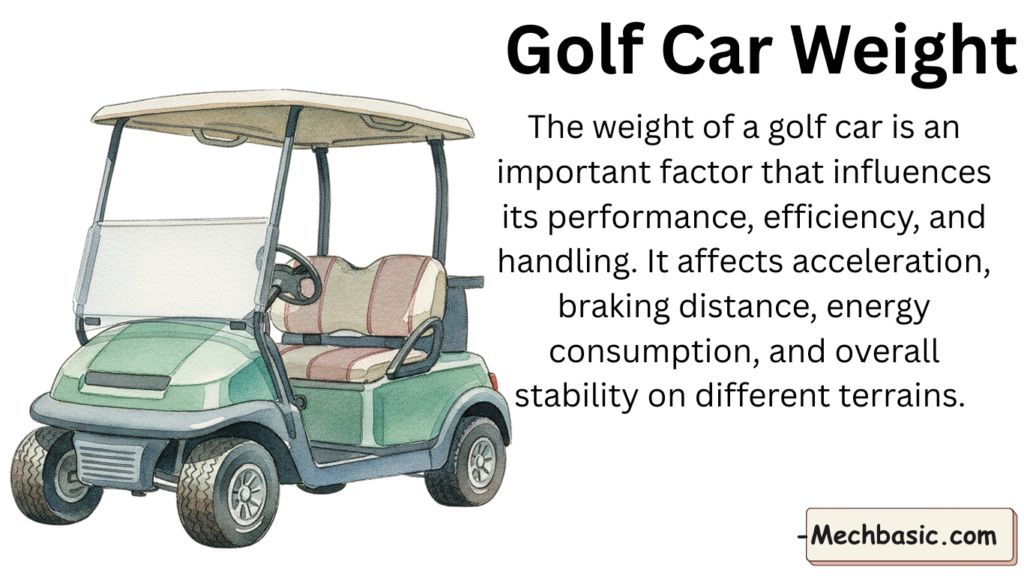
The weight of a golf car is an important factor that influences its performance, efficiency, and handling. It affects acceleration, braking distance, energy consumption, and overall stability on different terrains.
Golf car weight varies depending on design, materials, passenger capacity, and whether the vehicle is electric or gas-powered. Understanding golf car weight is essential for proper operation, load management, and safe usage.
1. What Is Golf Cart Weight?
Golf cart weight refers to the mass of the vehicle itself — usually expressed in pounds (lbs) or kilograms (kg) — and affects performance, range, stability, towing, and safety.
There are two commonly referenced weights:
- Dry weight – weight of the cart without batteries, fluids, passengers, cargo, and accessories.
- Curb weight – operational weight including batteries, fluids, and standard components (most important for practical use).
2. Typical Golf Cart Weight Ranges
Electric Golf Carts (with Batteries)
- Standard 2-seater electric carts: typically 900–1,100 lbs (≈408–499 kg).
- Lithium battery models (lighter): ~700–900 lbs (≈317–408 kg).
- Heavy 4- or 6-seater models: 1,000–1,600 lbs (≈454–726 kg) or more.
Gas-Powered Golf Carts
- Generally 800–1,200 lbs (≈363–544 kg) depending on engine size and body.
General Average
- Most standard golf carts (electric with batteries) weigh around 900–1,200 lbs (≈408–544 kg).
3. Main Components That Influence Weight
Batteries (Biggest Factor in Electric Carts)
- Lead-acid batteries: heavy — typically 55–80 lbs (≈25–36 kg) per battery.
- Electric carts often use 4 to 8 batteries to get 36 V or 48 V systems, meaning battery weight alone can be 300–500+ lbs (136–227+ kg).
- Lithium-ion batteries are much lighter — ~20–40 lbs (≈9–18 kg) per battery — reducing total weight significantly.
Example: Six 6-volt lead-acid units can weigh ≈360–480 lbs (≈163–218 kg), while a lithium pack for the same voltage may weigh only ≈70–200 lbs (≈32–91 kg).
Frame and Body Materials
- Steel frames are durable but heavy.
- Aluminum or lightweight composites reduce weight and improve efficiency.
Seating and Capacity
- More seats (4-seater, 6-seater) → larger frame → higher weight.
- Utility carts with cargo beds or accessories also add weight.
Accessories
Items such as:
- Windshields
- Roofs and rear seats
- Larger tires
- Lift kits
add 50–200+ lbs (≈23–91+ kg) depending on configuration.
4. Why Weight Matters
Performance
- Heavier carts require more energy to move.
- Reduced acceleration and range (especially uphill) for electric models.
Safety and Stability
- Weight distribution affects handling.
- Excessive or poor distribution can cause tipping or reduced traction.
Towing and Transport
- Must match cart’s GVWR (Gross Vehicle Weight Rating) for safe towing.
- Using curb weight ensures trailer/tow vehicle can handle the load.
5. Typical Weight Examples
| Cart Type | Power Source | Approx. Weight (Curb) |
|---|---|---|
| 2-Seater | Gas | ~800–1,000 lbs (363–454 kg) |
| 2-Seater | Electric (Lead-Acid) | ~900–1,100 lbs (408–499 kg) |
| 2-Seater | Electric (Lithium) | ~700–900 lbs (317–408 kg) |
| 4-Seater | Electric | ~1,000–1,300 lbs (454–590 kg) |
| 6-Seater / Utility | Electric/Gas | ~1,200–1,600+ lbs (544–726+ kg) |
6. Quick Facts
- Electric carts are often heavier than gas because of the battery weight — especially with lead-acid batteries.
- Lithium batteries can cut hundreds of pounds, improving performance.
- Always check the manufacturer’s GVWR for safe loading and towing.
Other courses:





