
In this article:
Types of Electric vehicles:
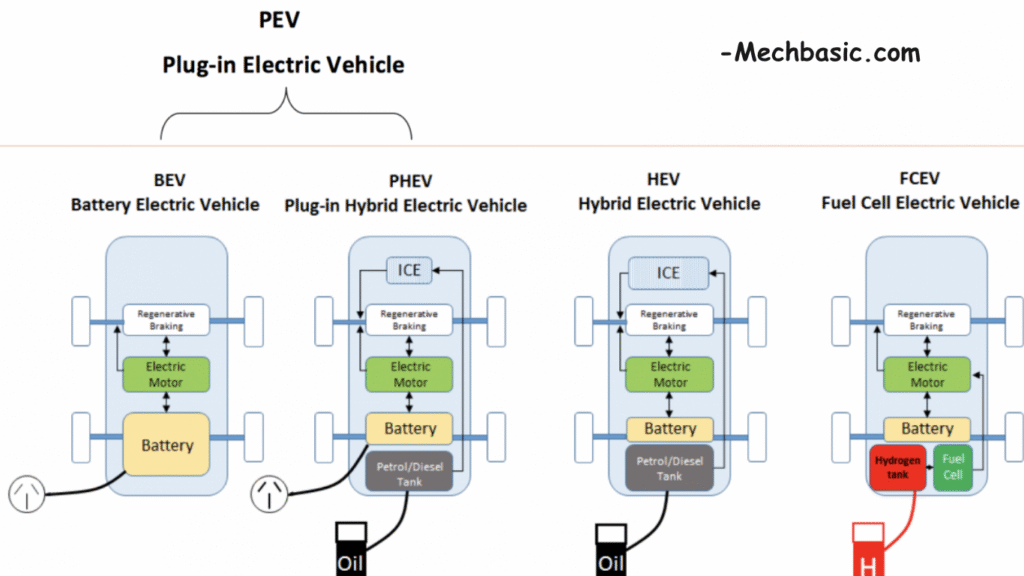
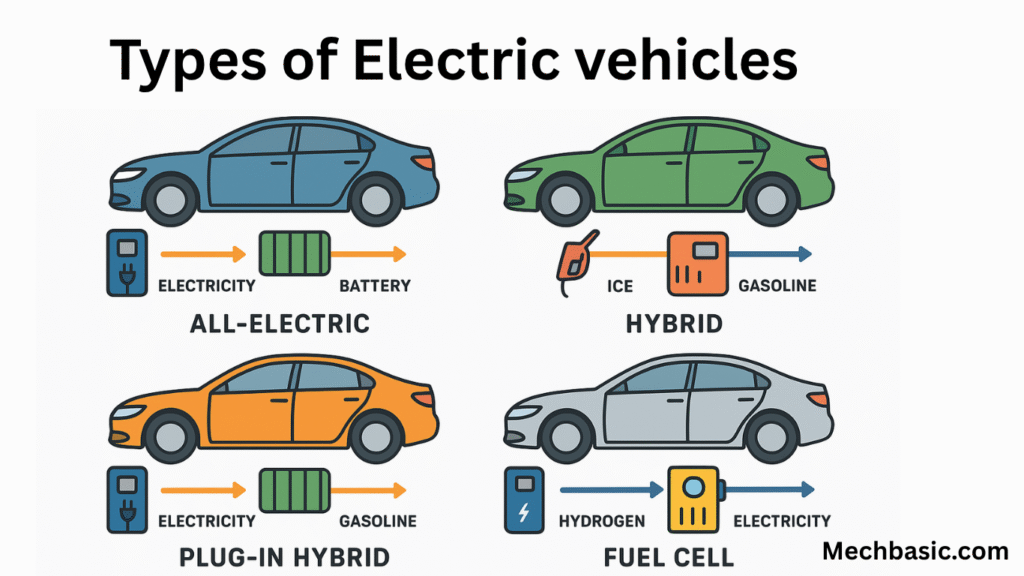
The four main types of electric vehicles (EVs) are classified based on how they use electricity and/or fuel. Here’s a detailed breakdown:
1. Battery Electric Vehicle (BEV)
- Definition: Runs entirely on electricity stored in a battery; no internal combustion engine (ICE).
- Energy Source: Rechargeable battery pack.
- Key Features:
- Zero tailpipe emissions.
- Requires charging via electric outlets or stations.
- Regenerative braking for energy recovery.
- Examples: Tesla Model 3, Nissan Leaf, Hyundai Kona Electric.
2. Hybrid Electric Vehicle (HEV)
- Definition: Combines a conventional ICE with an electric motor. The electric motor assists the engine but cannot be plugged in for external charging.
- Energy Source: ICE + battery (charged via regenerative braking and engine).
- Key Features:
- Fuel efficiency improved over conventional vehicles.
- Limited electric-only operation (usually at low speeds).
- Examples: Toyota Prius (non-plug-in), Honda Insight.
3. Plug-in Hybrid Electric Vehicle (PHEV)
- Definition: Combines ICE and a larger battery than HEVs; can be charged externally via a plug.
- Energy Source: ICE + battery (can charge from grid).
- Key Features:
- Can run on electricity alone for limited range (20–80 km typically).
- Switches to gasoline/diesel when battery is depleted.
- Reduced fuel consumption and emissions compared to conventional hybrids.
- Examples: Toyota Prius Prime, Mitsubishi Outlander PHEV.
4. Fuel Cell Electric Vehicle (FCEV)
- Definition: Uses hydrogen fuel cells to generate electricity onboard to power electric motors.
- Energy Source: Hydrogen gas → electricity through fuel cell.
- Key Features:
- Only emits water vapor as a byproduct.
- Longer range than BEVs (300–600 km typical).
- Refueling is faster than charging batteries (~5 min).
- Examples: Toyota Mirai, Hyundai Nexo, Honda Clarity Fuel Cell.
Summary Table
| Type | Power Source | Charging | Emissions | Example |
|---|---|---|---|---|
| BEV | Battery only | Electric outlet | None | Tesla Model 3 |
| HEV | Battery + ICE | No external charging | Reduced | Toyota Prius |
| PHEV | Battery + ICE | Electric plug & ICE | Reduced | Prius Prime |
| FCEV | Hydrogen → Electricity | Hydrogen refueling | Water vapor only | Toyota Mirai |
✅ In simple terms:
BEVs are fully electric, HEVs are partly electric, PHEVs are plug-in hybrids, and FCEVs run on hydrogen.
Other courses:





