
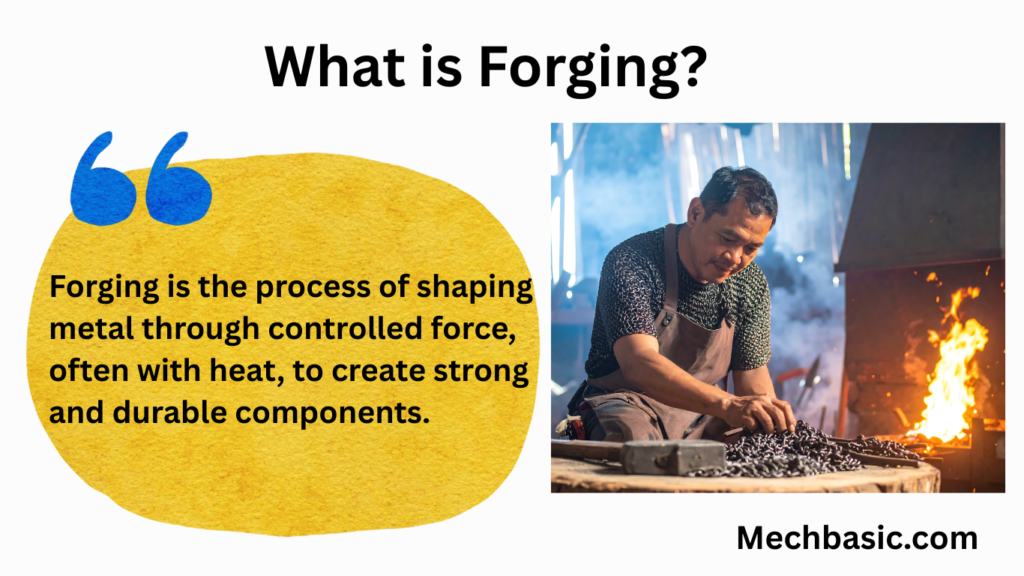
Forging is a manufacturing process where metal is shaped using compressive force, often through hammering, pressing, or rolling. By applying heat and force, forging improves the metal’s strength, durability, and structural integrity.
In this article:
Forging :
Forging is a metal shaping process in which compressive forces are applied to a metal workpiece to produce a desired shape, size, and mechanical property.
It is one of the oldest metalworking techniques and is widely used in manufacturing industries such as automotive, aerospace, defense, and industrial machinery.
Forging improves the strength, toughness, and reliability of components because it aligns the grain flow with the shape of the part.
1. Definition of Forging
Forging is the process of shaping metal by applying compressive forces, usually through hammers, presses, or dies, either at high or low temperatures, to produce parts with enhanced mechanical properties.
Key Points:
- Material does not melt (solid-state process).
- Deformation improves grain structure, resulting in stronger parts.
- Can produce simple to complex shapes, from small bolts to large turbine shafts.
2. History of Forging
- One of the earliest metalworking techniques used by humans.
- Initially performed with hand hammers on hot metal.
- Modern forging uses mechanical, hydraulic, or screw presses for precision and high-volume production.
3. Principle of Forging
- Metal is deformed plastically under compressive force.
- Grain structure follows the shape of the part, increasing strength.
- Heating reduces flow stress, making the metal easier to shape.
- Can be performed hot, cold, or warm depending on the material and application.
4. Classification of Forging
A. Based on Temperature
- Hot Forging: Above the recrystallization temperature.
- Cold Forging: Below recrystallization temperature, usually at room temperature.
- Warm Forging: Intermediate temperature.
B. Based on Method
- Open-Die Forging: Metal is deformed between flat or simple-shaped dies.
- Closed-Die Forging (Impression Die Forging): Metal is deformed into dies shaped like the final part.
- Seamless Ring Forging: Produces hollow, ring-shaped parts.
- Upset Forging: Increases diameter by compressing length.
C. Based on Equipment
- Hammer Forging: Uses repeated blows from a hammer.
- Press Forging: Uses hydraulic or mechanical press to apply gradual force.
- Roll Forging: Uses grooved rolls to reduce cross-section.
5. Materials Used for Forging
Forging can be done on ferrous and non-ferrous metals:
A. Ferrous Metals
- Carbon Steel (low, medium, high)
- Alloy Steel
- Stainless Steel
B. Non-Ferrous Metals
- Aluminum and Aluminum Alloys
- Copper, Brass, Bronze
- Titanium and Titanium Alloys
- Nickel Alloys
Metals are chosen based on forgeability, mechanical properties, temperature resistance, and corrosion resistance.
6. Forging Equipment
- Mechanical Presses: Fast strokes, high production.
- Hydraulic Presses: Gradual, controlled force, suitable for large parts.
- Screw Presses: Gradual force, precision forging.
- Hammers: Mechanical, pneumatic, or steam-powered for repeated impact.
- Rollers: For long rods or shafts.
7. Advantages of Forging
- High strength and toughness due to aligned grain structure.
- Improved fatigue resistance and impact strength.
- Can produce large, complex, and high-performance parts.
- Reduces machining operations (near-net shape possible).
- Wide range of materials can be forged.
8. Limitations of Forging
- Higher initial cost for dies and presses.
- Skilled operators may be required for open-die forging.
- Dimensional accuracy may be lower for open-die or hot forging.
- Not suitable for very thin or intricate designs.
9. Applications of Forging
- Automotive: Crankshafts, connecting rods, gears, bolts.
- Aerospace: Turbine shafts, landing gear, structural components.
- Defense: Artillery shells, weapon parts.
- Industrial Machinery: Rolls, shafts, valves, flanges.
- Tools: Hammers, chisels, punches, wrenches.
10. Comparison with Casting and Machining
| Feature | Forging | Casting | Machining |
|---|---|---|---|
| Grain Flow | Aligned with shape | Random | Cut metal only |
| Strength | High | Moderate | Moderate |
| Surface Finish | Good (hot forging may need finishing) | Depends on mold | Excellent |
| Dimensional Accuracy | Moderate to high | High | Very high |
| Waste | Low | Low | High |
| Cost | Moderate | Low | Moderate to high |
In Simple Words
Forging is the process of shaping metal with compressive force. It can be done hot, cold, or warm using hammers, presses, or rolls. Forged parts are stronger, tougher, and more reliable than cast or machined parts and are used in automobiles, aerospace, and heavy machinery.
FAQ Section:
- What is forging?
Forging is a manufacturing process in which metal is shaped using compressive forces, typically applied with a hammer, press, or die, often while the metal is heated. - What materials are commonly used in forging?
Commonly forged materials include steel, iron, aluminum, copper, brass, and titanium, chosen based on strength, durability, and application needs. - Why is metal heated during forging?
Heating makes metal more malleable, allowing it to be shaped more easily and reducing the risk of cracking or failure during deformation. - What are the main types of forging?
The main types are open-die forging, closed-die (impression-die) forging, and seamless rolled ring forging, each suited to different shapes and production volumes. - How is forging different from casting?
Forging shapes metal by deformation, while casting involves pouring molten metal into a mold. Forged parts generally have greater strength and structural integrity. - What industries use forging?
Forging is widely used in automotive, aerospace, construction, energy, agriculture, and industrial machinery industries. - What are the advantages of forging?
Forging produces strong, reliable parts with refined grain structure, improved toughness, and better resistance to fatigue and impact. - Are forged parts always stronger than machined parts?
Forged parts are often stronger because the metal’s grain flow follows the shape of the part, but strength also depends on material choice and heat treatment. - Is forging safe?
Forging can be safe when proper training, protective equipment, and safety procedures are followed, as it involves high temperatures and heavy machinery. - Can forging be done on a small scale?
Yes, forging can be done on a small scale for hobby, artistic, or educational purposes using basic tools, though industrial forging requires specialized equipment.
Other courses:





