
In this article:
Ferrous vs non ferrous metal
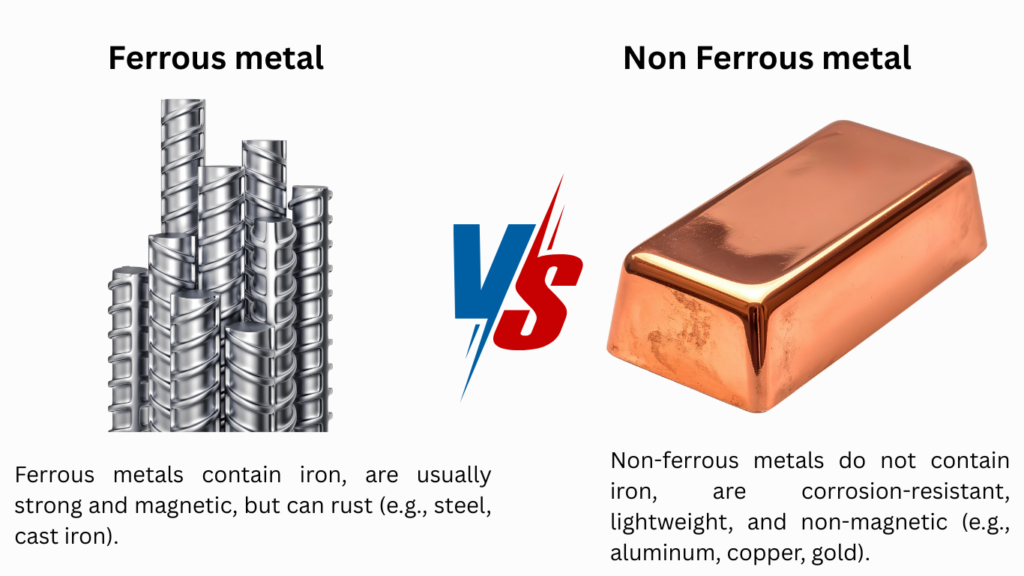
Ferrous metals contain iron, are usually strong and magnetic, but can rust (e.g., steel, cast iron).
Non-ferrous metals do not contain iron, are corrosion-resistant, lightweight, and non-magnetic (e.g., aluminum, copper, gold).
Ferrous metals are mainly used in construction and machinery, while non-ferrous metals are used in aerospace, electronics, and jewelry.
The key difference is the presence of iron and susceptibility to rust.
Here’s a detailed comparison of ferrous and non-ferrous metals, covering definitions, properties, examples, advantages, disadvantages, and applications. This is structured for easy understanding and exam use.
1. Definition
Ferrous Metals:
Metals that contain iron (Fe) as their main constituent.
- Example: Steel, cast iron, wrought iron
Non-Ferrous Metals:
Metals that do not contain significant amounts of iron.
- Example: Aluminum, copper, zinc, lead, gold, silver
2. Key Differences Between Ferrous and Non-Ferrous Metals
| Feature | Ferrous Metals | Non-Ferrous Metals |
|---|---|---|
| Iron Content | High | Negligible or zero |
| Rusting / Corrosion | Prone to rust (oxidation) | Resistant to corrosion |
| Magnetic Properties | Usually magnetic | Usually non-magnetic (except Ni, Co) |
| Density | Generally high | Can be low (Al, Mg) or high (Au, Pb) |
| Strength | High tensile & compressive strength | Moderate to high depending on alloy |
| Malleability & Ductility | Less malleable (cast iron brittle, mild steel ductile) | Highly malleable and ductile (Cu, Al, Au) |
| Melting Point | Usually high | Varies; some very high (Ti, Pt) |
| Cost | Usually low | Usually high (precious metals, lightweight alloys) |
| Ease of Fabrication | Can be forged, welded, cast | Some easy (Al, Cu), some difficult (Ti, Pt) |
| Conductivity | Moderate | High for some metals (Cu, Ag, Al) |
| Examples | Steel, cast iron, wrought iron | Aluminum, copper, gold, silver, titanium, zinc, lead |
3. Properties Comparison
| Property | Ferrous Metals | Non-Ferrous Metals |
|---|---|---|
| Strength | Generally high | Moderate to high |
| Durability | Strong, but rusts | Strong and corrosion-resistant |
| Weight | Heavy | Can be lightweight (Al, Mg) |
| Thermal Conductivity | Moderate | High (Cu, Al, Ag) |
| Electrical Conductivity | Moderate | High (Cu, Al, Ag) |
| Magnetism | Usually magnetic | Usually non-magnetic |
4. Advantages
Ferrous Metals
- Strong and durable
- Good load-bearing capacity
- Relatively cheap and widely available
- Easy to weld and machine (steel)
Non-Ferrous Metals
- Corrosion-resistant
- Lightweight for aerospace and transport applications
- High electrical and thermal conductivity
- Non-magnetic (useful in electronics)
- Can be alloyed to enhance specific properties
5. Disadvantages
Ferrous Metals
- Rusts easily unless coated or alloyed (stainless steel)
- Heavy, not suitable where weight is critical
- Poor corrosion resistance in harsh environments
Non-Ferrous Metals
- Expensive compared to ferrous metals
- Some have lower strength (pure aluminum, copper)
- Certain metals difficult to machine (titanium, platinum)
- Recycling can be more challenging (precious metals)
6. Applications
Ferrous Metals
- Construction (steel beams, rods)
- Bridges, railways, ships
- Machine tools and industrial equipment
- Automotive chassis
Non-Ferrous Metals
- Electrical wiring (copper, aluminum)
- Aircraft and aerospace components (aluminum, titanium)
- Jewelry (gold, silver, platinum)
- Packaging (aluminum cans, foil)
- Batteries (lead, lithium, nickel)
7. Summary
- Ferrous metals: iron-based, strong, cheap, prone to rust, usually magnetic.
- Non-ferrous metals: iron-free, corrosion-resistant, lightweight, expensive, often non-magnetic.
- Selection depends on: strength, weight, corrosion resistance, conductivity, cost, and specific application.
Conclusion:
Ferrous = Iron → Rusts → Magnetic → Cheap → Strong
Non-Ferrous = No Iron → Doesn’t rust → Non-magnetic → Expensive → Lightweight/conductive
Other courses:





