
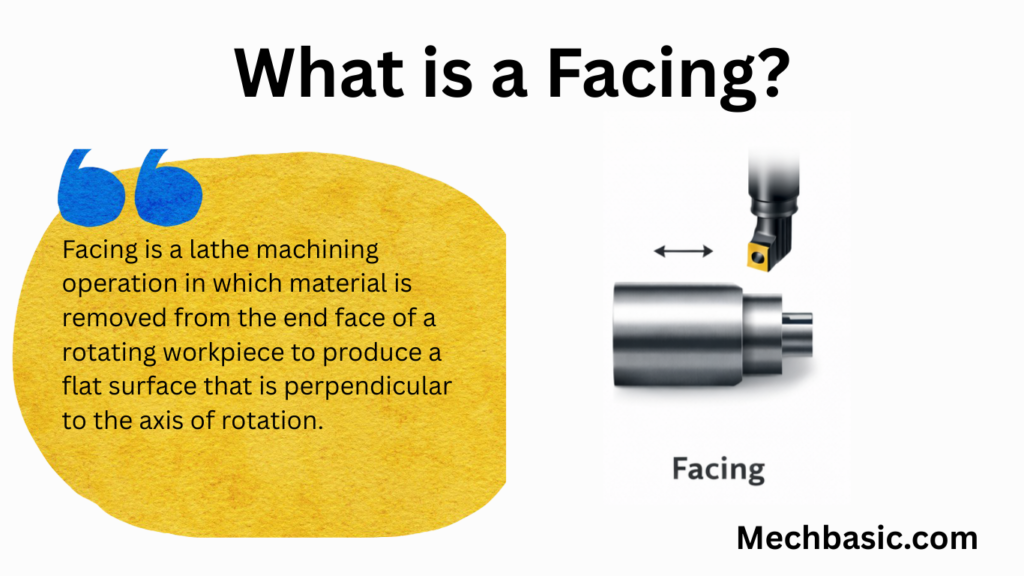
Facing is a lathe machining operation in which material is removed from the end face of a rotating workpiece to produce a flat surface that is perpendicular to the axis of rotation.
Facing Operation in Turning (Lathe Machining)
1. What is Facing?
Facing is a fundamental turning operation performed on a lathe to produce a flat, smooth surface at the end of a cylindrical workpiece, perpendicular to its axis of rotation.
It is commonly the first operation carried out to square the end of the job and establish a reference surface.
2. Purpose of Facing
- To make the end surface flat and perpendicular to the axis
- To bring the workpiece to accurate length
- To remove rough or damaged ends
- To prepare the surface for drilling, boring, or threading
- To improve surface finish and dimensional accuracy
3. Principle of Facing
- The workpiece rotates in the spindle.
- The single-point cutting tool is fed radially inward, i.e., perpendicular to the axis of rotation.
- Material is removed from the outer diameter toward the center.
4. Tool Used for Facing
- Single-point cutting tool (right-hand or left-hand)
- Tool material:
- High Speed Steel (HSS)
- Carbide tipped tool
- Coated carbide inserts (in CNC lathes)
- Tool geometry:
- Proper side rake and back rake
- Adequate clearance angles
- Sharp nose radius for good finish
5. Facing Operation Setup
- Workpiece holding
- 3-jaw chuck (most common)
- 4-jaw chuck
- Collet (for precision work)
- Tool positioning
- Tool tip must be set exactly at the center height
- Tool should be rigidly clamped in the tool post
- Machine settings
- Select appropriate spindle speed
- Choose correct feed rate
- Set depth of cut
6. Steps in Facing Operation
- Mount and secure the workpiece in the chuck.
- Set the facing tool at center height.
- Start the lathe and bring the tool near the outer edge.
- Engage the feed to move the tool toward the center.
- Continue cutting until the tool reaches or slightly crosses the center.
- Retract the tool and stop the machine.
- Measure the length and surface finish.
7. Types of Facing
- Plain Facing
- Produces a flat surface
- Most common type
- Step Facing
- Produces stepped faces at different diameters
- Angular Facing
- Produces a surface at a specified angle
- Form Facing
- Produces a contoured or profiled face using a form tool
8. Cutting Parameters (Typical)
- Cutting speed (V): Depends on material (e.g., mild steel: 25–40 m/min for HSS)
- Feed (f): 0.05–0.3 mm/rev
- Depth of cut (d): 0.5–2 mm (roughing), 0.1–0.3 mm (finishing)
9. Common Problems & Defects
| Defect | Cause | Remedy |
|---|---|---|
| Center pip | Tool not crossing center | Move tool slightly past center |
| Rough surface | Low speed, blunt tool | Increase speed, sharpen tool |
| Tool chatter | Poor rigidity | Reduce overhang, tighten setup |
| Non-flat face | Tool height incorrect | Set tool exactly at center |
10. Advantages of Facing
- Simple and quick operation
- Improves dimensional accuracy
- Essential for precision machining
- Compatible with both manual and CNC lathes
11. Applications
- Shaft manufacturing
- Flanges and discs
- Automotive components
- Machine parts requiring accurate length
Other courses:





