Extrusion Vs Forging: 15 Differences you need to know

Extrusion and forging are important metal forming processes used to shape materials by plastic deformation under compressive forces.

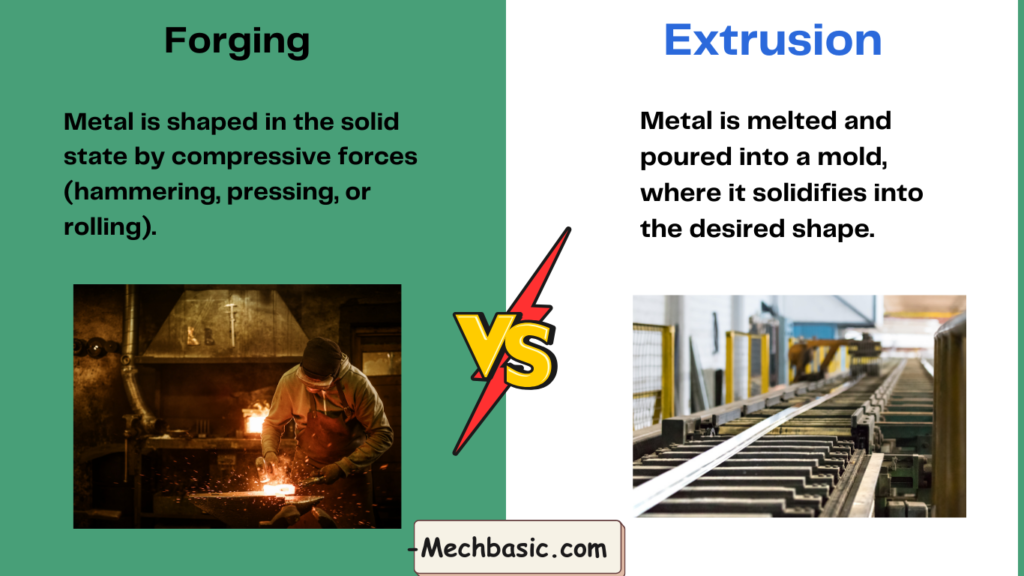
While extrusion produces long components with a uniform cross-section by forcing metal through a die, forging shapes metal by applying compressive loads to obtain strong, durable components. Understanding the differences between extrusion and forging helps in selecting the appropriate process based on shape, mechanical properties, and application requirements.

Extrusion Vs Forging: 15 Differences you need to know


Extrusion Vs Forging: 15 Differences:

Below is a detailed, point-by-point comparison of Extrusion vs Forging, written in a clear, exam-ready format, including principle, process, characteristics, advantages, and applications.

1. Basic Definition

AspectExtrusionForging
DefinitionA metal forming process in which material is forced to flow through a die to produce a uniform cross-sectionA metal forming process in which metal is shaped by compressive forces using hammers or presses

2. Principle of Operation

ExtrusionForging
Metal flows under compressive stress through a die openingMetal is plastically deformed by compressive impact or squeezing forces
Material flows in the direction of extrusionMaterial flows in multiple directions to fill the die cavity

3. Type of Forces

AspectExtrusionForging
Nature of forceContinuous compressive forceIntermittent or continuous compressive force
Stress statePredominantly compressive and shearPurely compressive

4. Temperature of Operation

ExtrusionForging
Can be cold, warm, or hot extrusionMostly hot forging; also cold and warm forging
Hot extrusion reduces force requirementHot forging improves ductility

5. Shape and Geometry

ExtrusionForging
Produces long components with uniform cross-sectionProduces complex shapes with varying cross-sections
Length is much greater than cross-sectionSuitable for discrete components

6. Grain Flow and Mechanical Properties

AspectExtrusionForging
Grain flowGrains elongate along the extrusion directionGrain flow follows the contour of the component
StrengthModerate mechanical strengthVery high strength and fatigue resistance

7. Tooling and Dies

ExtrusionForging
Uses extrusion dies with constant profileUses open-die or closed-die (impression) dies
Die wear is moderateDie wear is high due to heavy impact loads

8. Material Utilization

ExtrusionForging
High material utilization, minimal scrapSome material loss as flash
No flash formationFlash removal often required

9. Surface Finish and Accuracy

ExtrusionForging
Excellent surface finish and close tolerancesGood finish but may require machining
Suitable for near-net shape productionMachining often needed for precision

10. Production Rate

ExtrusionForging
Continuous and high production rateHigh production rate for mass production
Ideal for long productsIdeal for high-strength components

11. Equipment Used

ExtrusionForging
Hydraulic extrusion pressForging hammer or forging press
Lower impact loadsHigh impact and noise (hammer forging)

12. Typical Materials

ExtrusionForging
Aluminum, copper, magnesium, leadSteel, aluminum, titanium, nickel alloys

13. Applications

ExtrusionForging
Pipes, tubes, channels, window frames, heat sinksCrankshafts, connecting rods, gears, bolts, spanners

14. Advantages

Extrusion

  • Produces complex cross-sections
  • High surface finish
  • Minimal material waste
  • Uniform properties along length

Forging

  • Superior mechanical properties
  • High structural integrity
  • Excellent fatigue resistance
  • Suitable for critical components

15. Limitations

ExtrusionForging
Limited to constant cross-sectionHigh tooling and equipment cost
High force required for hard materialsFlash and die wear

Summary Table

FeatureExtrusionForging
Product shapeConstant cross-sectionVarying cross-section
StrengthModerateVery high
Material wasteVery lowModerate
Grain flowLinearContour-aligned
Typical productsLong sectionsDiscrete parts

Conclusion

Extrusion is preferred for long products with uniform cross-section, while forging is chosen for high-strength components where superior mechanical properties are required.


Other courses:

Leave a Comment

Your email address will not be published. Required fields are marked *

Follow by Email
Pinterest
fb-share-icon
WhatsApp
Scroll to Top
