
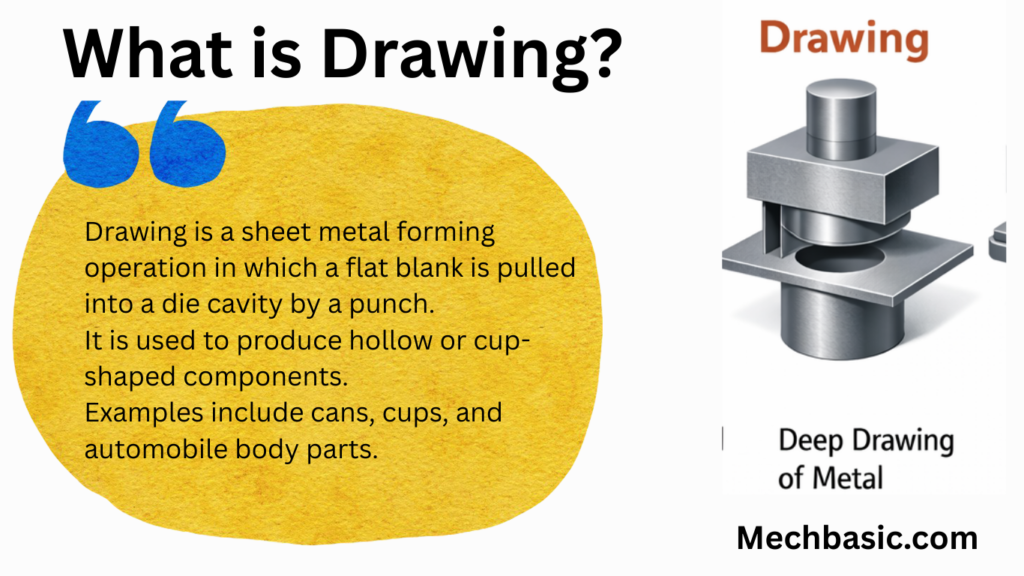
Drawing is a sheet metal forming operation in which a flat blank is pulled into a die cavity by a punch.
It is used to produce hollow or cup-shaped components.
Examples include cans, cups, and automobile body parts.
In this article:
Drawing (Deep Drawing) in Sheet Metal
What is Drawing?
Drawing (commonly called Deep Drawing) is a sheet metal forming process in which a flat sheet blank is converted into a hollow or cup-shaped component by pushing it into a die cavity using a punch.
👉 No material is removed
👉 Thickness changes slightly
👉 Used to produce cups, cans, and containers
When the depth of the component is greater than its diameter, it is called Deep Drawing.
Working Principle
Step-by-step Process:
- A circular blank is placed over the die opening.
- A blank holder holds the sheet firmly.
- The punch moves downward.
- The sheet metal flows into the die cavity.
- A cup-shaped component is formed.
Main Components
1️⃣ Punch
Pushes sheet into die cavity.
2️⃣ Die
Has cavity of required shape.
3️⃣ Blank Holder
Prevents wrinkling by applying pressure.
4️⃣ Press Machine
Usually hydraulic or mechanical press.
Metal Flow in Drawing
- Flange area → Under compressive stress
- Wall of cup → Under tensile stress
- Bottom → Under biaxial tension
Thickness:
✔ Nearly constant at bottom
✔ Slightly thinner at walls
Important Terms
Drawing Ratio (DR)
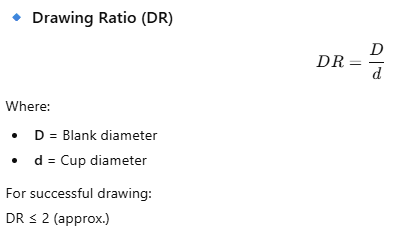
Limiting Drawing Ratio (LDR)
Maximum safe drawing ratio without failure.
Earing
Uneven rim formation due to material anisotropy.
Wrinkling
Occurs due to insufficient blank holder pressure.
Drawing Force (Basic Formula)
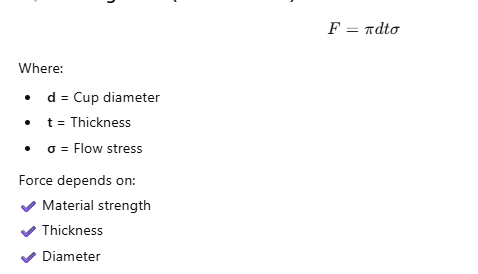
Force depends on:
✔ Material strength
✔ Thickness
✔ Diameter
Types of Drawing
1. Deep Drawing
Depth greater than diameter.
2. Redrawing
Further drawing of already drawn cup.
3. Reverse Drawing
Cup drawn in opposite direction.
4. Ironing
Reduces wall thickness intentionally.
Applications
- Beverage cans
- Kitchen utensils
- Automobile fuel tanks
- Sink bowls
- Cartridge cases
- Electrical enclosures
Advantages
✔ Produces seamless hollow parts
✔ Good surface finish
✔ High production rate
✔ Economical for mass production
Disadvantages
✖ Wrinkling
✖ Tearing
✖ Requires precise tool design
✖ High initial tooling cost
Drawing vs Stretching
| Feature | Drawing | Stretching |
|---|---|---|
| Metal Flow | Material flows inward | Material stretches |
| Thickness | Slight variation | Reduces |
| Shape | Cup-shaped | Smooth curved panel |
| Blank Holder | Required | Not always required |
Summary
- Drawing is a metal forming process.
- Blank holder prevents wrinkling.
- Drawing ratio determines success.
- Used for hollow cylindrical components.
- No material removal occurs.
Other courses:





