
Die casting uses a permanent metal mould and high pressure to produce accurate, smooth-finished parts, while sand casting uses a disposable sand mould, making it cheaper and suitable for larger or complex castings but with lower accuracy and surface finish.
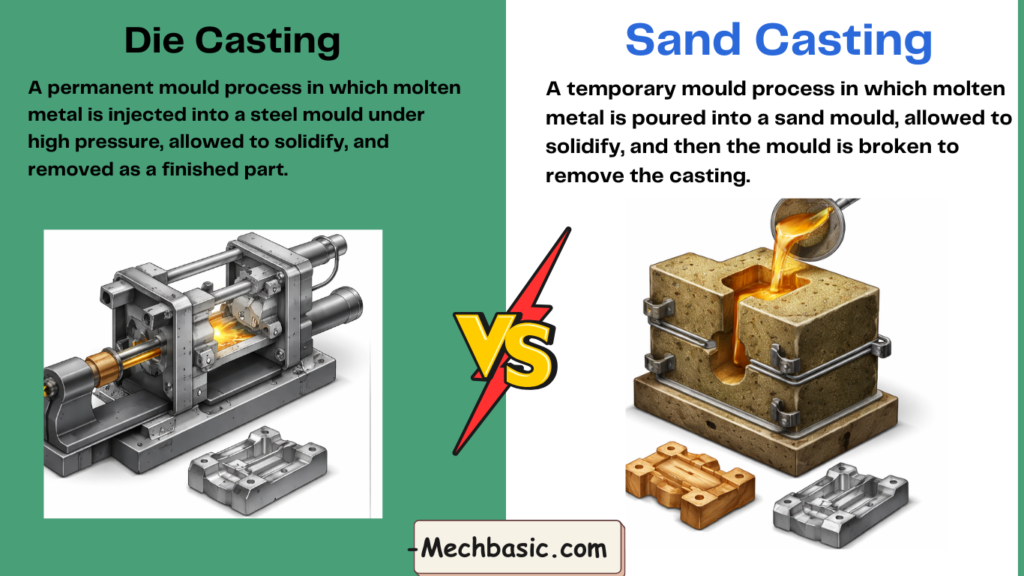
Die Casting vs Sand Casting :
Let’s go step by step, because die casting vs sand casting is a classic manufacturing comparison question. I’ll explain definitions, processes, advantages, disadvantages, applications, and a detailed comparison table—everything you need for exams or interviews.
1. Definition
Die Casting:
- A permanent mould process in which molten metal is injected into a steel mould under high pressure, allowed to solidify, and removed as a finished part.
- Mainly used for non-ferrous metals like aluminium, zinc, magnesium, and copper alloys.
Sand Casting:
- A temporary mould process in which molten metal is poured into a sand mould, allowed to solidify, and then the mould is broken to remove the casting.
- Can be used for ferrous and non-ferrous metals.
2. Process Comparison
| Step | Die Casting | Sand Casting |
|---|---|---|
| Mould | Permanent steel die | Temporary sand mould |
| Metal Pouring | High-pressure injection | Gravity pouring |
| Mould Preparation | CNC-machined, polished | Packing sand around pattern |
| Solidification | Fast due to metal mould | Slower due to sand’s low thermal conductivity |
| Pattern | Usually integrated into die | Separate pattern used to form cavity |
| Venting | Built-in vents, ejector pins | Simple venting channels |
| Production Rate | Very high (seconds per part) | Low to medium |
| Complexity | Thin walls, precise features | Moderate complexity, thicker walls |
3. Materials Used
| Die Casting | Sand Casting |
|---|---|
| Non-ferrous metals: Al, Zn, Mg, Cu | Ferrous & non-ferrous: Iron, steel, Al, Cu |
| Mould: Steel (permanent) | Mould: Sand + binder |
| Lubricants / Coatings applied | Sand moulds require no coating, sometimes facing powders |
4. Advantages Comparison
Die Casting Advantages:
- Excellent dimensional accuracy and surface finish
- Thin walls possible
- High production rate
- Reusable mould → low unit cost for mass production
- Reduced material wastage
- Can incorporate inserts and threaded features
Sand Casting Advantages:
- Very versatile → almost any size or shape
- Low initial cost → suitable for small batches
- Can cast large, heavy components
- Any metal can be cast
- Simple equipment required
5. Disadvantages Comparison
Die Casting Disadvantages:
- High initial die cost → not economical for small production
- Limited to small-medium sized parts
- Mostly non-ferrous metals
- Porosity and ejection marks possible
- Complex die design needed
Sand Casting Disadvantages:
- Lower dimensional accuracy
- Poorer surface finish
- Slower production rate
- Sand must be broken to remove casting → one-time use
- Limited thin-wall capability
6. Applications
Die Casting Applications:
- Automotive parts: gear housings, engine components
- Electrical: connectors, switches, housings
- Consumer products: camera bodies, appliance parts
Sand Casting Applications:
- Engine blocks, pump housings
- Large valves, pipes, heavy machinery components
- Steel castings for structural applications
7. Summary Table
| Feature | Die Casting | Sand Casting |
|---|---|---|
| Mould Type | Permanent steel die | Temporary sand mould |
| Metal Used | Non-ferrous | Ferrous & non-ferrous |
| Surface Finish | Excellent | Moderate |
| Dimensional Accuracy | High | Moderate to low |
| Production Rate | Very high | Low to medium |
| Wall Thickness | Thin possible | Thick walls preferable |
| Initial Cost | High | Low |
| Part Size | Small to medium | Small to very large |
| Reusability of Mould | Yes | No |
| Complexity | High | Medium |
| Applications | Mass production, precision parts | Large, heavy, low-volume parts |
8. Conclusion:
- Die casting = high-volume, precision, small/medium non-ferrous parts
- Sand casting = versatile, low-volume, can be very large, any metal
- Always include mould type, metal type, surface finish, production rate, and cost in answers
- A diagram showing die casting vs sand casting helps score marks
Summary:
Die casting uses permanent metal dies under high pressure for fast, precise, small/medium non-ferrous parts, while sand casting uses temporary sand moulds for versatile, large, or ferrous components with lower accuracy and surface finish.
Other courses:





