
Deep hole drilling is a machining process used to create holes with a depth much greater than their diameter. It requires special drills, techniques, and often coolant or lubrication to remove chips, control heat, and maintain accuracy, making it suitable for long, precise holes in components like engine cylinders, hydraulic parts, and molds.
In this article:
Deep Hole Drilling :
Deep hole drilling (DHD) is a specialized drilling process used to produce holes that are significantly deeper than their diameter, typically with a depth-to-diameter ratio greater than 10:1. This process requires special techniques, tools, and setups to ensure accuracy, chip evacuation, and surface quality.
1. Definition
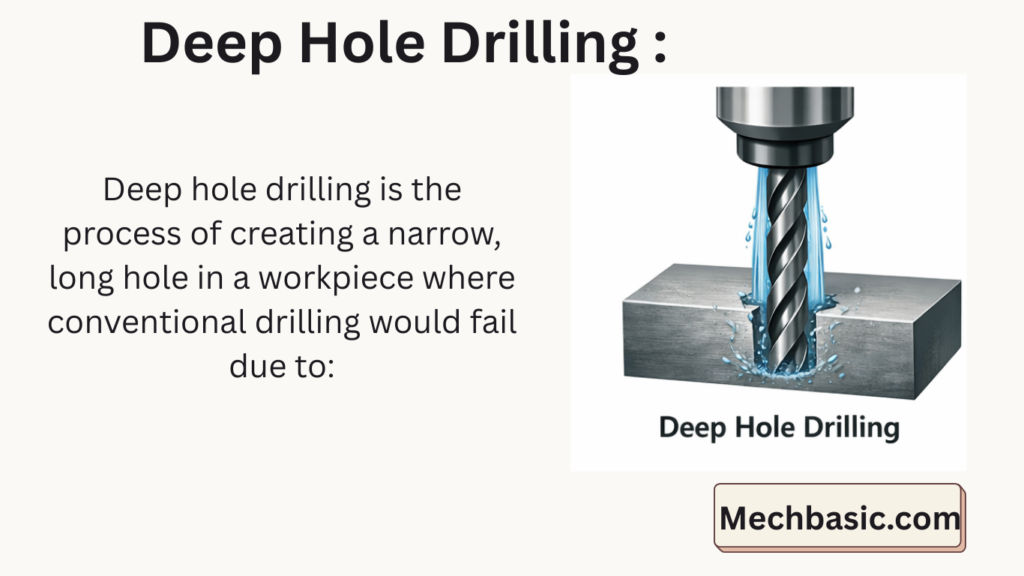
Deep hole drilling is the process of creating a narrow, long hole in a workpiece where conventional drilling would fail due to:
- High tool deflection
- Poor chip removal
- Excessive heat generation
Typical applications: hydraulic cylinders, engine blocks, firearm barrels, mold making.
2. Purpose of Deep Hole Drilling
- Produce accurate long holes
- Maintain tight tolerances in diameter and straightness
- Ensure smooth internal surface finish
- Enable high length-to-diameter ratio holes
3. Machines Used
- Gun drilling machines (dedicated for deep holes)
- BTA (Boring & Trepanning Association) machines for large diameters
- CNC deep-hole drilling machines
- Lathe with special deep hole attachment (less common)
4. Tools Used
a) Gun Drill
- Rigid, long, straight drill
- Hollow body for coolant passage
- Cutting tip is single-lip or double-lip
- Self-guiding due to flute design
b) BTA Drill
- Large diameter deep-hole drill
- Coolant flows between drill and workpiece (annular flow)
- Mainly used for diameter > 25 mm
c) Ejector Drill
- Uses coolant to flush chips from the bottom of the hole
5. Deep Hole Drilling Methods
- Gun Drilling Method
- Small to medium diameter holes
- Uses hollow gun drill with internal coolant supply
- BTA Method
- Large diameter holes
- Uses annular cutting tool
- Coolant flows between tool and hole wall
- Ejector System
- Coolant flows through inner tube of the tool
- Chips removed through outer tube
6. Process Steps
- Workpiece Setup
- Clamped rigidly
- Alignment critical
- Pilot Hole (Optional)
- Small hole guides the main deep drill
- Drilling
- Tool enters slowly
- Coolant pumped continuously to remove chips and reduce heat
- Chip Evacuation
- Essential to prevent tool breakage and hole damage
- Depth Monitoring
- CNC or manual stop used
- Measurement for tolerance control
- Finishing
- Reaming or honing may be used for final diameter and surface finish
7. Cutting Parameters
- Speed (RPM): Low for metals to prevent tool wear
- Feed: Very light feed per revolution
- Coolant: High-pressure through-tool coolant is mandatory
Example:
- Hole Ø20 mm, depth 500 mm → L/D ratio = 25:1
8. Chip Management
- Chips must be evacuated continuously
- Use of coolant with high pressure (20–60 bar)
- Poor chip removal leads to:
- Tool breakage
- Hole wall scoring
- Inaccurate straightness
9. Accuracy & Surface Finish
- Tolerances: ±0.01–0.05 mm
- Straightness: Controlled by tool design and coolant flow
- Surface finish: Ra 0.4–1.6 μm depending on material
10. Advantages
- Can drill very deep holes accurately
- Produces smooth internal surface
- High length-to-diameter ratio holes possible
- Suitable for high-precision applications
11. Limitations
- Requires special machines and drills
- High setup cost
- Chip evacuation is critical
- Limited diameter range for some methods (e.g., gun drilling < 25 mm)
12. Applications
- Hydraulic cylinders and pistons
- Gun barrels and firearms
- Automotive engine blocks (oil passages)
- Aerospace components
- Mold and die making
- Oil and gas industry
13. Deep Hole Drilling vs Normal Drilling
| Feature | Deep Hole Drilling | Normal Drilling |
|---|---|---|
| Depth-to-Diameter Ratio | > 10:1 | < 10:1 |
| Tool | Gun drill, BTA drill | Twist drill |
| Chip Evacuation | High-pressure coolant required | Natural via flutes |
| Accuracy | Very high | Moderate |
| Machine | Special deep-hole machines | Drill press / lathe |
14. Best Practices
- Always start with pilot hole for high L/D ratios
- Use high-pressure coolant to remove chips
- Keep feed rate low to avoid deflection
- Monitor tool wear frequently
- Consider reaming/honing for final surface finish
Other courses:





